
Archeologists have located lost tunnel from the Great Escape POW camp
Archeologists have located the last “Great Escape” tunnel dug by Allied prisoners during World War II.
Archeologists have located the last “Great Escape” tunnel dug by Allied prisoners during World War II.
An evening pause:
A baby star has been found only 27 light years away.
AP Columbae lies in the constellation Columba the Dove, south of the brilliant constellation Orion. “AP Columbae is still contracting under gravity towards the main sequence,” says astronomer Adric Riedel of Georgia State University in Atlanta, whose team measured the star’s parallax—an indication of its distance—and discovered that the star is abnormally luminous. Although the star is dim and red, it’s four times as bright as it should be, because it’s twice the diameter of a main-sequence star of the same color.
Oh my: A new poll shows the Republican is in the lead in the special election in New York to replace disgraced Democratic Congressman Anthony Weiner.
If the Republican wins this election, in what has always been a Democratically-entrenched district in Brooklyn-Queens, it will send a clear signal to all that the 2012 election is going to be a very very very unusual election.
Repeal it! Despite many promises to the contrary, the uninsured have increased since Obamacare was passed.
The Kepler team pushes for a mission extension in order to find Earth-sized planets.
The Kepler spacecraft has hit an unexpected obstacle as it patiently watches the heavens for exoplanets: too many rowdy young stars. The orbiting probe detects small dips in the brightness of a star that occur when a planet crosses its face. But an analysis of some 2,500 of the tens of thousands of Sun-like stars detected in Kepler’s field of view has found that the stars themselves flicker more than predicted, with the largest number varying twice as much as the Sun. That makes it harder to detect Earth-sized bodies. As a result, the analysis suggests that Kepler will need more than double its planned mission life of three-and-a-half years to achieve its main goal of determining how common Earth-like planets are in the Milky Way.
While it is important to find those Earth-sized planets, to me the important discovery here is that Kepler is confirming what previous research has suggested: Stars like our Sun are generally far more active and variable than the Sun itself. Which means that either the Sun is unusual, or has been unusually inactive during recorded human history.
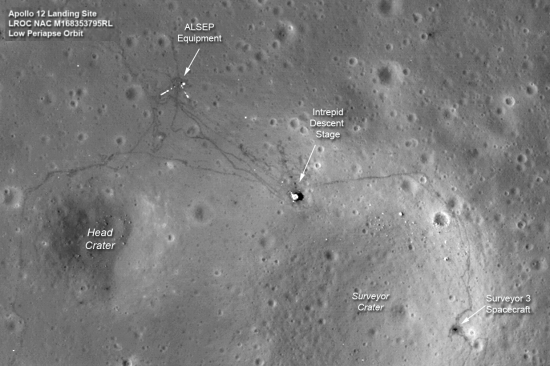
The Lunar Reconnaissance Orbiter team have released new images of the Apollo 12, 14, and 17 landing sites on the Moon. Below is a cropped image of the Apollo 12 site, showing the trails left by astronauts Pete Conrad and Alan Bean when they walked from their lunar module to Surveyor 3, an unmanned lunar lander that had soft landed there two years earlier. The full image shows some incredible detail.
Some suggestions for keeping ISS occupied.
I especially like Harman’s suggestion that the Russians consider landing in the U.S. during the winter, thereby allowing them to extend one crew’s occupancy of ISS into December, January, or even February. Also, he proposes the Russians send an unmanned Soyuz to ISS during testing of the rocket, thereby providing the crews onboard a fresh lifeboat. This is something they have done in the past on their previous space station Mir.
Awakening the only British launched science satellite, dead for decades.
The launch of China’s first space station module has now been scheduled to late September.
Japan plans to test fire the engine of its failed Venus probe Akatsuki twice this month, in anticipation of another try at Venus orbit in 2015.
