Obama shuts down oil exploration in Atlantic

Our lord and master: In a reversal the Obama administration has announced that it will ban all oil exploration in the Atlantic for the next five years.

Makes sense to me. By putting the squeeze on American oil companies it will force American industry to increase its dependence on the Arab oil barons, thus sending more of our wealth to the Islamic world. Moreover, this action will be very effective in further weakening the struggling American economy.

3 comments

Curiosity reaches Naukluft Plateau

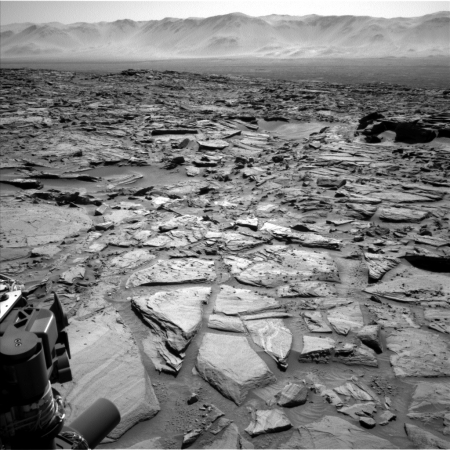
The view from Naukluft

Apropos to my post yesterday on Curiosity’s journey on Mars, the rover this week reached the flat area the science team has dubbed Naukluff Plateau.

The Sol 1281 drive completed as planned, crossing the Murray/Stimson contact at the edge of the Naukluft plateau. Now that we have a better view of the plateau, we are ready to start driving across it. But first, ChemCam and Mastcam will observe targets “Orupembe” and “Witvlei” on the bedrock in front of the rover. Mastcam will also take pictures of the rocks in front of the rover and targets “Natab East” and “Natab West” on either side of the vehicle before the Sol 1282 drive. After the drive, in addition to the usual post-drive imaging, the Left Mastcam will acquire a full 360-degree panorama, as the view from the new location (near the left edge of the image above) is expected to be good. We are looking forward to seeing the new data!

The second link above leads to the rover’s daily update site. It was here that the science team reported an issue with the rover’s scoop back in early February. Since then, however, they have never revealed if the problem was solved. Nor have they used the scoop in any way since then. I now wonder if it is no longer operational and am considering pursuing that question a bit to find out.

2 comments

China plans first commercial rocket company

The competition heats up: A Chinese company has announced plans to start a new commercial rocket company to compete for the burgeoning space launch market.

China Sanjiang Space Group Co. is preparing to enter the commercial-rocket business with a launch slated for 2017, Xinhua reported Tuesday, citing the company’s chief engineer Hu Shengyun. Some Internet companies have expressed interest in collaborating on commercial launches, Hu said.

The Kuaizhou-11, translated as “fast vessel,” rocket is being developed by the Fourth Academy of China Aerospace Science & Industry Corp., a major missile supplier to the People’s Liberation Army, according to China Daily.

There is not much information at the link. The rocket was first launched in 2013, but not much has been revealed about it since.

3 comments

What next for the computer Go program?

Link here.

The software uses neural networks to learn from experience. For example, to train for its Go match the computer program studied 30 million Go board positions from human games, then played itself again and again to improve its skills.

DeepMind’s founder and chief executive Demis Hassabis mentioned the possibility of training a version of AlphaGo using self-play alone, omitting the knowledge from human-expert games, at a conference last month. The firm created a program that learned to play less complex arcade games in this manner in 2015. Without a head start, AlphaGo would probably take much longer to learn, says Bengio — and might never beat the best human. But it’s an important step, he says, because humans learn with such little guidance.

DeepMind, based in London, also plans to venture beyond games. In February the company founded DeepMind Health and launched a collaboration with the UK National Health Service: its algorithms could eventually be applied to clinical data to improve diagnoses or treatment plans. Such applications pose different challenges from games, says Oren Etzioni, chief executive of the non-profit Allen Institute for Artificial Intelligence in Seattle, Washington. “The universal thing about games is that you can collect an arbitrary amount of data,” he says — and that the program is constantly getting feedback on what’s a good or bad move by playing many games. But, in the messy real world, data — on rare diseases, say — might be scarcer, and even with common diseases, labelling the consequences of a decision as ‘good’ or ‘bad’ may not be straightforward.

Hassabis has said that DeepMind’s algorithms could give smartphone personal assistants a deeper understanding of users’ requests. And AI researchers see parallels between human dialogue and games: “Each person is making a play, and we have a sequence of turns, and each of us has an objective,” says Bengio. But they also caution that language and human interaction involve a lot more uncertainty.

2 comments

Fifteen-year-old pilot wins 250K at drone race

A fifteen year old has taken the top prize in the first World Drone Prix, held in Dubai on March 11 and 12.

Some 150 teams, hailing from all around the globe, started out in the World Drone Prix. Entrants were able to remotely qualify for the event via an American Idol-style submission video. Then, at an indoor qualifying track at Skydive Dubai, this number was whittled down to 32. The field then pitted their drones against one another on an outdoor, 591-m (646-yd) race track. The illuminated course tempts the more audacious competitors with Mario Kart-style shortcuts and makes for quite a spectacular setting with Dubai’s towering skyline in the background.

The 32 was cut down to a round of 16, followed by semi finals and then a grand finale on Saturday night. Bannister’s Tornado X-Blades Banni UK team claimed first place in the final, beating out Dubai Drone Tek, VS Meshcheriakov and Dutch Drone Race Team SQG , whose hauls of $125,000, $50,000 and $25,000, respectively, aren’t exactly pocket change either. By way of comparison, and to demonstrate how the sport has exploded in popularity, last year’s inaugural US Drone Racing National Championship offered a total purse of $25,000.

Be sure to check out the video at the link.

0 comments

Akatsuki to finally begin studying Venus

After a five year delay because its initial attempt to enter Venus orbit failed, the Japanese probe Akatsuki is finally about to begin science operations.

Its present orbit is less than ideal, passing 440,000km from the planet at its farthest point. That is roughly five times greater than initially planned and means the orbit time is now nine days. The change in orbit has affected the probe’s observation plan. Of its seven planned missions, Akatsuki will be able to complete only one: taking serial images of clouds. Unfortunately, the probe’s five cameras, each capturing images in different wavelengths, including infrared and ultraviolet, will not be able to provide the same resolution at this greater distance. Observing volcanic eruptions on the Venusian surface may also be difficult.

There is an upside to the situation, however. Takeshi Imamura, an associate professor at JAXA’s Institute of Space and Astronautical Science, says the longer orbital period means the probe will be able to collect longer continuous stretches of data.

Considering everything, it is magnificent that Akatsuki will be able to do any science at Venus at all.

0 comments

Pinpointing Curiosity’s location in Gale Crater

Curiosity's traverse

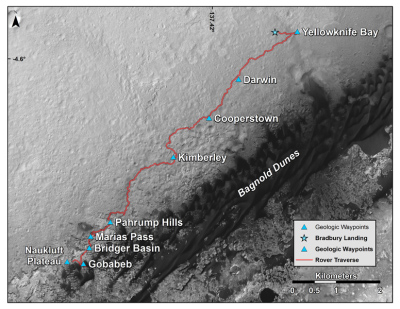
The Curiosity science team recently released a new Mars Reconnaissance Orbiter image, showing Curiosity’s overall route since its landing on Mars in August 2012. I have posted a reduced version on the right.

Similarly, on the Curiosity website you can view this more detailed map of its traverse route. This map is updated regularly as Curiosity continues its climb up Mount Sharp.

Neither of these maps is to me very satisfying or useful, however. Neither shows the overall location of Curiosity within Gale Crater. Nor do they give one a sense of how far it is has come on its climb up the mountain. In fact, it is very unclear how close the rover actually is to the peak from either image.

Thus, I decided to do a little research to get some better context of Curiosity’s position and its overall journey.
» Read more

13 comments

Iran to launch satellite?

Does this make you feel safer? Iran is preparing to launch a new ballistic missile capable of placing satellites in orbit.

The Simorgh rocket is a new development not seen previously. Its launch would also be a violation of a UN resolution forbidding Iran to do such research, but who cares about that? It wouldn’t be violation of the great deal Obama negotiated for us with Iran, a deal that they themselves never endorsed.

9 comments

Mathematicians discover pattern in prime numbers

The uncertainty of science: Mathematicians have discovered that, among the first billion prime numbers, there is a peculiar uneven distribution that is not random to the last digit of each prime.

[I]f the sequence were truly random, then a prime with 1 as its last digit should be followed by another prime ending in 1 one-quarter of the time. That’s because after the number 5, there are only four possibilities — 1, 3, 7 and 9 — for prime last digits. And these are, on average, equally represented among all primes, according to a theorem proved around the end of the nineteenth century, one of the results that underpin much of our understanding of the distribution of prime numbers. (Another is the prime number theorem, which quantifies how much rarer the primes become as numbers get larger.)

Instead, Lemke Oliver and Soundararajan saw that in the first billion primes, a 1 is followed by a 1 about 18% of the time, by a 3 or a 7 each 30% of the time, and by a 9 22% of the time. They found similar results when they started with primes that ended in 3, 7 or 9: variation, but with repeated last digits the least common. The bias persists but slowly decreases as numbers get larger.

As the article notes, this pattern does not appear to have any practical use, though it definitely fascinates everyone who hears about.

64 comments

ExoMars blasts off

The European-Russian Mars orbiter/lander ExoMars was successfully launched on a Proton rocket this morning from Baikonur.

It will still take most of today for the rocket’s Briz-M upper stage to complete several additional engine burns to send the spacecraft on its path to Mars, but the most difficult part of the launch has now passed.

The article does a nice job of summing up Russia’s most recent track record in trying to send spacecraft to Mars, thus illustrating the significance of today’s success:

For Russian scientists, the launch marks the resumption of a cooperative effort with Europe to explore the Solar System, after the failure of the Phobos-Grunt mission in 2011.The launch of the ExoMars-2016 spacecraft will be Proton’s first “interplanetary” assignment in almost two decades. During its previous attempt in November 1996, Proton’s upper stage failed, sending the precious Mars-96 spacecraft to a fiery desmise in the Earth’s atmosphere and effectively stalling Russia’s planetary exploration program for a generation.

Further in the past, during the Soviet era, the Russians tried numerous times to either orbit or land on Mars. Every mission failed. If this mission successfully reaches Mars and lands it will mark the first time the Russians played a major role in a mission to Mars that actually reached its goal and worked.

1 comment

It’s a sweep!

Google’s AlphaGo computer program today completed a three game sweep of Go professional champion Lee Sedol.

This might be the best quote from the article:

The algorithm seems to be holding back its power. Sometimes it plays moves that lose material because it is seeking simply to maximise its probability of reaching winning positions, rather than — as human players tend to do — maximise territorial gains. Jackson thinks that some of these odd-looking moves may have fooled Lee into underestimating the machine’s skills at the beginning of game 1 — which, I suppose, makes AlphaGo a kind of computerized hustler.

6 comments
1 143 144 145 146 147 171