
Atlas 5 launches GPS satellite
The competition heats up: ULA has opened its 2016 launch schedule with the successful launch of an Air Force GPS satellite.
The competition heats up: ULA has opened its 2016 launch schedule with the successful launch of an Air Force GPS satellite.
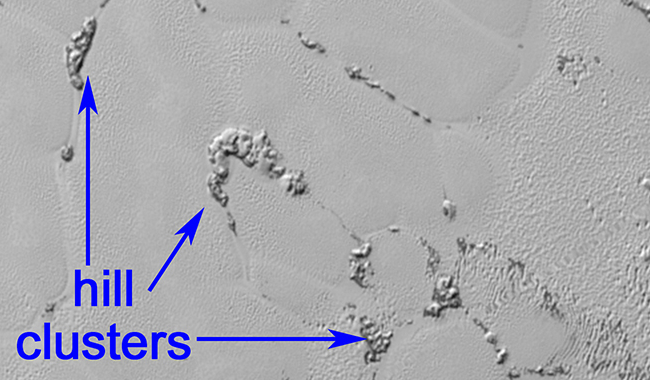
The New Horizons science team has released a new image of Pluto’s smooth heart-shaped area, dubbed Sputnik Planum, focusing this time on the mountains of water ice that pop up through the plain and are apparently floating on the nitrogen sea, having broken off from the shoreline.
Because water ice is less dense than nitrogen-dominated ice, scientists believe these water ice hills are floating in a sea of frozen nitrogen and move over time like icebergs in Earth’s Arctic Ocean. The hills are likely fragments of the rugged uplands that have broken away and are being carried by the nitrogen glaciers into Sputnik Planum. ‘Chains’ of the drifting hills are formed along the flow paths of the glaciers. When the hills enter the cellular terrain of central Sputnik Planum, they become subject to the convective motions of the nitrogen ice, and are pushed to the edges of the cells, where the hills cluster in groups reaching up to 12 miles (20 kilometers) across.
I have significantly cropped the image to show it here. Be sure and check out the full version, because there is a wealth of fascinating details in it.
I think John Batchelor’s own description of what I talked about on this podcast, which is embedded below the fold, says it all: “Commercial space lifts off while big space stalls.” Plus I outlined some good stuff about the various planetary missions that are presently ongoing.
» Read more
An evening pause: Performed live at the Broken Arrow Performing Arts Center in her hometown of Broken Arrow, Oklahoma, her family were in the front row and, like her, strongly moved by the moment.
Hat tip Edward Thelen.
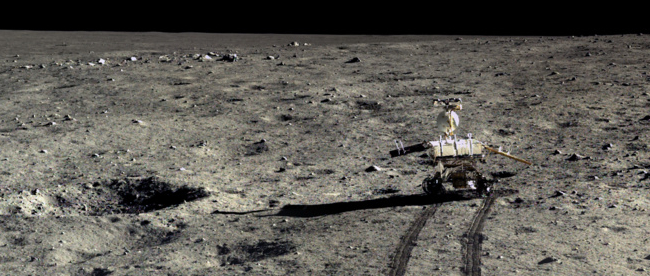
China has made available a new batch of very cool images taken by its Chang’e 3 lander and Yutu rover, and Emily Lakdawalla at the Planetary Society has figured out how to view them.
In a recent guest blog post, Quanzhi Ye pointed to the Chinese version of the Planetary Data System, and shared the great news that Chang’e 3 lander data are now public. The website is a little bit difficult to use, but last week I managed to download all of the data from two of the cameras — a total of 35 Gigabytes of data! — and I’ve spent the subsequent week figuring out what’s there and how to handle it.
So, space fans, without further ado, here, for the first time in a format easily accessible to the public, are hundreds and hundreds of science-quality images from the Chang’e 3 lander and Yutu rover. I don’t usually host entire data sets (PDS-formatted and all) but I made an exception in this case because the Chinese website is a bit challenging to use.
The image above is a cropped version of Yutu, taken by the lander. Be sure and go to the link to see the full image as well as others.
Curiosity’s science team has finished its work at Namib Dune and has decided to move on, even though they are still analyzing an unspecified issue with the rover’s scoop instrument.
So far, in the week since they first had a problem while sifting sand from the dune, they have not described in any way what the problem is. All they have said is this:
Unfortunately, the CHIMRA behaved in an unexpected way during processing of the third scoop on Sol 1231, which prevented completion of the arm activities planned for last weekend.
The robot arm functions, and they used it yesterday to get some extreme close-ups of the sand, but it appears they cannot use the scoop at this time.
The Rosetta science team has determined that Comet 67P/C-G has no voids or large caverns in its interior, and that its low density is because its dust and water ice have mixed to produce a “fluffy” density.
In a new study, published in this week’s issue of the journal Nature, a team led by Martin Pätzold, from Rheinische Institut für Umweltforschung an der Universität zu Köln, Germany, have shown that Comet 67P/Churyumov-Gerasimenko is also a low-density object, but they have also been able to rule out a cavernous interior. This result is consistent with earlier results from Rosetta’s CONSERT radar experiment showing that the double-lobed comet’s ‘head’ is fairly homogenous on spatial scales of a few tens of metres.
The most reasonable explanation then is that the comet’s porosity must be an intrinsic property of dust particles mixed with the ice that make up the interior. In fact, earlier spacecraft measurements had shown that comet dust is typically not a compacted solid, but rather a ‘fluffy’ aggregate, giving the dust particles high porosity and low density, and Rosetta’s COSIMA and GIADA instruments have shown that the same kinds of dust grains are also found at 67P/Churyumov-Gerasimenko.
The competition heats up: SpaceX is modifying its Falcon 9 rocket based on engine tests it performed on the December 22 returned first stage.
SpaceX will be making modifications to its Falcon 9 rocket based on what the company learned from re-igniting the engines on the vehicle it landed. That’s according to SpaceX president Gwynne Shotwell, who spoke about the state of the company today at the Commercial Space Transportation Conference in Wasington, DC. Shotwell didn’t specify what those modifications will be, but said the changes will make the vehicle “even more robust” for its ascent into space.
This report helps explain why SpaceX has pushed back all planned launches of the upgraded Falcon 9 rocket. Their tests of the returned first stage revealed issues that they think are important enough to be addressed before another rocket is launched, and they are proceeding to deal with those issues.
It also illustrates an enormous advantage they have over every other rocket company that has ever existed in the past. They, unlike all past rocket companies, actually have a used first stage that they can study to see the real consequences of launch and landing. All previous estimates of those consequences were only based on computer models and speculation.
The Juno spacecraft, heading for a July 4 rendezvous with Jupiter, when it will go into orbit around the giant planet, successfully completed a mid-course correction engine burn on Wednesday.
Below the fold is Tuesday’s podcast of my appearance on the John Batchelor show. In addition to discussing Falcon Heavy, Ariane 6, and the question of rocket re-usability, I also lambasted the glacially slow pace of NASA’s Orion project, producing four capsules for a mere $17 billion in only 19 years! And speaking of glaciers, I also noted in the science segment the stonewalling at NOAA that prevents scientists from analyzing the rational behind their “adjustments” to their climate data, all of which cool the past and warm the present.
» Read more
An evening pause: Hat tip Danae.
Heh: When asked by a reporter about the Presidential campaign, former President Jimmy Carter said he’d pick Donald Trump over Ted Cruz if they were his only choices. And why would he do that?
If he had to choose between Cruz and Trump for the Republican nomination, Carter chuckled, “I think I would choose Trump, which may surprise some of you.” (It did, judging by the loud laughter from the audience.)
“The reason is, Trump has proven already he’s completely malleable,” Carter explained. [emphasis mine]
I think this might one of those very rare moments when Jimmy Carter has correctly analyzed the situation.
