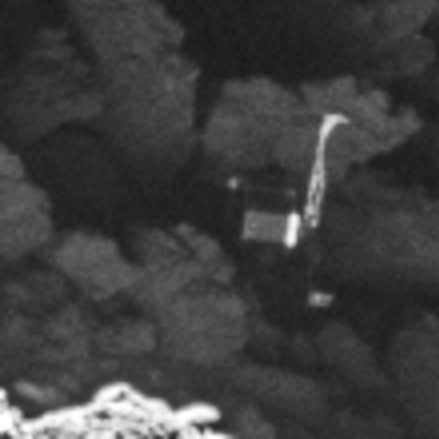
Comet 67P/C-G slowly breaking apart

A comparison of Rosetta images before and after Comet 67P/C-G’s close approach to the sun last year found new fractures and an enlargement of older fractures.

The fractures appear to be developing as forces subtly bend the comet to and fro, Stubbe Hviid, a planetary scientist at the German Aerospace Center Institute of Planetary Research in Berlin, reported October 17 in a press conference at a meeting of the American Astronomical Societyโ€™s Division for Planetary Sciences. Hviid and colleagues combined maps from Rosetta with computer simulations of all the forces at work within the comet to determine how the cracks develop. They found that the two bulbous ends rock in opposite directions as the comet spins, flexing the neck and creating severe stress. Because the comet isnโ€™t held together strongly โ€” itโ€™s a conglomeration of dust and ice not much stickier than snow, Hviid said โ€” the neck is starting to break. After a few hundred more years, he said, the comet could fold itself in half as the two lobes snap apart and smoosh together.

0 comments

Active volcano on Venus?

The uncertainty of science: A new analysis of past data from a variety of Venus orbiters suggests that at least one volcano is active there.

The review of old data from the Magellan and Venus Express orbiters suggests that some lava flows on the volcano’s slopes are fresh, though how fresh remains unknown. However, computer models and the detection of excess heat by Venus Express on the mountain’s eastern slopes adds weight to the theory that the volcano is spewing out lava.

0 comments

The clouds of hot Jupiter exoplanets

Exoplanet clouds

Cool image time! The image on the right, reduced to show here, provides an overall summary of what astronomers know about the atmospheres of many gas giant exoplanets that also orbit very close to their suns and are tidally locked. The view is of the planet hemisphere facing away from the star, which is also where most of the clouds are thought to be. These results come from Kepler data combined with computer modeling, and show what scientists thinks happens with different cloud compositions at different temperatures.

Link fixed!

2 comments

Mars rover update

Emily Lakdawalla at Sky & Telescope today provides an update of the two Mars rovers, but takes a different approach than I have. While I have been focusing on tracking where the rovers are going and what they are doing, she gives a very nice overview of each rovers’ condition, what instruments continue to work and what have failed.

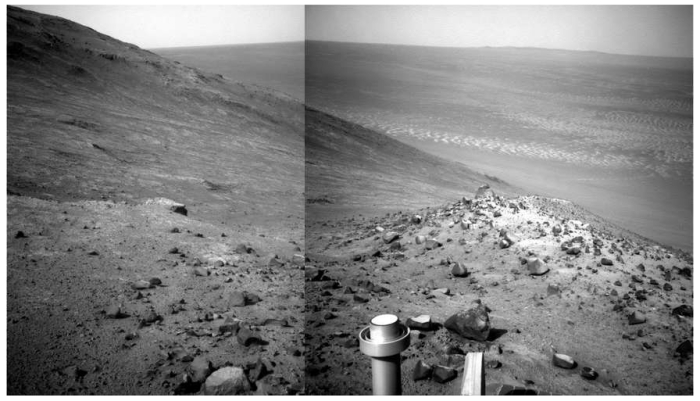
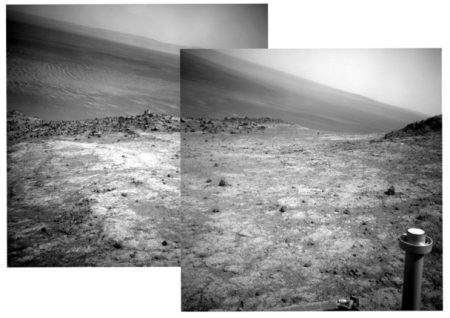
I myself have not done a new rover update since October 6 for several reasons. First and foremost, neither rover has gone anywhere since my last report. Opportunity is still sitting on Spirit Mound, studying the rocks there. Curiosity is still in the flats south of Murray Buttes, preparing to drill another hole.

Secondly, there was a delay this past weekend in downloading data, especially from Curiosity. I strongly suspect that the delay was simply because the Deep Space Network was being used to help with communications between Europe and its ExoMars probes, now set to arrive at Mars tomorrow. When the lander Schiaparelli separated from the orbiter on Sunday they had had some initial communications problems, and it is likely that though ESA was using its own deep space network, they also enlisted ours to help.

Thirdly, I have been very tied up trying to finish my cave project monograph. This is done now, so I finally have more time to work on Behind the Black.

0 comments

The first Arab space program

It happened in Lebanon, beginning in 1960, led by college students at a small college who were interested in rockets and space, and could have made that country prosperous and successful.

Instead, the program was co-opted by the military, and the students all ended up leaving the country to flee its endless wars, with most becoming successful academics here in the U.S.

Read the whole article. It is quite fascinating, and if you are at all familiar with the story of Wernher von Braun and his rocket club, you will immediately recognize the similarities. The one difference is that while von Braun and his rocket friends almost all accepted doing military work to continue to build their rockets, the students in Lebanon did not, abandoning their research to go elsewhere. In fact, it is very likely that they were aware of von Braun’s history, and decided to make a different choice based on what they knew. In the 1960s von Braun was very public about what had happened to him, and often noted that he made a mistake working for the Nazis.

1 comment

New object found beyond Kuiper belt

Worlds without end: Astronomers have discovered another object far beyond Pluto and in an elliptical orbit whose farthest point is 1,450 astronautical units, or about 135 billion miles from the Sun.

This is not the same object recently discovered in a somewhat similar elliptical orbit.

Astronomers right now do not understand the formation process that put these objects in these distant orbits. Some think the objects might have originally come from the Oort cloud that is even farther out from the Sun, their orbits shifted by the as-yet undiscovered Planet X that astronomers love to talk about, but others are skeptical. Since no one has ever actually detected anything in the the theorized Oort Cloud, it is also possible that it does not exist as presently theorized, and might actually be a more scattered collection of objects, like these new discoveries, that travel both farther and closer to the Sun.

1 comment

New comments by Musk on Sept 1 launchpad explosion

Unconfirmed and leaked statements made by Elon Musk at a National Reconnaissance Office presentation on October 13 suggest that the investigation is getting close to identifying the cause of the September 1 Falcon 9 launchpad explosion.

โ€œIt might have been formation of solid oxygen in the carbon over-wrap of one of the [helium] bottles in the upper stage tanks,โ€ according to an excerpt of Muskโ€™s remarks. โ€œIf it was liquid, it would have been squeezed out. But under pressure it could have ignited with the carbon. This is the leading theory right now, but it is subject to confirmation.โ€

Musk’s is also reported to have said that they found they could “…exactly replicate what happened on the launch pad if someone shoots the rocket.” He also dismissed this as a likely cause, though it has forced them to review their future launch security measures.

The article provides some very good additional analysis of the solid oxygen theory above. It suggests that though much of this technology has been used somewhat routinely in the launch industry for years, the specific environment used by SpaceX in its Falcon 9 rocket might have produced a new situation that caused the failure.

8 comments

Mars in ultraviolet

Data from the Mars orbiter MAVEN have given scientists their first detailed look at the red planet in ultraviolet wavelengths.

New global images of Mars from NASAโ€™s Mars Atmosphere and Volatile Evolution (MAVEN) mission being led by CU Boulder show the ultraviolet glow from the Martian atmosphere in unprecedented detail, revealing dynamic, previously invisible behavior.

They include the first images of โ€œnightglowโ€ that can be used to show how winds circulate at high altitudes. Additionally, dayside ultraviolet imagery from the spacecraft shows how ozone amounts change over the seasons and how afternoon clouds form over giant Martian volcanoes. The images were taken by the Imaging UltraViolet Spectrograph (IUVS) on MAVEN.

The build-up of clouds over Mars’ four big volcanoes is especially interesting, since it is thought this water vapor likely comes from underground ice left over from glaciers that were once on the mountains’ slopes. A very short video of that build up can be seen, below the fold.
» Read more

0 comments
1 33 34 35 36 37 171