
To read this post please scroll down.


Thank you!


The July fund-raising campaign is now over. Though the donations and subscriptions were poor for most of the month, the response in the last helped make up the difference. Thank you all for coming through in the end. It was beyond gratifying to find out that there are supporters to my work out there.


I will keep this thank you notice up for the next week, just so that everyone who donated or subscribed can see it. And if you haven’t donated this year as yet, please consider supporting me in some small manner. My website has no advertising and no sponsors (other than my readers), and it is free for all to read and comment without charge or registration. Your support is the only thing that keeps me going. You can either give a one-time contribution or a regular subscription. There are five ways of doing so:


1. Zelle: This is the only internet method that charges no fees. All you have to do is use the Zelle link at your internet bank and give my name and email address (zimmerman at nasw dot org). What you donate is what I get.


2. Patreon: Go to my website there and pick one of five monthly subscription amounts, or by making a one-time donation. Takes about a 10% cut.


3. A Paypal Donation or subscription, which takes about a 15% cut:


4. Donate by check. I get whatever you donate. Make the check payable to Robert Zimmerman and mail it to

Behind The Black
c/o Robert Zimmerman
P.O.Box 1262
Cortaro, AZ 85652


You can also support me by buying one of my books, as noted in the boxes interspersed throughout the webpage or shown in the menu above.


13th Starship/Superheavy launch goes almost perfectly
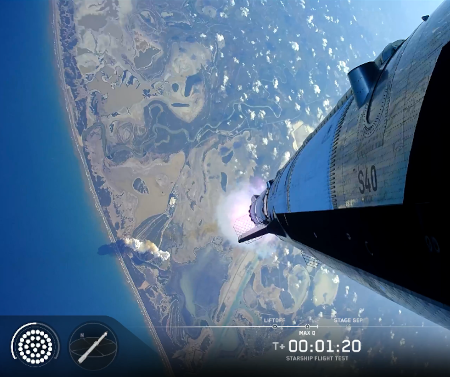
Starship/Superheavy, shortly after launch and looking down at Boca Chica
Starship/Superheavy, shortly after launch and looking
down at Boca Chica

SpaceX today successfully launched its Starship/Superheavy rocket on its 13th orbital test flight, during which the company was able to complete almost all of its planned tasks, as intended.

The only issue occurred when Superheavy ignited its engines for its landing burn a couple of miles off the coast of Texas. The plan was to fire 13 Raptor-3 engines. Instead, only ten lit initially. Almost immediately another two engines cut out, leaving eight firing, only for three more to shut down a few seconds later. The five working engines however were not enough to slow the booster enough for a soft splashdown. It instead continued to fire until the rocket hit the water hard.

In orbit, Starship successfully deployed 20 version-3 Starlink satellites, with the last two using cameras to photograph the ship’s exterior, as was done on the previous flight with the dummy satellites. Engineers were able to activate and communicate with all 20, and also link the satellites using communication lasers, before the satellites began breaking up in the atmosphere as their orbits decayed.

The ship then did a 14-second engine firing of one Raptor-3 engine, proving again that the engines can relight reliably once in orbit to accurately de-orbit Starship.
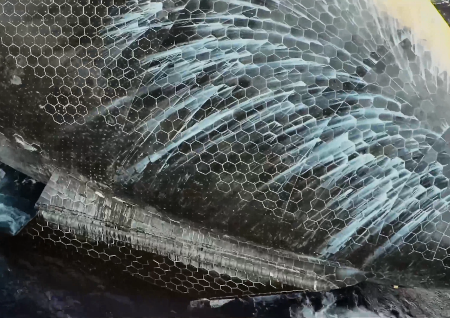
Starship afloat and intact after the flight

Finally, Starship completed a soft splashdown in the Indian Ocean, once again proving that its thermal system works as planned. In fact, the splashdown was so soft and perfect that Starship fell sideways and then floated serenely on the ocean. On previous landings after splashing down vertically, the ship fell over hard and exploded. This time it remained afloat long enough for drones to get great imagery of the thermal tile system post landing. Even cameras inside the ship beamed back images. As noted by one announcer, the heat shield seemed “pretty intact. … You could count the number of missing tiles on one hand.” I would not be surprised if SpaceX manages to salvage the ship and bring it back to Boca Chica.

This success makes it very likely that the 14th test flight will be a full orbital test, lasting several orbits at least but more likely a full day.

The failure of several of Superheavy’s Raptor-3 three engines during the landing burn needs to be addressed, but this flight showed a significant improvement over the last flight, where multiple engines failed to light on both Superheavy and Starship after stage separation. The improvement suggests SpaceX’s engineers have a handle on this issue, and are making progress in fixing it. Based on the company’s multi-decade track record, once fixed it will not reappear ever again.

I predict that the next flight will take place no more then six weeks from now.

Though this flight did not complete a full orbit, I consider this an orbital success, because that low orbit was intentional. The rocket demonstrated the ability to reach orbit, and did so successfully. I thus add it to my launch count. The leaders in the 2026 launch race:

89 SpaceX
48 China
10 Rocket Lab (plus two suborbital HASTE launches)
10 Russia

For the third straight year SpaceX leads the entire world combined in total launches, 89 to 83.

Genesis cover

On Christmas Eve 1968 three Americans became the first humans to visit another world. What they did to celebrate was unexpected and profound, and will be remembered throughout all human history. Genesis: the Story of Apollo 8, Robert Zimmerman's classic history of humanity's first journey to another world, tells that story, and it is now available as both an ebook and an audiobook, both with a foreword by Valerie Anders and a new introduction by Robert Zimmerman.

The print edition can be purchased at Amazon or from any other book seller. If you want an autographed copy the price is $60 for the hardback and $45 for the paperback, plus $8 shipping for each. Go here for purchasing details. The ebook is available everywhere for $5.99 (before discount) at amazon, or direct from my ebook publisher, ebookit. If you buy it from ebookit you don't support the big tech companies and the author gets a bigger cut much sooner.


The audiobook is also available at all these vendors, and is also free with a 30-day trial membership to Audible.
 

"Not simply about one mission, [Genesis] is also the history of America's quest for the moon... Zimmerman has done a masterful job of tying disparate events together into a solid account of one of America's greatest human triumphs."--San Antonio Express-News

30 comments

30 comments

  • Jeff Wright

    N.I.M.R./S.S.R.N Starship awash, Captain Crane….. awaiting orders from Admiral Nelson

  • Bob Wilson

    Great job SpaceX team.

  • Steve White

    Great to see and thanks for the info/analysis.

    Beyond fixing the Raptor engine re-ignition problem(s), I do wonder what more SpaceX would need to do to declare Starship/Heavy to be operational? And how many flights will they do with launching their own v3 Starlink satellites before they’re open for business with other customers?

    • Operational Starlinks next flight. Starship won’t be operational but SpaceX won’t waste an orbital launch without putting some satellites in orbit.

      • Dick Eagleson

        Agreed. I’m expecting a full load of 60 V3s. That would add as much new bandwidth to the Starlink constellation as roughly 20 launches of F9s carrying current-model V2s. SpaceX can then either not fly those 20 F9s or, more likely, load them with Amazon LEO sats instead and make some more money.

    • Edward

      Steve White,
      You asked: “I do wonder what more SpaceX would need to do to declare Starship/Heavy to be operational?

      SpaceX is working on a fourth version that is longer, supposedly so that it can take heavier payloads to orbit. On the other hand, they choose to take operational V3 Starlink satellites into orbit on its first orbital flight, so would you consider taking payload to orbit as being operational? To be operational, however, it has to attain an actual orbit rather than these partial-orbit (half-orbit) flights.

      And how many flights will they do with launching their own v3 Starlink satellites before they’re open for business with other customers?

      Another question with an interesting answer. Starship is already scheduled to take Superbird-9 into orbit in June of next year and to take Starlab space station into orbit in 2028. Presumably, these two will require the “clam shell” payload-release version of Starship. I don’t know whether other satellite manufacturers are making satellites in a profile that can use the “Pez dispenser” that Starship has already tested on its suborbital test-flights.

      So, when will we call Starship operational? When it releases operational satellites during development flights? Probably not. But SpaceX is likely to be changing Starship even after we start calling it operational. They did this with Falcon 9.

      Today’s flight has gone a long way toward getting Starship operational. Ship seemed successful in every way, but the data will tell the tale to SpaceX, and they will make improvements for future flights. Super Heavy is still acting up, which means that its methods for relighting its engines are somewhat different, and I suspect that the problems lie mostly with the plumbing or some other design that is exclusive to Super Heavy.

      • Nate P

        I don’t know whether other satellite manufacturers are making satellites in a profile that can use the β€œPez dispenser” that Starship has already tested on its suborbital test-flights.

        There are at least three or four companies making flat satellites that have publicly announced that design style. Whether they’ll all fly on Starship is another question.

        Overall: that was a good flight. Starship performed superbly, and while the booster had some issues with its landing burn, this was great progress.

    • Edward

      Come to think of it, Steve White, SpaceX could have made Starship operational with version 1, if all they wanted was a launch vehicle. This is what most launch companies do; they design a launch vehicle, then make it work.

      SpaceX has a different goal in mind. They want a specific launch vehicle and an upper stage that doubles as the space ship that should have been the payload of that upper stage. These SpaceX guys do not just think outside the box, they think off the planet.

      Thinking outside the box won’t get them a colony on Mars. They need a rocket and spaceship that does more than just outside the box.

  • Jeff Wright

    Starship looking like Enterprise rounding a planet from TOS
    https://x.com/SpaceX/status/2080826996490199070

  • Ray Van Dune

    Re recovery of Starship: it was indeed amazing to see the Starship floating after landing, but recovery seems doubtful. Typical landing sites have been hundreds of miles from the nearest port, requiring multi-day transit times, even at normal cruising speed. And as far as I know there are no provisions on (either) ship for ocean towing.

    So expecting a spacecraft never designed to be a watercraft to hold together and remain watertight for what would be nearly a week of open ocean towing… just not realistic.

  • Dick Eagleson

    I’ve always thought Starships look a lot like orcas. They look even more like orcas floating on their sides in the ocean.

    The relight problems on the landing burn were a bit surprising after all 33 lit up just fine for the boostback burn – something I would have thought to be more difficult. SpaceX will, no doubt, promptly run this problem to ground but, as a backup option, perhaps the engine control software could be tweaked to light one of the two nearest engines on the outer ring to compensate for any engine on the middle ring that doesn’t light. Which of the two engines to light should be determined by which one would best balance the thrust anent all the other middle and inner ring engines that did and didn’t light. The same could be done to compensate for any of the inner ring of three engines that don’t restart. The idea would be to have 13 engines slowing the booster in the initial phase of the landing burn even if not the 13 engines ideally intended. Cutting out engines, successively, as the booster slows and descends would be done so as to maintain as close to an ideal thrust distribution as possible. Doing this wouldn’t fix the restart problem, but it would preserve the capability of catching the booster and allow a later extended inspection/teardown to assist in nailing down the relight problem.

    • Jeff Wright

      I wonder if Elon could pay to have another kind of heavy lifter return Starship

      https://en.wikipedia.org/wiki/Heavy-lift_ship

      I’d love to see it in a museum.

      Maybe at Christmas Island…to spark a little wonder in Aussie children tired of their Green nannies.

      I would like to see cockpits of scrapped airplanes left at or near playgrounds.

      Teachers can prattle onβ€”but just having this Starship on display…it by itself as an object of wonder…is enough to get kids looking up again.

      This is how deprogramming begins…hard to get youth obsessed with carbon footprints in mud when this craft points skyward.

  • Edward

    Some things that I noticed on this flight:

    Blue glowing turbulence (turbulence at mach 25?).

    I expected that Starship would roll on its long axis so that the inspector satellites could see the tiles without having to maneuver around the mothership. This seems to have been what it did.

    After splashdown, some of the tiles seemed to have lost small chunks. That is not good for rapid reuse, but not as bad for reentry as losing entire tiles.

    Yes, Starship looked like a whale, riding high in the water. Actually, it was riding kind of low in the water, suggesting to me that the structure is fairly heavy. This is not good for winning the war with the rocket equation.

    The hosts said that they had stressed the tiles on the way up but did not do so on the way back down. The on-orbit inspection gave the engineers an opportunity to determine which part of the flight resulted in which damage to the tiles. The survival of splashdown was quite a bonus for tile inspection. They did not have to wait for a caught Ship before learning these lessons.

    The Starlink antennae are located on the “upper” side of Starship, yet the cameras were still sending video despite Ship being upside-down in the water. Well done, Starlink.

    The hosts showed a comparison of the launches of the three versions of Starship, and this version got above the tower about seven or eight seconds after becoming airborne. I calculate an acceleration approaching 1/2 G.

    (1) d = (1/2) * a* (t^2)
    (2) a = 2 * d / (t^2)

    where:
    d = ~130 meters (~400 ft.)
    t = ~8 seconds

    t^2 = ~65 seconds

    a = 2 * 130m / (65s^2) = 4m/s^2 = 0.4G

    • Dick Eagleson

      It didn’t seem to be riding low in the water to me. At the rear, which has the most weight when empty, all six engines were well above the waterline.

  • Ray Van Dune

    I suspect that the video while the ship was floating in the water was sent from the drone to the support ship, and thence to Starlink.

  • Richard M

    Elon posted a comment (in reply to a query from Scott Manley) in the wee morning hours: “Unless we discover problems after mission data review, SpaceX will attempt to catch the ship with the tower on next flight.”

    Sounds kinda orbital to me.

  • BillB

    The design of the TPS system is still ongoing. The overall minimal damage shows that SpaceX may be on the right track to rapid reusability. It seems they should be able to figure out if it will work over a few Starship “landings”.

  • John

    I always ASSumed that when the ship tipped over in the water, it kaboomed because they were testing the flight termination system. Didn’t see how ship could be so fragile on mostly empty tanks that are presumably stainless and structurally sound when unpressurized.

    So thinking out side the box one might spitball that maybe a water landing is easier and almost as quick. They could do it over a flooded dry dock or something. Yeah, I know put down the pipe.

    • Jeff Wright

      Perhaps they burned a bit longer…foamed that water up but good.

      Not exactly a Leidenfrost deal, but enough bubbling to soften the fall?

      Video
      https://m.youtube.com/watch?v=_EN5Jsl_G0I&source_ve_path=MjE0Mjgz&embeds_referring_euri=https%3A%2F%2Fforum.nasaspaceflight.com%2F

      Now, if the sea-level (literally) engines pivoted toward the ventral (tile side) after initially touching the air/water interface, you have a bit of a lever action that would also explain her coasting out of the foam.

      Might the drone/buoy have deposited detergent?

      Ships used to cover waves with oil to limit chop.

    • Edward

      John wrote: “[I] Didn’t see how ship could be so fragile on mostly empty tanks that are presumably stainless and structurally sound when unpressurized.

      Typically, rockets are designed for vertical forces, and side forces tend to be hard on them. It is why the Falcon booster exploded after the Dragon abort test, a decade-ish ago; it did not stay straight into the airstream after separation, and it was still deep enough in the atmosphere for aerodynamic forces to be strong — close to the Max Q point.

      You are correct that steel has more strength than the usual aluminum bodies, but we would expect that they would use only as much as they needed for those vertical forces. Added weight reduces the payload capacity. SpaceX engineers may have been more surprised that it survived the tip-over into the water than the rest of us were.

      The choice of steel rather than composite, as I recall, was for rapid manufacture and reduced turnaround time spent on implementing improvement in the design. It also allows for the structure to survive higher temperatures that may be conducted or radiated to it during reentry.

      My expectation is that the forces on the Ship had deformed some parts of the metal, explaining the methane leak and the fire. I suspect that they came fairly close to an explosion. Someone commented (somewhere, not here) that they may have intentionally tried to minimize the splash in order to save the heat shielding as long as possible for drone inspection, but I think that was only speculation on his part. It would be amazing if true. SpaceX was concentrating on the heat shield with this flight. They launched in clear weather in order to observe it during launch and as far along the flightpath as they could see. They inspected the shielding on orbit (or on sub-orbit, if you prefer). And they got a great inspection of it after splashdown.

      It looks as though they are getting close to solving the reusable heat shield problem. That is exciting.

      One of the reasons that SpaceX has so many explosions and why it takes so long to complete a development program (e.g. Falcon went through five major versions before it was frozen, mostly, and Starlink is still going through versions and iterations) is the basic philosophies of:

      1. The best part is no part, and
      2. If you don’t have to put parts back on, then you didn’t take off enough parts.

      Because Ship survived the tip-over splashdown, I wonder if there are parts that still can be taken off.

      • Nate P

        It looks as though they are getting close to solving the reusable heat shield problem. That is exciting.

        It really is. Once the heat shield and engines have both been foolproof for several flights in a row, we should see the launch rate accelerate. I want to see lots of competition to SpaceX, but Starship is definitely the most exciting launch program.

      • Dick Eagleson

        There were other reasons for the switch to stainless steel from composites. Composites are a lot harder to check for defects, especially really big structures. Also, composites cost more than two orders of magnitude more per pound than stainless steel. And then there’s the fact that stainless is a lot easier to work on on the lunar or Martian surface than composites. Stainless withstands dust/sandstorms better. Stainless isn’t degraded by long exposure to intense sunlight.

  • Mike Borgelt

    I think they ran one sea level Raptor for longer. Rocket engines work fine underwater, something tested on Aerobee sounding rockets about 70 years ago.

  • One of the most impressive parts of launch take place about 2+04 after liftoff. It is a view from the business end of Booster with a row of 4 Raptor V3s. All four of them have glowing turbopumps and plumbing around the upper part of the engine. I am an old Aero with over half a century of experience with rotating machinery, mainly turbines and fans. Always used to equate red, glowing engine parts with impending failure. The didn’t. Better yet, they shut them down and restarted them a couple times. If this is the new State of the Art in rotating machinery, OMG. Hats off the the 30-somethings who designed and built these beasts. Cheers –

  • Jeff Wright

    Still afloat:
    https://forum.nasaspaceflight.com/index.php?topic=63727.720

    Close to Christmas Island, which was to be a launch site:

    http://www.astronautix.com/c/christmasisland.html

    Hmm…

    Now, for funsies…if SH were launched off shore off Mobile, could it land in Florida downrange…and might Starship land at Christmas Island?

    All to reduce flips and such…

  • Richard M

    Latest update on Flight 13 aftermath: The FAA has confirmed no mishap investigation will be required following Friday’s launch, despite the early boostback burn shutdown.

    https://x.com/i/status/2081768094259617793

    Good news.

Leave a Reply

Your email address will not be published. Required fields are marked *

Readers: the rules for commenting!

No registration is required. I welcome all opinions, even those that strongly criticize my commentary.

However, name-calling and obscenities will not be tolerated. First time offenders who are new to the site will be warned. Second time offenders or first time offenders who have been here awhile will be suspended for a week. After that, I will ban you. Period.

Note also that first time commenters as well as any comment with more than one link will be placed in moderation for my approval. Be patient, I will get to it.

Formatting buttons insert safe HTML. Links and comments with more than one link will still be moderated.