Sweden delivers science instrument for Chinese lunar probe

The new colonial movement: The Swedish Institute of Physics has completed construction and delivered a science instrument to be flown on China’s Chang’e 4 spacecraft that will bring an orbiter, lander, and rover to the Moon’s far side in 2018.

The instrument will be installed on the rover, and will study the surface and how it interacts with the solar wind. This will also be a continuation of research performed by India’s Chandayaan-1 orbiter.

1 comment

New Horizons goes back to sleep

The New Horizons science and engineering team has placed the spacecraft back in hibernation mode for the first time since prior to its fly-by of Pluto in 2014.

During hibernation mode, much of the New Horizons spacecraft is unpowered. The onboard flight computer monitors system health and broadcasts a weekly beacon-status tone back to Earth, and about once a month sends home data on spacecraft health and safety. Onboard sequences sent in advance by mission controllers will eventually wake New Horizons to check out critical systems, gather new Kuiper Belt science data, and perform course corrections (if necessary).

This hibernation period will last until September, when they will wake the spacecraft so that they can make a mid-course correction in preparation for the January 1, 2019 flyby of Kuiper Belt Object 2014 MU69.

0 comments

Large archive of Canadian ice cores melts

A large archive of Canadian ice cores has been lost, melting when the freezer they were stored in failed.

The 2 April failure left “pools of water all over the floor and steam in the room,” UA glaciologist Martin Sharp told ScienceInsider. “It was like a changing room in a swimming pool.” The melted cores represented 12.8% of the collection, which held 1408 samples taken from across the Canadian Arctic. The cores hold air bubbles, dust grains, pollen, and other evidence that can provide crucial information about past climates and environments, and inform predictions about the future.

The storage facility is normally chilled to –37°C. But the equipment failure allowed temperatures to rise to 40°C, melting tens of thousands of years of history. Among the losses: some of the oldest ice cores from Mount Logan, a 5595-meter-high mountain in northern Canada. “We only lost 15 meters [of core], but because it was from the bottom of the core, that’s 16,000 years out of the 17,700 years that was originally represented,” Sharp says.

Scientists also lost 66 meters of core from Baffin Island’s Penny Ice Cap, which accounts for 22,000 years—a quarter of the record. That leaves “a gap for the oldest part, which is really the last glaciation before the warming that brought us into the present interglacial,” Sharp says.

Considering the cost and difficulty of drilling these cores, and then safely bringing them to the facility without melting, it seems to me astonishing that the facility did not have back-up freezer capability.

4 comments

The storms of Jupiter

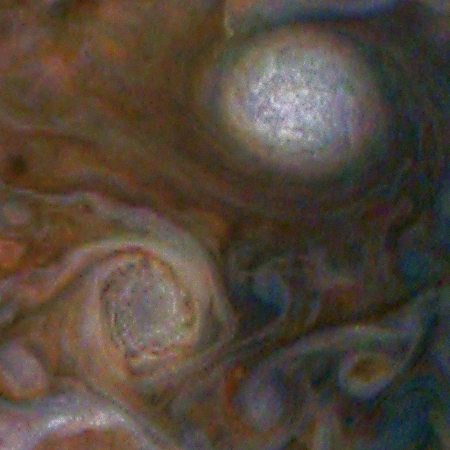
The storms of Jupiter

Cool image time! The image on the right, taken by Juno during its fifth close fly-by of Jupiter in late March and cropped to post here, shows two of the major storms in what I think is one of Jupiter’s main large mid-latitude belts. The full image, posted below in a significantly reduced form but annotated by me to indicate the location of the inset, covers a much larger area, but I have specifically zoomed into these two storms to highlight how large these storms are as well as how much detail is hidden within them.

In the bright spot in particular (officially called A6 by planetary scientists) you can see a hint of the existence of innumerable mini-storms. Juno’s camera does not have the resolution to image these smaller storms, but this image suggests that the gas giant’s atmosphere is far far far more complex than we can yet imagine.
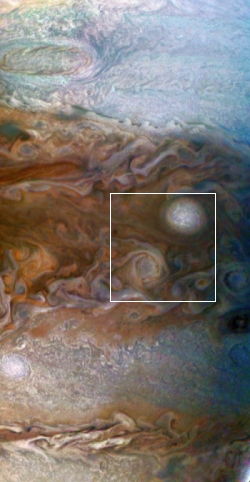
Full image of Jupiter reduced and annotated

Unfortunately, these images do not provide a scale. Based on a global image taken by Juno in October 2016 and matching the gas giant’s major horizontal bands, the annotated full image strip on the left appears to cover a little less than a third of Jupiter, from about 10 degrees latitude to about 50 degrees latitude. From this I estimate that if we put the Earth in the inset image it would probably be only slightly larger than the image itself, which means these two storms would cover most of one hemisphere.

In other words, the mini-storms inside the big bright oval are still larger than the biggest hurricanes on Earth, and they are packed together inside a much larger planet-sized storm.

What should fill us with even more awe is that this only covers a very thin slice of the top of Jupiter’s deep atmosphere. The planet itself is about 89,000 miles in diameter, more than ten times larger than Earth. The depth of its atmosphere is not really known, but it must be deeper than several Earths, piled on top of each other. In that depth there must be many atmospheric layers, each thicker and denser than the one above, and each with its own weather systems and complexities.

It will take centuries of research, including the development of new engineering capable of accessing this place, to even begin to map out its meteorology. And this is only one gas giant, of what we now know must be millions and millions throughout the galaxy.

If we have the nerve and daring, the human race has the opportunity to go out there and never be bored. There will always be something unknown to discover.

2 comments

Soyuz returns ISS crew to Earth

A Russian Soyuz capsule safely returned three astronauts to Earth this morning.

This completes the second flight of the Soyuz-MS upgraded capsule.

The new MS series sports more efficient solar panels, a new Kurs NA approach and docking system weighing less than half that of its predecessor, additional micro-meteoroid debris shielding, and a modified docking and attitude control engine – which will add redundancy during docking and deorbit burns.

0 comments

R.I.P: Georgy Grechko

Russian cosmonaut Georgy Grechko died today at the age of 85.

Grechko was one of the Soviet Union’s most important early cosmonauts, flying some of the first long term missions on several of Russia’s early Salyut stations. He was also important in that in the first real elections run by the Soviet Union he ran for office against party officials, won, and helped throw the Communists out of power.

I met and interviewed Grechko when I was writing Leaving Earth. He struck me as a kind and intelligent person, exactly the kind of person you’d want in charge, and who rarely gets that chance. Russia is diminished by his passing.

10 comments

Solar panel project costing millions produces enough energy to run one microwave

Our government in action! An Idaho solar panel project that cost $4.3 million (so far) only produces enough energy per day to run one microwave.

On March 29th, the solar road panels generated 0.26 kWh, or less electricity than a single plasma television consumes. On March 31st, the panels generated 1.06 kWh, enough to barely power a single microwave. The panels have been under-performing their expectations due to design flaws, but even if they had worked perfectly they’d have only powered a single water fountain and the lights in a nearby restroom.

Solar FREAKIN’ Roadways has been in development for 6.5 years and received a total of $4.3 million in funding to generate 90 cents worth of electricity.

Obviously, none of this matters. The people who created the project care, and that’s what counts!

16 comments

Another Grand Canyon tour

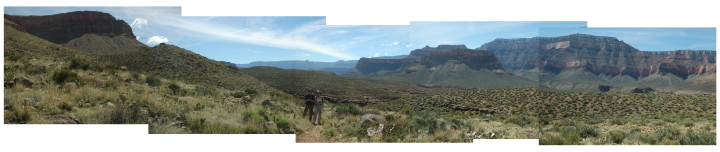
On the Tonto Platform

Because I live in southern Arizona, I take advantage of this location to make an annual trip to the Grand Canyon. On my previous trips I’ve talked about the right way to hike the canyon (slowly!) and then provided some suggestions for proper preparation.

This time I am simply going to suggest two hikes. One is very easy and should be done by every visitor to the south rim. The other hike is for those who go to the bottom, and reserve themselves one day there for a day hike.
» Read more

24 comments

Mob shuts down speech at Claremont McKenna College

Fascists: An angry mob of around 250 at Claremont McKenna College blocked access to a speech while threatening violence to the speaker and forcing her to end the speech early.

A throng of angry protesters converged at Claremont McKenna College on Thursday and effectively shut down a pro-police speech as they surrounded the building, forcing the speaker to give the talk via livestream to a near-empty room as they yelled “F*ck the police” and “Black Lives Matter” and banged on windows.

Heather Mac Donald, a Manhattan Institute scholar and author of the 2016 book “The War on Cops,” even gave her talk earlier than originally planned at the preppy and private Southern California campus because of the rowdy crowd estimated at more than 250 protesters, she told The College Fix via email Thursday. Thirty minutes into the speech, police officers told her to cut it short, and she was given a four-officer escort through a side door and safely through some surprised protesters who had flanked that exit, Mac Donald said.

These leftist protesters at all these universities nothing but brown-shirted jack-booted thugs, using violence to silence any dissent to their way of thinking. Worse, it increasingly appears they are going to succeed, as it appears most college administrations and their faculty agree with their violent tactics, while the general public seems uninterested in stopping the oppression being imposed here.

1 comment

ULA slashes launch prices for Atlas 5

Capitalism in space: In order to compete with SpaceX ULA announced this week that it will cut its launch price for the Atlas 5 rocket by one third.

United Launch Alliance has dropped the price of its workhorse Atlas 5 rocket flights by about one-third in response to mounting competition from rival SpaceX and others, the company’s chief executive said on Tuesday. “We’re seeing that price is even more important than it had been in the past,” Tory Bruno, chief executive of United Launch Alliance, or ULA, said during an interview at the U.S. Space Symposium in Colorado Springs. “We’re dropping the cost of Atlas almost every day. Atlas is now down more than a third in its cost,” Bruno said.

It appears that they have discovered that the prime reason they lost their bid of an Air Force GPS satellite launch to SpaceX was because their price was too high.

9 comments
1 120 121 122 123 124 164