Russians successfully launch Progress to ISS

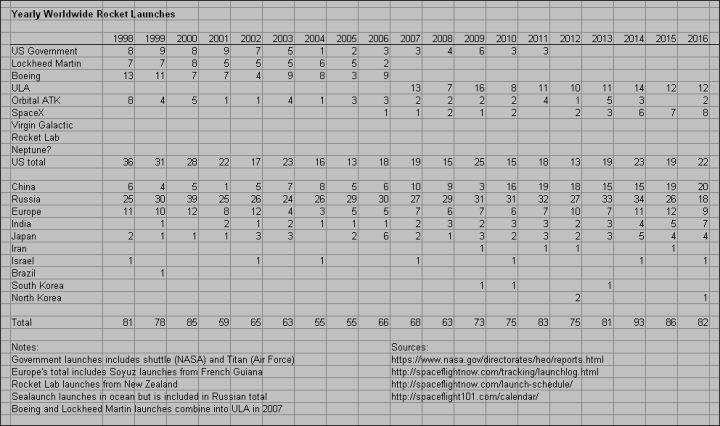
A Russian Soyuz rocket successfully launched a Progress freighter to ISS early today.

That’s the second Russian launch in less than a week, after a very long pause caused by the discovery of corruption in one of their major engine factories. Though the Russians presently only have two launches scheduled for July, and none scheduled for August, I suspect that this will change in their effort to clear their launch backlog.

0 comments

KFC pays to put chicken sandwich on four day World View shakedown flight

Capitalism in space: A publicity stunt by Kentucky Fried Chicken to sell a new chicken sandwich will help pay for the the first long shakedown of World View’s Stratollite balloon.

For World View Enterprises, the flight is expected to serve as a four-day shakedown cruise for its “Stratollite” system, which could eventually send military and commercial imaging payloads to the edge of the atmosphere for months at a time. “When KFC first brought this to us, we had a good chuckle,” World View CEO Jane Poynter told reporters during a teleconference today. But then the Arizona-based company realized there could be a serious point behind the project. “If you can fly a chicken sandwich to the edge of space … you can fly really just about anything,” Poynter said.

Besides, the payment that KFC is providing for the publicity will cover the cost of the test flight, including the expense of beaming down live HD video from a height of 60,000 to 75,000 feet, Poynter said.

Neither she nor KFC brand communications director George Felix would say precisely how much the fast-food chain is paying, but Felix said “we’re fully confident that this is going to be worth every penny.” For reference, NASA has paid World View as much as $440,000 for balloon test flights.

What is interesting to me is how World View appears to have significantly backed off its effort to sell and fly tourists on a balloon.

When World View was founded in 2013, the company’s main objective was to provide hours-long tours to the stratosphere in a pressurized Voyager capsule for $75,000 a ticket. Since then, World View has pivoted to the Stratollite concept, but it still intends to fly people someday. “We’re actually making huge progress,” Poynter said.

Poynter is no longer giving out a timetable for the start of Voyager tours, but she said two more Stratollite missions are scheduled for this summer. MacCallum, who is Poynter’s husband, said a full-scale mass simulator for the Voyager capsule is due to be flown by the end of the year.

All in all, the suborbital space tourism business appears, at least for now, to be fading, overwhelmed by the new and growing orbital launch industry.

3 comments

Worm grows 2 heads on ISS

The uncertainty of science: For reasons that are not yet understood, a flatworm fragment flown to ISS in a microgravity experiment regenerated with two heads.

But the most dramatic difference was a type of regeneration observed in one of the 15 worm fragments sent to the ISS. That worm returned to the scientists with two heads (one on each end of its body), a type of regeneration so rare as to be practically unheard of — “normal flatworms in water never do this,” Levin told Live Science. When the researchers snipped both heads off back on Earth, the middle portion regenerated into a two-headed worm again.

“And these differences persist well over a year after return to Earth!” Levin said. “Those could have been caused by loss of the geomagnetic field, loss of gravity, and the stress of takeoff and landing — all components of any space-travel experience for living systems going to space in the future,” he said.

The flatworms that flew in space showed other significant differences from the control group that stayed on Earth, further suggesting that for flatworms at least the environment of weightlessness causes more problems that were expected.

6 comments

More news from fascist Evergreen State College

The mob riots at Evergreen State College in Washington state have unveiled a number of new facts about that publicly funded leftwing indoctrination mill:

The source of the documents in the first link said this, “I feel compelled to come forward with evidence that the school has allowed student groups (at best) or domestic terrorists (at worse) to indoctrinate freshman into their extremist ideology,” The article also gives a sense about the distribution of these documents and the violent, fascist, leftwing, and anti-American philosophy they promote across many campuses.

From the second article is this tidbit: “Evergreen employees have not given a single dollar to a Republican congressional candidate since 2012.” Since the administration of Evergreen has also been very supportive of the leftist mob that threatened anyone who disagreed with them with violence, the political donations give a nice sense of where the Democratic Party is going.

Finally, one more story today about this fascist university: Evergreen State professor: ‘I have no way of knowing whether it’s safe for me to return’

Durning a recent appearance on Tucker Carlson’s Tonight on Fox News, Professor Bret Weinstien claims that “the college has never acknowledged the danger they put us in,” and that, as a result, “I have no way of knowing whether it’s safe for me to return.”

“Their assurances that it is safe don’t mean anything,” Weinstein said, adding: “Not that they’ve offered them.”

Weinstein noted that he had received “tremendous support” from outside Evergreen State, and “quite a bit of support, privately,” from within the school. Publicly, however, “only one other professor” at Evergreen has come forward to support Weinstein.

But other than that, it’s a great place to send your kids to be educated.

Update: One more story from Evergreen: Students accuse Weinstein of hiding behind Jewishness

What a cesspool of bigotry.

49 comments

A dust-off broom for Mars

Romanian engineers have developed a small plasma jet capable of blowing Martian dust from solar panels and other equipment that can be used by future missions.

The “plasma broom” solution developed by Ticoş and colleagues uses bursts of plasma jet produced by a simple plasma accelerator. When a large current is passed through two electrode plates separated by a field of rarefied gas, the voltage difference between the two electrodes ionizes the gas, creating the plasma. In the broom, this is done with a coaxial gun – the two metal electrodes are arranged as an inner rod within a hollow cylindrical shell. The discharge current flowing through the central rod electrode produces a magnetic field, which, together with the electric field, exerts a Lorentz force on the ionized gas that expels it. “The trick is that you need a quite high current in order to produce a reasonable magnetic field and this can be achieved more conveniently in a pulsed operation,” Ticoş explains. “For a fraction of a second (100 µs) the current is very high (several kiloamps) and the force pushing the plasma is quite strong.” During a pulse, the plasma is expelled at a very high speed – several kilometres per second – and so can simply blow dust away from an area two to four times bigger than the diameter of the jet.

An advantage of the plasma broom is that it uses low-pressure CO2 as the gas between the electrodes. This is particularly ideal for operation on Mars as the atmospheric pressure there is 150 times lower than on Earth and the atmosphere is 96% CO2. This means the gun will be able to function in “open” Martian atmosphere without the need for a pump or gas bottle. Ticoş and colleagues have also considered the energy required for the cleaner to function on Mars. This depends on the voltage the gun operates at and can vary between a few hundred to a few thousand Joules per pulse. “We did an energy budget estimate taking into account the solar irradiance on Mars,” says Ticoş, “and it appears perfectly feasible to fire a few shots even on a daily basis for cleaning the solar panels, which will boost considerably the energy production rate.”

Essentially, they are using ion engine concepts to create a can of dust-off, using the Martian atmosphere itself as the can.

Hat tip Mike Buford.

12 comments

How NIMH policy effects research

The uncertainty of science: A policy change in how the National Institute of Mental Health (NIMH) awards grants during the Obama administration has had a profound influence on the research of mental-health in the United States.

An analysis by Nature suggests that the number of clinical trials funded by the NIMH dropped by 45% between 2009 and 2015. This coincides with the agency’s launch, in 2011, of the Research Domain Criteria (RDoC) — a framework for research on the mechanisms of mental illness. The NIMH’s roll-out of RDoC included asking researchers to focus more on the biological bases of behaviour — such as brain circuitry and genetics — than on the broader symptoms that clinicians typically use to define and classify mental illness.

The NIMH’s embrace of fundamental research has infuriated many clinical researchers, who see it as an attempt to invalidate their methods — and say that there is scant evidence to support the idea that using RDoC will lead to greater insight or better treatments for mental illness. Many of these researchers also note that NIMH funding for clinical trials has declined steadily over the past decade, adding to the perception that the agency now favours research that uses the RDoC framework.

Read the article. I have no idea if the change in NIMH policy is a good or bad thing. What disturbs me however is the federal government’s overall top-down control over mental-health research. Rather than obtain funding from many different sources — which would allow for the greatest flexibility and the most creativity — this research field appears to depend almost entirely on NIMH grants. Thus, the particular preferences of that agency dictates the nature of the research, whether or not its preferences are right.

13 comments

House committee passes new commercial space bill

Last week the House Science committee passed a new commercial space bill designed to streamline the licensing system that presently exists for getting private space missions certified as required under the Outer Space Treaty.

The bill reforms the existing licensing system for commercial remote sensing satellites, streamlining a process that many companies in that sector said results in lengthy delays. It also establishes a “certification” process for commercial spaceflight not otherwise licensed today in order to eliminate any regulatory uncertainty and ensure compliance with the Outer Space Treaty.

“The goal of this bill is not to regulate space broadly,” [Committee chairman Lamar Smith (R-Texas)] said in a statement at the markup. “Instead, the bill takes a commonsense approach by establishing a legal foundation upon which U.S. industry can flourish.”

I am in the process of reviewing the proposed law, and hope to write something detailed about it in the next few days. I should say here that in general this law seems to be trying to address the same issues relating to the Outer Space Treaty that have been discussed during the Senate hearings organized recently by Senator Ted Cruz (R-Texas). And while to me the resulting bill seems generally good, it still leaves hanging the Outer Space Treaty’s fundamental problems relating to property rights.

7 comments

Sunspot update for May 2017

Last week NOAA posted its monthly update of the solar cycle, covering sunspot activity for May. Unfortunately, there appeared to be a problem with their posting software. Though the date of the image changed, the graph itself was not updated. I contacted NOAA, and Ann Newman, IT Specialist at NOAA’s
Space Weather Prediction Center, took a look and quickly fixed the problem.

The corrected graph is posted below, with annotations, as I have done now every month since 2010.

May 2017 Solar Cycle graph

The graph above has been modified to show the predictions of the solar science community. The green curves show the community’s two original predictions from April 2007, with half the scientists predicting a very strong maximum and half predicting a weak one. The red curve is their revised May 2009 prediction.

The decline in sunspot activity resumed in May, putting the trend back below the 2007 low prediction. Overall, the trend continues to suggest that this very weak solar maximum will end much earlier than predicted, and will make it an unprecedented short but weak cycle. As the Sun is at this moment blank, and has been for several days, I expect that June will end up with low numbers as well, continuing this trend.

As I have repeatedly said now monthly for six years, if history is any guide, the Sun’s low activity should correspond with cooler temperatures here on Earth. Why this happens is not yet understood, though there are theories.

3 comments

What ISRO charges for a launch

Capitalism in space: This article, outlining the overall expenditures and earnings of India’s space agency, ISRO included this tidbit about the price it charges for launches:

Several companies like SpaceX’s Falcon 9, Russia’s Proton ULA, and Arianespace are big names in the space but ISRO’s Antrix provides competitive rates for commercial launches. ISRO, that has now become a specialist in launching satellites, cost a third of SpaceX launches. The low rates are probably because of ISRO’s location while its Indian engineers earn a fraction of the salaries that engineers would command in foreign countries. [emphasis mine]

If India does charge in the range of $20 to $30 million per launch they are in a strong position to compete with SpaceX, even after it reduces its prices because of the use of used first stages.

5 comments
1 93 94 95 96 97 164