
Company focused on cleaning up space junk raises $50 million

Capitalism in space: Astroscale, a Japanese company with British ties, has raised $50 million in investment capital for developing a robot spacecraft for locating and removing space junk from orbit.

The company plans to use the funding to support several ongoing efforts, including the development of a technology demonstration satellite called ELSA-d. That spacecraft, scheduled for launch in early 2020 on a Soyuz rocket, will feature “target” and “chaser” satellites to demonstrate rendezvous and proximity operations. The target spacecraft is being built by British smallsat developer Surrey Satellite Technology Ltd. under a contract announced last November.

The funding will support scaling up an operations center Astroscale established in the United Kingdom in 2017 that also handles engineering, procurement and business development. Astroscale said it plans to establish an office in the United States in 2019.

The article notes also that much of this money comes from Japanese investors, including Mitsubishi, and reflects a growing interest in Japan in private commercial space.
4 comments

Planetary Resources bought by blockchain company

Capitalism in space: The so-called asteroid mining company Planetary Resources has now been bought by computer blockchain company.

Planetary Resources said in a statement that it was acquired by ConsenSys, Inc. in an “asset-purchase transaction.” The companies did not disclose specific terms of the agreement. Chris Lewicki, the president and chief executive of Planetary Resources, and Brian Israel, the company’s general counsel, will join ConsenSys as part of the deal.

ConsenSys describes itself as a “blockchain venture production studio focused on building and scaling tools, disruptive startups, and enterprise software products powered by decentralized technology, specifically Ethereum.” Ethereum itself is a decentralized computing platform best known for supporting a cryptocurrency called Ether similar to the better-known bitcoin.

Don’t ask me how ConsenSys makes its money. I haven’t the faintest. I also haven’t the slightest idea what they intend to do with Planetary Resources. I can say without doubt that it won’t be asteroid mining.

9 comments

OSIRIS-REx snaps image of target asteroid Bennu

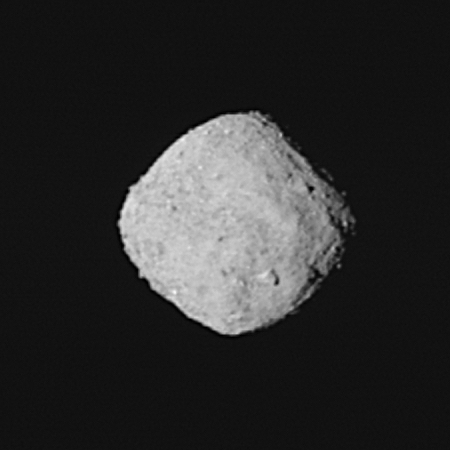
Bennu

OSIRIS-REx has snapped its sharpest image yet of its target asteroid Bennu, set for a rendezvous on December 3. The image on the right is that image, at full resolution but cropped.

This “super-resolution” view of asteroid Bennu was created using eight images obtained by NASA’s OSIRIS-REx spacecraft on Oct. 29, 2018 from a distance of about 205 miles (330 km). The spacecraft was moving as it captured the images with the PolyCam camera, and Bennu rotated 1.2 degrees during the nearly one minute that elapsed between the first and the last snapshot. The team used a super-resolution algorithm to combine the eight images and produce a higher resolution view of the asteroid. Bennu occupies about 100 pixels and is oriented with its north pole at the top of the image.

It is beginning to appear that the OSIRIS-REx engineering team is going to have the same kind of problems now faced by the Hayabusa-2 engineering team. In this first glance Bennu appears very similar to Ryugu, a rubble pile shaped approximately like a box, rotating on one point. If so, they are also going to find it difficult to locate a smooth landing site.

Bennu by the way is in an orbit that makes a collision with the Earth possible in the late 22nd century. Knowing its composition, density, and solidity is critical for determining what to do, should that collision become likely.

0 comments

China launches two more GPS-type navigation satellites

Completing its 31st successful launch this year, China today placed two more GPS-type Beidou satellites into orbit, using a Long March 3B/G2 rocket.

The article says this is China’s 32nd launch, but that includes one failure. The leaders in the 2018 launch race:

31 China
17 SpaceX
9 Russia
8 ULA
7 Europe (Arianespace)

China has widened its lead over the U.S. in the national rankings to 31 to 26.

0 comments

Russia releases video of October Soyuz launch, showing failed strap-on release

Russia has released video from the outside of its Soyuz rocket during the failed October 11 Soyuz launch, showing one of the rocket’s four strap-on boosters not releasing properly.

The key moment of the video, embedded below, is at 1:25. The booster on the left does not appear to release at its top. The article at the link says the Russians now believe that a failed sensor prevented the opening of a valve that would allow the venting of oxygen to push the booster away.

0 comments

Parker begins first perihelion fly-by of Sun

It’s getting hot in here: The Parker Solar Probe has begun its first close orbital fly-by of the Sun, set to last from now until November 11.

This solar encounter encompasses the first perihelion of the mission, the point at which Parker Solar Probe is closest to the Sun. Perihelion is expected at about 10:28 p.m. EST on Nov. 5. The spacecraft will come within 15 million miles of the Sun’s surface and clock in at a top speed of 213,200 miles per hour relative to the Sun — setting new records for both closest solar approach and top heliocentric speed by a spacecraft. At perihelion, Parker Solar Probe will fly through material at about 3.6 million degrees Fahrenheit — but because material in this region is so tenuous, it doesn’t influence the temperature of the spacecraft. However, the Sun’s intense radiation heats the Sun-facing side of the spacecraft’s heat shield, called the Thermal Protection System, to about 820 F.

For several days around the Nov. 5 perihelion, Parker Solar Probe will be completely out of contact with Earth because of interference from the Sun’s overwhelming radio emissions.

The article provides some nice details about the spacecraft’s design.

7 comments
1 7 8 9