
D-Day: A vast plan built on a grand heritage
One cannot but acknowledge that the history of war knows no other similar undertaking as regards breadth of design, vastness of scale and high skill of execution. … Only the British and American troops succeeded in carrying out with credit the vast plan of forcing the Channel and effecting the mass landing of troops.
Joseph Stalin, June 13, 1944
For anyone who wants to know how we got where we are now, knowing something about World War II is essential. It laid the foundation for all the political and cultural changes that took place in the latter half of the 20th century and the first quarter of the 21st century.
There are many histories and memoirs you can read. Two excellent places to start would be Winston Churchill’s six volume history, The Second World War, as well as Dwight Eisenhower’s own memoir, Crusade in Europe. Churchill especially is very readable, entertaining, and incredibly informative.
Those books however give the grand picture. To understand the war on a more human scale, it is often worthwhile to read books about individual events, such as Richard Tregaskis’ Guadalcanal Diary or Gordon Prange’s Miracle at Midway. Both describe specific important battles on which the war turned, and in doing so give a larger picture.
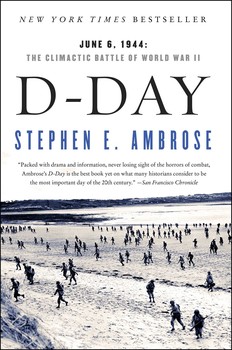
The most important battle by far of World War II however was the invasion of Normandy on June 6, 1944. It attempted something no one had achieved since the Normans in France invaded and conquered England in the 12th century — an invasion across the English Channel. And what to me must be by far one of the best books about the D-Day invasion is Stephen Ambrose’s D-Day June 6, 1944: The Climactic Battle of World War II.
I generally have mixed feelings about Ambrose, especially after reading his history of the Lewis & Clark expedition, Undaunted Courage. I had I read it just after finishing the actual memoirs of the expedition, and found Ambrose’s analysis and criticism of certain decisions of Lewis to be unfounded and unreasonable. To me, Ambrose was badly applying modern sensibilities to those working beyond the edge of civilization, in lands that were unknown to them.
Nonetheless, I have found that when Ambrose writes about World War II, he almost always gets it right. And in the case of D-Day, he gets it very right indeed.
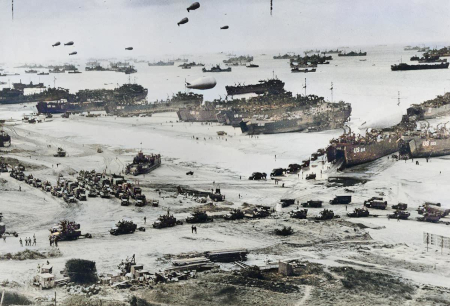
First, he makes the reader aware of the incredible scale of the invasion, the “vast plan,” as Stalin described it. Repeatedly he quotes the wonder and awe of participants — American, French, and German — in looking out over the Channel and seeing the entire ocean covered with ships of all sizes, and the sky above filled with planes too numerous to count. And before Ambrose even begins describing the actual events of June 6th, he spends ten fascinating chapters describing the epic planning required to make the arrival of that armada possible.
Second, he places the story in the context of the individuals who did it. In every case he tells the story from the point of view of the people involved. Ambrose has no interest in grand economic or social movements. His focus is to tell a human story, sometimes tragic, heart-rending, and horribly violent, and sometimes uplifting and joyful.
Third, in doing this so well Ambrose shows us the incredible and incomprehensible courage of the men who stormed that beach on June 6th. The first boats at every beach faced high causalities. At Omaha beach it was even worse, with the surviving soldiers pinned down for hours. Yet in every case, these men brushed themselves off and moved on. All followed the American way of war established by Washington and underlined by Grant: Never retreat, attack relentlessly, and demand unconditional surrender.
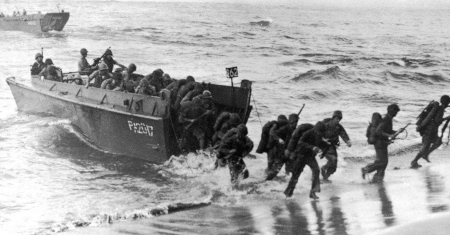
Storming the beach, under withering fire
For example, at Omaha it appeared before the day was out that the attack had failed. At one point Omar Bradley recalled the boats moving toward shore because the previous landings had failed to get off the beach and had left it jammed with the dead and the wounded, surrounded by damaged and destroyed vehicles, tanks, and equipment. Yet, the surviving troops on shore, huddled against the sea wall where machine gun fire couldn’t reach them, eventually marshaled the courage to climb that wall and get at German positions to silence them. By the end of the day the beach was taken, and the military was moving tens of thousands of troops into France.
The same courage was exhibited by the Americans, British, and Canadians at other beaches. They pushed on, despite seeing friends cut down around them. Some pushed on even when wounded. The invasion had to succeed. It was the only way Europe could be liberated from the Nazis, and the American dream of freedom and the pursuit of happiness could be secured for later generations.
This last point is the most important, considering the ignorance of too many younger people today about America’s honorable history, stained by the slanders of our corrupt and bankrupt leftist academia. All they know is the lie that America is evil and a oppressor, when in fact, when the U.S. invaded other countries it almost always came to liberate, not rule. It is why the French immediately celebrated. They knew their history, and they knew the Allied invasion would free them from tyranny.
So this is one book I recommend highly and without reservation. Give to your high school kids. Get them to read. Their lives will be enriched, because they will discover they come from a grand heritage.

On Christmas Eve 1968 three Americans became the first humans to visit another world. What they did to celebrate was unexpected and profound, and will be remembered throughout all human history. Genesis: the Story of Apollo 8, Robert Zimmerman's classic history of humanity's first journey to another world, tells that story, and it is now available as both an ebook and an audiobook, both with a foreword by Valerie Anders and a new introduction by Robert Zimmerman.
The print edition can be purchased at Amazon or from any other book seller. If you want an autographed copy the price is $60 for the hardback and $45 for the paperback, plus $8 shipping for each. Go here for purchasing details. The ebook is available everywhere for $5.99 (before discount) at amazon, or direct from my ebook publisher, ebookit. If you buy it from ebookit you don't support the big tech companies and the author gets a bigger cut much sooner.
The audiobook is also available at all these vendors, and is also free with a 30-day trial membership to Audible.
"Not simply about one mission, [Genesis] is also the history of America's quest for the moon... Zimmerman has done a masterful job of tying disparate events together into a solid account of one of America's greatest human triumphs."--San Antonio Express-News