
Trump administration cancels lunar rover mission

The Trump administration has shut down NASA’s only lunar rover mission that has been under development for four years.

The Resource Prospector mission consisted of a lander and a solar-powered rover equipped with a drill. The rover would have scouted the lunar surface, digging up soil for analysis. Scientists know that water ice exists on the moon, but the Resource Prospector would have provided scientists with a more complete understanding of these deposits.

Although it was not yet fully funded, the Resource Prospector mission had gotten well past the drawing board. Engineers had been working on the project for four years, and prototypes were tested on Earth in 2015 and 2016, according to The Verge. Plans had the mission launching in 2022. [emphasis mine]

What I see is a project with significant management and budgetary problems. Why has it taken four years and two prototypes to test a lunar rover when we have already flown four rovers successfully to Mars? Granted, redesign for the Moon would be necessary, but this development time, plus two prototypes, seems excessive. Furthermore, the article notes how the project was shifted from one NASA department to another, which apparently has caused some budget and management issues..

The project concept is certainly worthwhile and necessary in order to make future lunar colonies possible. I suspect that the cancellation was because the project managers were simply not delivering.

It could also be that this shut down is a tactical move by NASA upper management to force major changes in the project itself, including a complete change in its management. It could also be a political maneuver to force Congress to give the project its full funding, something it lacks as noted by the highlighted words above. Such maneuvers have been played numerous times in the past, with the most famous example the Hubble Space Telescope. NASA management cancelled it during development, knowing that this act would generate publicity that would force Congress to finally give it the funds it needed. The maneuver worked. Congress reinstated Hubble with a full budget, which was exactly what NASA wanted in the first place.
4 comments

Heat shield for 2020 Mars rover cracks during testing

The heat shield to be used during landing by the U.S.’s 2020 Mars rover cracked during recent testing.

The heat shield’s structural damage, located near the shield’s outer edge, happened during a weeklong test at the Denver facility of contractor Lockheed Martin Space, according to a NASA statement released Thursday (April 26). The test was intended to subject the heat shield to forces about 20 percent greater than those it will experience when it hits the Martian atmosphere for entry, descent and landing operations.

The Mars 2020 team found the fracture on April 12. Mission management at NASA’s Jet Propulsion Laboratory in Pasadena, California, will work with Lockheed Martin to lead an examination of the cause of the crack and to decide if any design changes should be made, NASA officials said in the statement.

They do not expect this issue to cause them to miss the 2020 launch window. However, it is astonishing that the heat shield should fail in this manner. First, to save development costs this rover was essentially a rebuild of Curiosity. The new heat shield should have been the same design, and thus should have already been proven capable of surviving this test. Second, Lockheed Martin has been making heat shields of all kinds for decades. This is not cutting edge technology.

Third, note that Lockheed Martin is building Orion, and it also experienced cracks in the capsule’s structure (not its heat shield) during manufacture and testing.

Overall, these facts suggest that some fundamental manufacturing error has occurred, and that there might also be a quality control problem at Lockheed Martin.

6 comments

Katie Mullins – A Disney Love Song Medley (on the ukulele)

An evening pause: In order, “Kiss the Girl” (The Little Mermaid), “Can You Feel the Love Tonight” (The Lion King), “A Whole New World” (Aladdin), “I See the Light” (Tangled), and “You’ll Be in My Heart” (Tarzan), and then finishing with a reprise of “A Whole New World.” All good songs, but to my ear, it is very clear that “A Whole New World” stands out.

And the singer is really joyous.

Hat tip Jim Mallamace.

2 comments

The thin dense crust of Mercury

Using data gathered by the MESSENGER spacecraft while it was in orbit around Mercury, scientists now estimate that the planet’s crust is thinner than previously believed, 16 miles thick rather than 22 miles.

The crust is also as dense as aluminum. It is also the thinnest crust, relative to the planet’s core, of any rocky planet in the solar system.

Mercury’s core is believed to occupy 60 percent of the planet’s entire volume. For comparison, Earth’s core takes up roughly 15 percent of its volume. Why is Mercury’s core so large?

“Maybe it formed closer to a normal planet and maybe a lot of the crust and mantle got stripped away by giant impacts,” Sori said. “Another idea is that maybe, when you’re forming so close to the sun, the solar winds blow away a lot of the rock and you get a large core size very early on. There’s not an answer that everyone agrees to yet.”

There appears to be a great deal of uncertainty to these conclusions, and I would not be surprised if these conclusions change with the arrival of more data.

2 comments

Mars rover update: April 27, 2018

Summary: Curiosity’s exploration of Vera Rubin Ridge is extended, while an attempt by Opportunity to climb back up Perseverance Valley to reach an interesting rock outcrop fails.

For a list of past updates beginning in July 2016, see my February 8, 2018 update.

Curiosity

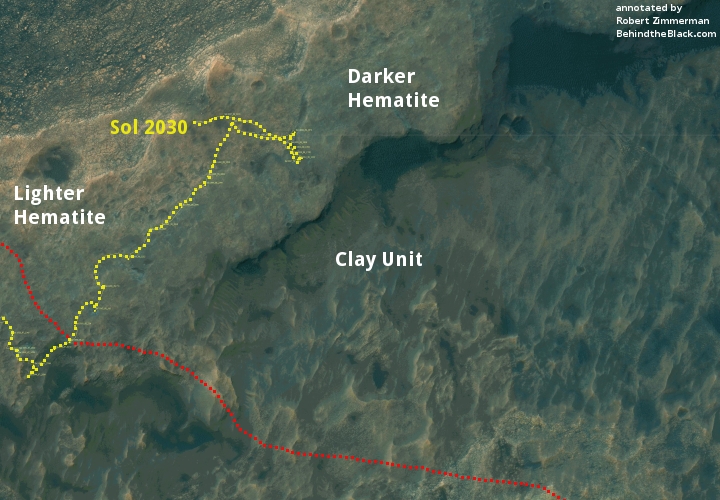
Curiosity's traverse map, Sol 2030

For the overall context of Curiosity’s travels, see Pinpointing Curiosity’s location in Gale Crater.

Since my March 21, 2018 update, it has become apparent that the Curiosity science team has decided to extend the rover’s research on Vera Rubin Ridge far beyond their original plans. They have continued their travels to the northeast well past the original nominal route off the ridge, as indicated by the dotted red line on the traverse map above. Along the way they stopped to inspect a wide variety of geology, and have now moved to the north and have actually begun descending off the ridge, but in a direction that takes the rover away from Mount Sharp and its original route. As noted in their April 25 update,
» Read more

1 comment

Big earthquake in South Korea linked to geothermal power plant

South Korea’s second largest earthquake has now been linked by two different studies to the injection of water deep below the surface at a new geothermal power plant.

Perched on South Korea’s southeast coast and far from grinding tectonic plates, Pohang is an unlikely spot for a big earthquake. Before the geothermal plant’s two wells were drilled, there had never been an earthquake there of any significance, says Kwanghee Kim, a seismologist at Pusan National University in Busan, South Korea, and lead author of one study. But while Kim was monitoring the aftermath of an unrelated earthquake in 2016, he began to detect rumbles from Pohang. That prompted his lab to deploy eight temporary seismic sensors at the site, which were finally in place on 10 November 2017. He expected any quakes to be small—after all, the largest previous quake tied to enhanced geothermal power, in Basel, Switzerland, was just 3.4 in magnitude.

It took only 5 days to be proved wrong. “The Pohang earthquake was larger than any predicted by existing theories,” Kim says. Although some initial measures placed the source of the quake several kilometers away from the plant, Kim’s network revealed that the earthquake, and several of its foreshocks, all began right below the 4-kilometer-deep well used to inject water into the subsurface to create the plant’s heating reservoir. Indeed, it appears likely that the well’s high-pressure water lubricated an unknown fault in the rock, causing it to slip and triggering the quake, Kim says.

A second paper, by European scientists who used regional seismic data, reinforces the South Korean team’s results, in particular its shallow depth. That study also points out that an earlier 3.1-magnitude earthquake also took place near the well bottom, increasing the odds of a common source. Satellite measures of shifts in the surface after the November 2017 quake support that idea, says Stefan Wiemer, the second study’s lead author and director of the Swiss Seismological Service in Zurich. It’s clear the locked fault was storing energy that was waiting to be released, Wiemer says. “If that fault would have gone next Tuesday or 50 years from now, we’ll never know.”

The article notes that scientists had previously concluded that injecting water underground for geothermal purposes was okay (since it reduced use of fossil fuels) while doing the same for fracking (to obtain and use fossil fuels) was bad.. The data here actually suggests just the reverse, since fracking has never produced an earthquake as large as the 5.5 magnitude Pohang quake.

3 comments

China aims to reuse vertically-landed first stages by 2020

One of China’s top space engineers said this week at a conference that they are aiming to reuse vertically-landed first stages by 2020 on a new Long March 8 rocket.

At an aerospace industry seminar on Tuesday, leading Chinese carrier rocket designer Long Lehao said that China is expected to realize vertical recycling – similar to the technology employed by US-based firm SpaceX – by 2020 at the earliest on its CZ-8 rockets. This will further lower the price tag of a launch and boost China’s chances of getting international commercial satellite launch orders, the CCTV report said.

Lan Tianyi, founder of Beijing-based Ultimate Blue Nebula Co, a space industry consultancy, said China will become the second rocket power to have this capacity, putting the country ahead of Russia and the EU. However, Lan said that while the aim of recycling rockets is to reduce costs for launch operators, whether this can be achieved remains to be seen.

The recycled rockets developed by SpaceX are reported to have helped the company reduce launch costs by as much as 30 percent, according to media reports.

“There is no way to verify SpaceX’s claim, as it is the only company that owns the technology, and China has to wait for the moment when it has successfully recycled a rocket to see whether the costs can be lowered,” Lan told the Global Times on Thursday.

Right now, the politics in China are extremely favorable for space development, with so many top posts occupied by former space managers. Thus, it seems reasonable to believe that the country is investing the cash necessary to develop rocket stages that can land vertically. If they do it, they will put themselves in a strong position for future space colonization, because such technology is essential for landing spacecraft on other worlds. Right now, only the U.S. has done this repeatedly and successfully.

1 comment

Summit between leaders of North and South Korea began today

The first summit in more than a decade between the leaders of North and South Korea began today.

The two leaders are meeting at Peace House, south of the demarcation line in the border truce village of Panmunjom.

Kim is the first North Korean leader to step foot in South Korea since the 1950-53 Korean War, and the two leaders are expected to discuss issues relating to peace and denuclearisation of the Korean peninsula.

The two leaders smiled and shook hands after which Kim gestured to Moon to cross over to North Korea briefly, which they did for a few steps, then returned to the South, holding hands.

Though no one should trust much of what Kim says or does, this summit is certainly a testament to the foreign policy of Donald Trump. During the Obama administration, all we had from North Korea were nuclear tests and threats of war, with the U.S. weakly responding with typically empty diplomatic statements of “serious concern.”

Now Kim is signing the guest register in South Korea like so: “New history starts now; age of peace, from the starting point of history.” Trump forced his allies, most specifically China, to put pressure on him, and it has apparently had a positive effect.

16 comments

Short movie from Rosetta of Comet 67P/C-G

A search by a Twitter user of the Rosetta archive from its visit to Comet 67P/C-G has produced a very short movie of the comet’s surface.

The bright dots travelling from the top of the frame to the bottom, which look something like snow, are in fact background stars. They have that apparent motion as the spacecraft moves and the comet rotates. The more rapidly moving streaks are thought to be dust particles illuminated by the Sun. There also appear to be a few streaking cosmic rays.

Take a look. The twelve second movie gives a flavor of what it would be like to walk that comet’s surface.

4 comments
1 107 108 109 110 111 155