
SpaceX using up old used boosters as it shifts to final Falcon 9 design

Capitalism in space: As SpaceX prepares to introduce its final Falcon 9 design, dubbed Block 5, it also plans to use up its stock of old used boosters, with four of the six launches scheduled through the end of April using previously flown boosters.

The article’s review of SpaceX’s stock suggests that the company will only have two used boosters after these launches. It also notes that the company appears to have decided that these earlier Falcon 9 designs can only fly two or three times safely, and that it will be the Block 5 final design that they hope will finally be the booster that can fly repeatedly and reliably.

Since NASA won’t let astronauts fly on anything other than Block 5, and insists it fly at least seven times successfully before the agency will allow its astronauts on it, SpaceX has a lot at stake with this final design. If it has problems, the company will be in trouble. If not, the company will cement the dominate position it presently holds in the launch industry.
7 comments

Failure history of the Russian launch industry

Doug Messier has compiled a detailed and what appears to be a complete list of all Russian/Soviet launch failures going back to 1988. As he says, “Launch failures are not a bug in the system, they’re a feature.”

What struck me most about his graph is the number of Soyuz rocket failures. For decades, various versions of this rocket have been used to bring astronauts up to either Mir or ISS, and because there have not been any launch failures during those manned launches, the impression given is that the Soyuz is one of the most reliable rockets in existence. Messier’s table proves that impression false, and also tells us that the Russians, and the United States, have been very lucky that no lives have been lost in the past three decades on any Soyuz launches.

The table also illustrates why commercial customers have been so quick to shift their business from the Russians to SpaceX. The Russians have not provided a very good or reliable product. Since 1988 there have only been two years, 2001 and 2003, in which the Russians had no failures. And the table indicates that their failure rate has increased in the past decade.

5 comments

India delays Chandrayaan-2 six months

Because engineers wished more time, India has delayed the launch of its second unmanned Moon mission, Chandrayaan-2, from April to October.

Union Minister of State in the Prime Minister’s Office, in-charge of the Department of Space, Jitendra Singh had on 16 February last said the lunar mission under which the Isro will for the first time attempt to land a rover on the moon’s south pole, will be launched in April.

Sivan (head of ISRO) had earlier said the window to launch the Rs800 crore mission was between April and November 2018. While the “targeted date” was April, Isro would launch the mission in October or November, he had said.

This is a very ambitious mission, so pushing the launch back to October seems quite reasonable. That they are aiming for the south pole is also smart, especially since NASA has abandoned that location as a target to instead build a giant Potemkin village orbiting the Moon, where it can accomplish nothing.

Posted between Flagstaff and Phoenix as we head back from a very successful four-day caving expedition in the Grand Canyon.

1 comment

Congress pumps pork money to NASA in omnibus budget

The omnibus budget that Congress plans to pass this week for 2018 gives NASA $20.7 billion, significantly more than requested and funding almost every pork project Congress could conceive of, including a second mobile launcher for SLS.

The budget gives SLS and Orion more than $3 billion, funds all the Earth science and education projects the Trump administration wished to cut, as well as WFIRST, which the Trump administration wants to cancel because of cost overruns. In general, the NASA budget is a microcosm of the entire spending bill, which does nothing to cut any program anywhere, including Obamacare and a number of liberal programs that the Republicans have repeatedly promised to shut down, until they are in a position to do so. Then they act like leftist Democrats and fund everything.

This is posted between Tucson and Phoenix. I am heading up to the Grand Canyon for a four day cave expedition, which is why I can’t do a more thorough analysis. This really isn’t necessary however, as it is very clear that the Republican leadership in Congress are continuing their corrupt passion for spending money that does not exist. And they wonder why they may lose seats in 2018.

38 comments

Mars rover update: March 21, 2018

Summary: Curiosity continues its exploration of Vera Rubin Ridge, including several drilling attempts. Opportunity is halfway down Perseverance Valley.

For a complete list of all past updates going back to July 2016, see my February 8, 2018 update.

Curiosity

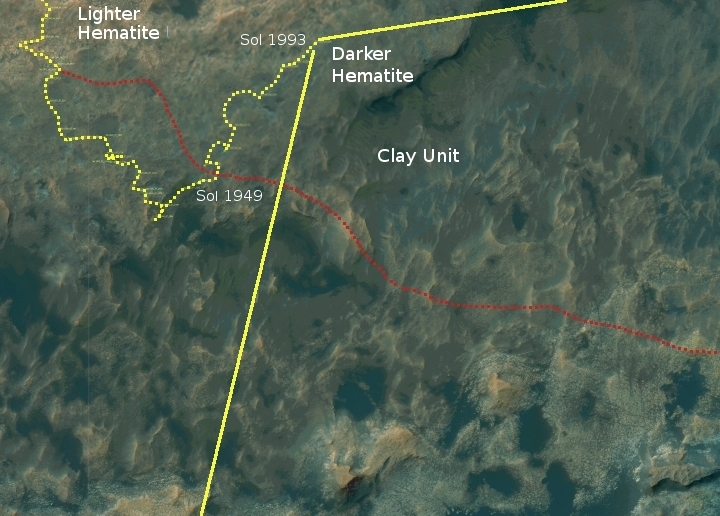
Curiosity's traverse map, Sol 1993

For the overall context of Curiosity’s travels, see Pinpointing Curiosity’s location in Gale Crater.

Since my February 8, 2018 update, the Curiosity science team has apparently been loath to leave Vera Rubin Ridge. They had begun the trek to the northeast that would take them towards the exit ridge heading to the southeast, as indicated by the dotted red line on the traverse map above, but then continued past that planned route to continue to the northeast. Along the way they attempted to drill twice using an improvised approach that they hoped would bypass the drill’s stuck feed mechanism, without apparent success.

The panorama below is looking to the west and south, as indicated by the yellow lines in the image above.
» Read more

4 comments

SpaceX’s August launch created largest shockwave from rocket ever measured

The August launch by SpaceX of a communications satellite created the largest rocket shockwave in the atmosphere ever measured.

In the new study, Lin and his colleagues used GPS signals to determine how the FORMOSAT-5 launch affected the upper atmosphere. They found Falcon 9’s vertical trajectory created a circular shock wave above the western United States that had never before been seen from a rocket launch. The only similarly-shaped shock wave Lin had seen was from an eruption of Russia’s Sarychev volcano in June 2009.

Not only was the shock wave circular, it was also the largest one Lin had ever seen – roughly four times the area of California. In the new study, he ran computer simulations of rocket launches and found the momentum from a vertical trajectory would tend to create a much stronger atmospheric disturbance than a curved one, which could explain why the shock wave was so large.

In addition to creating a gigantic shock wave, the launch created a hole in the ionosphere above California. Water vapor in the rocket’s exhaust reacted with the ionosphere’s charged particles to create a hole in the plasma layer that took up to two hours to recover.

The rocket’s vertical trajectory was because the overall payload was light. Heavier payload cause the trajectory to curve more as the rocket rises.

5 comments

The mysterious upcoming commercial launch in Alaska

Link here. The article takes a detailed look to try to find out the unnamed commercial company behind the mid-April launch, and learns that it will be a suborbital launch, and that the company might be one called Astra Space.

Alaska Aerospace signed a contract with Astra Space in 2017 to support launches of that company’s vehicle from PSCA, according to the minutes of an Alaska Aerospace board of directors meeting in August 2017.

Alaska Aerospace “has a contract with Astra to support the first four launches of their small liquid fuel commercial launch vehicle from PSCA. The first launch is planned for December 2017,” the minutes state. It added that it would be the first liquid-propellant launch from the spaceport, which previously had hosted only solid-fuel rockets. “This will be a very innovative launch.”

Minutes from a Nov. 2 meeting of the Alaska Aerospace board stated that “Astra is moving forward” with plans, holding weekly planning teleconferences and paying a $100,000 deposit for a launch date. That launch was planned at that time for “possibly February or later.”

It appears the company is doing work for both NASA and DARPA, the latter of which might explain the secrecy. Or maybe the company is taking the Blue Origin approach, keeping things close to the vest until they are sure of success.

0 comments
1 121 122 123 124 125 155