
Justice Dept inspector general to review FISA abuses

Progress? Justice Department inspector general Michael Horowitz announced today that he has initiated a full review of the suspected FISA abuses that took place at both the FBI and the Justice Department that allowed the Obama administration to spy on the Trump campaign during the election, and were subsequently used to initiate the Mueller special counsel investigation.

The Office of the Inspector General released a statement Wednesday outlining the start of the review. “The OIG will initiate a review that will examine the Justice Department’s and the Federal Bureau of Investigation’s compliance with legal requirements, and with applicable DOJ and FBI policies and procedures, in applications filed with the U.S. Foreign Intelligence Surveillance Court (FISC) relating to a certain U.S. person,” the statement obtained by Fox News read. “As part of this examination, the OIG also will review information that was known to the DOJ and the FBI at the time the applications were filed from or about an alleged FBI confidential source.”

The OIG statement added that Horowitz also would “review the DOJ’s and FBI’s relationship and communications with the alleged source as they relate to the FISC applications.” The statement continued, “If circumstances warrant, the OIG will consider including other issues that may arise during the course of the review.”

It must be noted that Horowitz was appointed by Obama. It must also be noted that this review leaves many of the highest officials of both the FBI and Justice very exposed, considered what we know now about how they misused the FISA courts.

The bottom line remains: until someone from the Democratic Party, the Obama administration, or their allies in the administrative state actually get charged with a crime, they will be getting off scot-free, and will continue to pose a threat to the American democratic process and future elections.

One positive sign today: Justice Dept. charges Minnesota FBI agent for leaking secret document to news outlet This story suggests that Sessions might be serious about tracking down those in his department that are leaking classified information to the press.
5 comments

Hubble finds galaxy with no evidence of dark matter

The uncertainty of science: Using the Hubble Space Telescope astronomers have discovered a nearby galaxy that apparently has little or no evidence of dark matter.

The unique galaxy, called NGC 1052-DF2, contains at most 1/400th the amount of dark matter that astronomers had expected. The galaxy is as large as our Milky Way, but it had escaped attention because it contains only 1/200th the number of stars. Given the object’s large size and faint appearance, astronomers classify NGC 1052-DF2 as an ultra-diffuse galaxy. A 2015 survey of the Coma galaxy cluster showed these large, faint objects to be surprisingly common.

But none of the ultra-diffuse galaxies discovered so far have been found to be lacking in dark matter. So even among this unusual class of galaxy, NGC 1052-DF2 is an oddball.

Van Dokkum and his team spotted the galaxy with the Dragonfly Telephoto Array, a custom-built telescope in New Mexico they designed to find these ghostly galaxies. They then used the W.M. Keck Observatory in Hawaii to measure the motions of 10 giant groupings of stars called globular clusters in the galaxy. Keck revealed that the globular clusters were moving at relatively low speeds, less than 23,000 miles per hour. Stars and clusters in the outskirts of galaxies containing dark matter move at least three times faster. From those measurements, the team calculated the galaxy’s mass. “If there is any dark matter at all, it’s very little,” van Dokkum explained. “The stars in the galaxy can account for all the mass, and there doesn’t seem to be any room for dark matter.”

The galaxy is unusual in many other ways.

The Hubble images also revealed the galaxy’s unusual appearance. “I spent an hour just staring at the Hubble image,” van Dokkum recalled. “It’s so rare, particularly these days after so many years of Hubble, that you get an image of something and you say, ‘I’ve never seen that before.’ This thing is astonishing: a gigantic blob that you can look through. It’s so sparse that you see all of the galaxies behind it. It is literally a see-through galaxy.”

The ghostly galaxy doesn’t have a noticeable central region, or even spiral arms and a disk, typical features of a spiral galaxy. But it doesn’t look like an elliptical galaxy, either. The galaxy also shows no evidence that it houses a central black hole. Based on the colors of its globular clusters, the galaxy is about 10 billion years old. Even the globular clusters are oddballs: they are twice as large as typical stellar groupings seen in other galaxies.

The bottom line here is that we have only circumstantial evidence that dark matter exists, based solely on the fact that in all other measured galaxies, the outer stars rotate much faster than they should. That rotation speed however does not guarantee the existence of dark matter, only that something is causing the fast rotation. And the lack thereof in this galaxy puts a big crimp in the theory that dark matter exists, since the theories that posit its existence almost require it to be present in every galaxy.

4 comments

The James Webb Telescope: a signpost for identifying fake news sources

The news yesterday that NASA will once again have to delay the launch of the James Webb Space Telescope due to a variety of technical issues and management errors not only exemplified the fundamental failure of the federal government, it also illustrated the routine failures of today’s mainstream press.

First, Webb’s new delay epitomizes the systemic incompetence of Washington. Despite being 13 years behind schedule and costing eight times more than originally planned, NASA and its contractors still couldn’t get things right.

Most of the problems have occurred with the spacecraft half of the project, which was built by Northrop Grumman in California and is undergoing testing there. During the teleconference, NASA officials, including acting Administrator Robert Lightfoot, expanded upon technical problems first reported publicly by the agency’s inspector general last month.

These include leaky valves within the spacecraft’s propulsion system and difficulties encountered during deployment tests of the sun shield. Not only did the thin, five-layer sun shield snag during the deployment, but technicians also found seven tears up to 10cm long within the material. NASA and Northrop Grumman have identified fixes for these problems, but their repair has added months of delays to the project, and engineers cannot be sure that more issues will not crop up during further testing.

Such failures, in NASA and in all big federal projects in recent years, are hardly news. Only the willfully blind or those who support wasting tax dollars to distribute pork will deny they exist.

The failures of the federal government however is not the focus of this essay. Instead, the announcement yesterday and the coverage of it by the press provides us a perfect and very obvious signpost for differentiating between the fake news sources that are generally unreliable or too often allow their biases to influence their reporting, and those sources that do a good job.

That signpost is one simple fact: Webb is not a replacement or successor to the Hubble Space Telescope, despite NASA making this false claim for decades. Hubble is an optical telescope. Webb will view the universe in the infrared. These are too entirely different things.

Yet, too many news sources today repeated NASA’s false claim, illustrating how little they know about both telescopes and their design, while revealing their complete inability to do some basic journalistic research. Instead they merely rewrite old press releases, and thus prove clearly by their bad reporting why so many people have so little respect for the modern press.

The worst examples made this false claim right in the headline:
» Read more

7 comments

Tiangong-1 reentry window narrowed to 24 hours centered on April 1st

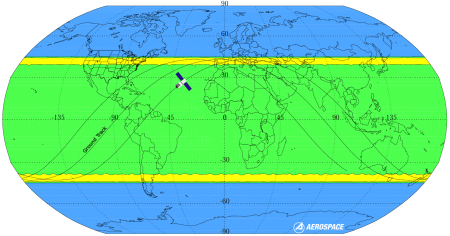
Tiangong-1 landing possibilities

The reentry window for Tiangong-1 has now been narrowed to 24 hours, centered on April 1st. It is still too soon, however, to determine where it will land. The map on the right shows the likeliest regions in yellow, the next likeliest in green, and areas with no chance of impact in blue.

The focus so far has been on where the surviving pieces of Tiangong-1 might land. The summary at the link notes that it also will provide an interesting fireworks display.

It may be possible to see Tiangong-1 reentering depending on your location, the time of day, and visibility during reentry which will not be known until a few days prior to the event…. Visibly incandescent objects from this reentry will likely last tens of seconds (up to a minute or more) in contrast with the vast majority of natural meteors which last mere seconds.

…Depending on the time of day and cloud visibility, the reentry may appear as multiple bright streaks moving across the sky in the same direction. Due to the relatively large size of the object, it is expected that there will be many pieces reentering together, some of which may survive reentry and land on the Earth’s surface.

The spacecraft does carry toxic hydrazine fuel, so if by some miracle a piece falls near you don’t touch it.

4 comments

First commercial crew flights still set for 2018 with chance of delay

NASA’s manager of the commercial crew program provided an update to the agency’s advisory board on Monday, noting that both SpaceX and Boeing are making good progress to their scheduled first flights late this year.

The bottom line however is that there is a good chance the flights will slip into 2019, though based on the update it appears to me that the flights will not slip that much beyond that.

2 comments

Evergreen State College suspends new dorm construction due to drop in enrollment

You reap what you sow: Evergreen State College has suspended construction of a new dorm because enrollment at the radical leftist college has plunged.

Evergreen State College is still paying the price for allowing far-left students to run rampant on campus last spring. Friday the Olympian reported that the school had decided to put off plans for a $42 million replacement dormitory out of concern that declining enrollment could make it difficult to handle the new debt. In fact, it wasn’t just Bridges who recommended putting this off, it was the bonding company that would raise the money.

And why have they made this decision?

Last fall Evergreen’s enrollment dropped by about 200 students or 5 percent. That drop was partly responsible for a $2.1 million budget deficit which necessitated a hiring freeze at the school. At the time, the school was rather optimistically predicting the downturn for the following year would be smaller. However, last month President Bridges predicted enrollment for 2018 could drop by as many as 700 students or 18.5 percent.

The attendance drop will continue as long as the college’s administration continues to deny the existence of the school’s racist and leftist politically correct culture.

0 comments

Webb telescope delayed again to 2020

NASA has announced that it is once again delaying the launch of the James Webb Space Telescope, from 2019 to 2020.

The observatory was supposed to fly this year. But last fall, NASA bumped the launch to 2019. NASA announced the latest delay on Tuesday. “We have one shot to get this right before going into space,” said Thomas Zurbuchen, NASA’s associate administrator of science. He said some mistakes were made while preparing the telescope, and NASA underestimated the scale of the job. [emphasis mine]

None of this is a surprise. Webb is more pork than science. It was originally budgeted at $1 billion, with a planned launch in 2011. It will now cost more than $9 billion, and be delayed almost a decade. Since the project began in the early 2000s, by the time it launches it will have been in development for almost two decades, which is almost a lifetime career for some people.

And note, the article includes the lie that Webb is “a successor to the Hubble Space Telescope.” It is not. Hubble is an optical telescope. Webb will only look in the infrared. These are very different things.

8 comments

NASA chief argues against purchasing Falcon Heavy over SLS

When asked at a meeting of a NASA advisory council meeting why NASA doesn’t buy a lot of Falcon Heavies instead of building a few SLS rockets, NASA chief of human spaceflight Bill Gerstenmaier argued that only the SLS could launch the large payloads NASA requires to establish its Lunar Orbiting Platform-Gateway (LOP-G).

Gerstenmaier then said NASA’s exploration program will require the unique capabilities of the SLS rocket. “I think it’s still going to be large-volume, monolithic pieces that are going to require an SLS kind of capability to get them out into space,” he said. “Then for routine servicing and bringing cargo, maybe bringing smaller crew vehicles other than Orion, then Falcon Heavy can play a role. What’s been talked about by [Jeff] Bezos can play a role. What United Launch Alliance has talked about can play a role.”

The problem with this argument is that the “large-volume, monolithic pieces” Gerstenmaier proposes don’t exist yet, either in design or in budget. NASA could very easily design LOP-G’s pieces to fit on Falcon Heavy, and then use it. Instead, they are purposely creating a situation where SLS is required, rather than going with the most cost effective solution.

Unless someone in power, such as a president, puts his foot down and demands NASA do this intelligently, I expect NASA to accomplish nothing significant in manned space in the next decade. That does not mean Americans will be trapped on Earth, only that NASA will not be the way they will get off the planet. And unfortunately, based on the most recent budget passed by Congress and signed by Trump, I do not expect this president to do anything to change things. Right now, NASA is being run by the big contractors (Boeing and Lockheed Martin) that need SLS and Orion, and thus NASA is going to give them a lot of money to build things that we can’t afford and can do nothing to put Americans in space.

14 comments

Tabby’s Star dims again

Scientists studying Tabby’s Star have revealed that it suddenly dimmed last week, the most since 2013, and then just as quickly returned almost to normal.

The latest dimming event started with a slow decline and ended with a rapid increase in brightness, Boyajian and her team wrote on their blog. Dust from a backward comet tail and then larger chunks from the broken-up body would explain that uneven pattern.

At this time the evidence clearly points not to alien megastructures but to clouds of fine dust whose structure and origin remain puzzling.

1 comment

Tiangong-1 re-entry narrowed to four days centered on April 1

Tiangong-1's likely landing locations

China’s first space station, Tiangong-1, is now predicted to crash to Earth in a window that has been narrowed to four days centered on April 1. The map to the right shows the station’s most likely landing areas, with yellow the most likely, green less likely, and blue not at all. Essentially, there is about a 50-50 chance the station will come down in the north mid-latitudes, with about a 70 percent chance it will land in water if it does so.

Thus, the odds of the station hitting a populated area is not large, but it definitely exists. We will not know the exact area of impact until very close to the moment the station finally comes down.

3 comments
1 120 121 122 123 124 155