How fast do things change on Mars?

Looking for dune changes on Mars

On Earth, it is assumed that in a period of a dozen years a sand dune would change significantly. Wind and rain and the yearly cycle of the seasons would work their will, reshaping and moving the dune steadily from one place to another.

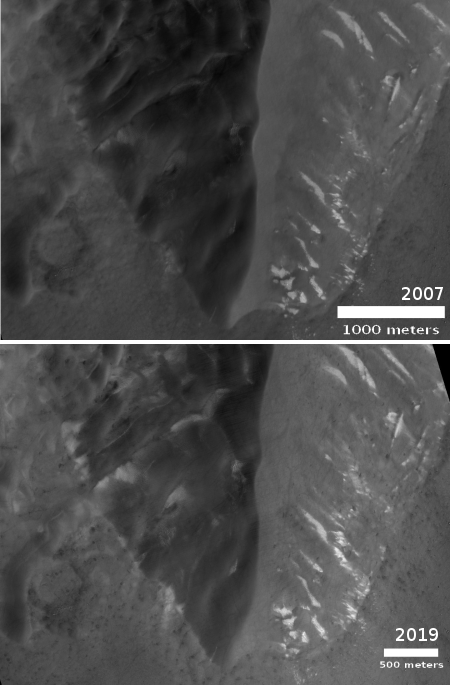
On Mars, we would be reasonable to expect the same. Yet, this might be a mistake, as illustrated by the two images on the right, taken by cameras on Mars Reconnaissance Orbiter (MRO) a dozen years apart of the same large dune located in a crater far to the south in the planet’s southern highlands. Both images have been cropped and reduced in resolution to show here. For the full images, go here for 2007 and here for 2019.

The top image was taken October 31, 2007 by MRO’s context camera. The bottom image was taken on January 29, 2019 by MRO’s high resolution camera. Though the context camera does not have the resolution of the high resolution camera, the difference is of less significance in this context.

Have things changed? Putting aside lighting differences, it does appear that the white patches have changed slightly in a variety of places. There also might be changes in the small dunes on the left of the image, at the base of the large central dune.

The white patches are probably what interests the scientists who requested the second image. Could this be snow or frost, as is thought to exist in other places? There are studies [pdf] that expect ice to exist inside craters near the south pole. Identifying changes here would help answer this question.

Overall, however, not much is different. Though dunes definitely change on Mars, they do so much more slowly than on Earth. And in some cases what look like dunes are not really dunes at all, but a form of cemented sandstone, exhibiting even fewer changes over long time spans.

I do not know if these dunes are of sand or sandstone. What the two images reveal is that in either case, things do not change on Mars at the same pace as they do on Earth. Even after three Martian years, the thin Martian atmosphere simply doesn’t have the same energy as on Earth, even though it can move things easier in the weak gravity.

While the pole caps of Mars change a lot seasonally, the rest of the planet evolves very slowly. Mars is no longer an active planet like the Earth. It is, in many ways, a dead planet, once alive with activity but now silent and relatively quiet.
0 comments

Rivers on Mars?

The uncertainty of science: A new study of Martian geology suggests that rivers ran on the surface are longer and later in the planet’s history than previously thought.

Seeking a better understanding of Martian precipitation, Kite and his colleagues analyzed photographs and elevation models for more than 200 ancient Martian riverbeds spanning over a billion years. These riverbeds are a rich source of clues about the water running through them and the climate that produced it. For example, the width and steepness of the riverbeds and the size of the gravel tell scientists about the force of the water flow, and the quantity of the gravel constrains the volume of water coming through.

Their analysis shows clear evidence for persistent, strong runoff that occurred well into the last stage of the wet climate, Kite said.

The results provide guidance for those trying to reconstruct the Martian climate, Kite said. For example, the size of the rivers implies the water was flowing continuously, not just at high noon, so climate modelers need to account for a strong greenhouse effect to keep the planet warm enough for average daytime temperatures above the freezing point of water.

The rivers also show strong flow up to the last geological minute before the wet climate dries up. “You would expect them to wane gradually over time, but that’s not what we see,” Kite said. The rivers get shorter—hundreds of kilometers rather than thousands—but discharge is still strong. “The wettest day of the year is still very wet.”

They also found that these rivers had been wider than those seen on Earth, which would make sense if there were few if any plant life to fix the banks in place, as on Earth. The lower Martian gravity probably plays an even larger role in this.

You can read the paper here. The study confirms many other previous studies of Martian surface features, which have repeatedly found evidence that liquid water once existed on Mars. That it found the water flowed later and more extensively only makes more difficult the deeper and probably biggest mystery of Martian geology, however, which is that scientists have not been able to come up with a historic atmospheric model that would allow that liquid water to exist. Mars today is too cold and its atmosphere is too thin for liquid water to flow, and the evidence from the past does not suggest an atmosphere different enough to change that.

It must have been different, but we don’t know how that was possible, based on the data we presently have. And this study makes solving that mystery even more difficult.

1 comment

Update on the upcoming second Falcon Heavy launch

Link here. The rocket’s three first stages will be Block 5 versions. A static fire dress rehearsal countdown is set for April 1, with the launch scheduled for April 7.

Though the article does not say so, it hints at a number of serious engineering issues discovered during the first Falcon Heavy launch, suggesting to me once again that the success of that launch was somewhat fortuitous. SpaceX has spent the last year correcting those issues in preparation for this launch. Based on the company’s track record, the odds are very high the April 7 launch will be successful.

3 comments

Fresh crater in Martian northern lowlands

Fresh impact crater in northern lowlands
Click for full image.

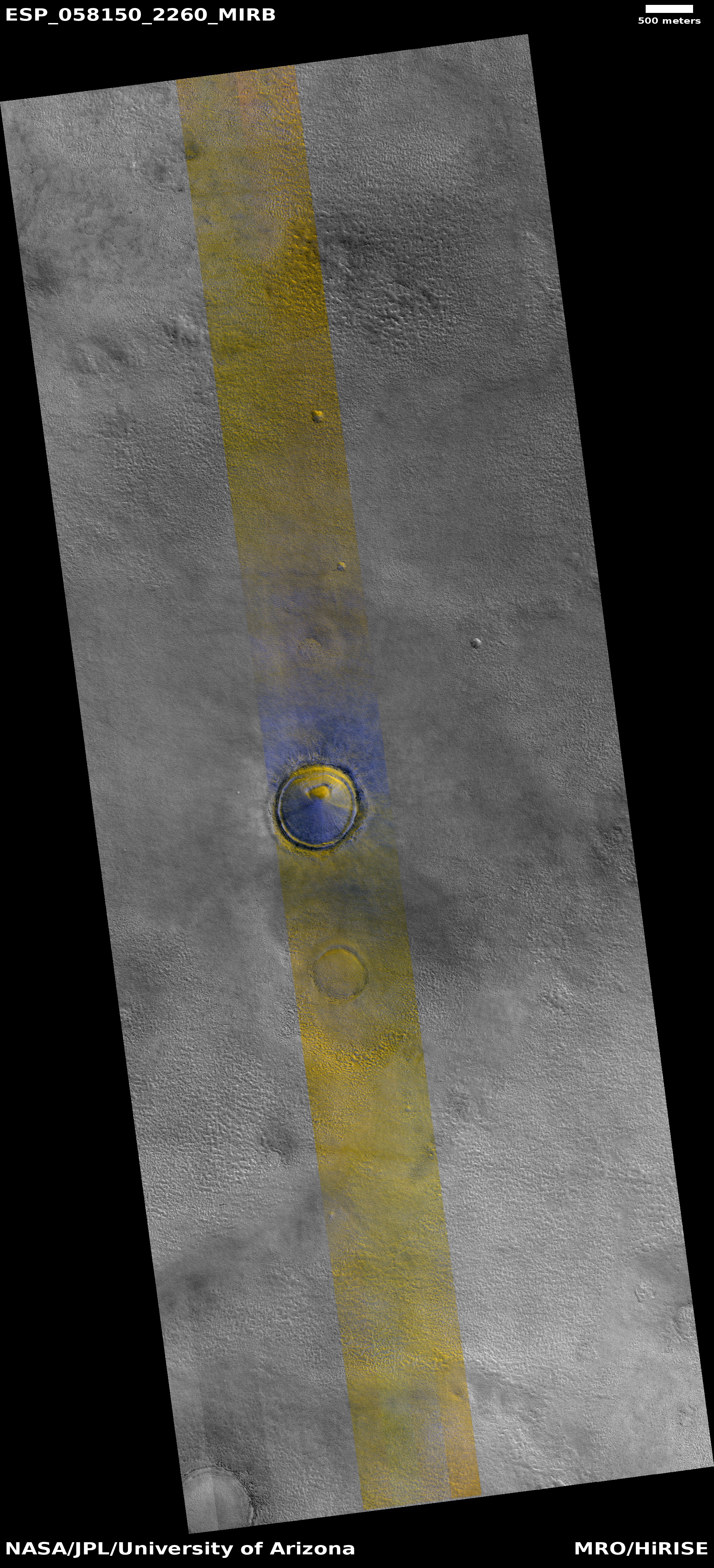
Today’s cool image could be a sequel to yesterday’s. The image on the right, cropped to post here, was one of the many images released from Mars Reconnaissance Orbiter’s (MRO) high resolution camera in March. The release, uncaptioned, calls this a “fresh impact crater.”

In many ways it resembles the craters I posted yesterday, with a splashed look and a crater floor with features that favor the north. Why that divot exists in the northern half of the floor is to me a mystery. The crater floor looks like a sinkhole to me, with material slowly leaking downward at that divot to cause this surface depression. Yet the rim screams impact. And yet, why the double rim? Was this caused by ripples in wet mud when the bolide hit?

Location of fresh impact crater

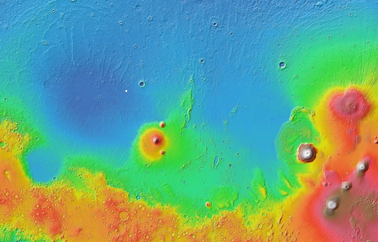
The crater itself is all by itself deep in those northern plains. You can see its location as the tiny white rectangle slightly to the left of the center in the overview image to the right. The giant Martian volcanoes can be seen at the image’s right edge, almost a quarter of a planet away. This is at a very low elevation on Mars, almost as deep as Hellas Basin.

For some fun context, this location is very close to where Viking 2 landed in 1976. The Mars 2020 rover meanwhile will land at this overview image’s left edge, on the western shore of the oval cut into southern highlands at about the same latitude as Olympus Mons, the largest volcano on the right. And InSight and Curiosity sit almost due south, with Curiosity in the yellow in the transition from green to orange, and InSight to the north in the green.

2 comments

Senate rejects Democratic New Green Deal 57-0

The Senate yesterday rejected the Democratic New Green Deal proposal by a vote of 57-0, with 43 Democrats (including Bernie Sanders) voting present.

No senator voted to begin debate on the legislation, while 57 lawmakers voted against breaking the filibuster. Democratic Sens. Doug Jones of Alabama, Joe Manchin of West Virginia and Kyrsten Sinema of Arizona joined 53 Republicans in voting “no.” Sen. Angus King, I-Maine, who caucuses with the Democrats, also voted “no.”

The vote had been teed up by Senate Majority Leader Mitch McConnell, R-Ky., in a bid to make Democratic senators — including several 2020 presidential candidates — go on the record about the measure. McConnell had called the proposal “a radical, top-down, socialist makeover of the entire U.S. economy.”

The speech that Senator Mike Lee (R-Utah) gave prior to the vote is worth watching for every one of its 13 minutes. He describes the substance of this bill quite accurately, and he does so in a most amusing manner.

4 comments

Scientists horrified that Trump wants to require universities to honor free speech

This is not a Babylon Bee story. An article today in the science journal Nature actually expressed outrage and concern about President Trump’s executive order last week tying the grants a university gets to its willingness to protect the free speech of all its students and teachers.

What evil thing did Trump’s order require of these universities? To quote the Nature article itself,

US President Donald Trump signed an executive order on 21 March that requires universities to certify that they protect free speech, or risk losing federal research funds.

Public institutions will have to certify that they are following free-speech protections laid out in the First Amendment of the US Constitution, and private institutions must promise to follow their stated policies on free speech, a White House official told reporters on 21 March.

The order applies to 12 research agencies, including the National Institutes of Health, the National Science Foundation, the Department of Energy and NASA. It affects only money for research, not financial aid for students.

O the horror! The universities will have to show that they support free speech! What a travesty!

The Nature article then proceeded to find quotes from a number of scientists and organizations who oppose Trump’s action. One even claimed that Trump was not trying to protect free speech, “but the enhancement of conservative voices.”

In other words, to these scientists, there is plenty of free speech in academia. Liberals and leftists are all free to say whatever they want. However, any attempt to allow conservatives the right to speak is clearly a biased threat to freedom and must be stopped at all costs. And to threaten their funding because of this? The nerve of that bad orange man!

The intellectual dishonesty exhibited here is mind-boggling. And for it to come from scientists, whose entire field is built on the need for brutal intellectual honesty at all times, is quite appalling.

21 comments

Russians routinely disrupt GPS data in sensitive areas

According to one report, in the past three years the Russians have routinely and successfully fed fake GPS data to units at locations the Russians consider sensitive or of high priority.

The report — published by the Center for Advanced Defense (C4ADS), a nonprofit intelligence firm focused on worldwide security issues — found that at least 9,883 instances of spoofing occurred near sensitive areas in Russia and Crimea and during times when high-ranking officials, such as President Vladamir Putin, were present. In addition, the data showed that spoofing regularly occurred near Khmeimim Airbase in Syria during Russian operations there.

The findings underscore the dangers of relying on global positioning data, such as that provided by the global positioning system and similar technology across the globe, because the service can be disrupted or co-opted to deliver false data, says one author of the C4ADS report, who asked not to be named because of the sensitivity of the topic.

The story also described one case where researchers at the University of Texas in Austin:

were able to build a device for less than $1,000 to spoof the position of a ship and cause it to change course. “The ship actually turned, and we could all feel it, but the chart display and the crew saw only a straight line,” said Todd Humphreys, assistant professor of the department of aerospace engineering and engineering mechanics, at the time.

None of this should surprise anyone. It does however underline the need for there to be alternative navigational systems available. Ship’s crews should have a sextant available and should know how to use it. Missiles and airplanes similarly should have a backup system to check their GPS against.

And hikers and drivers should never totally rely on their GPS. Use it as a map, for guidance, but always verify its suggestions with common sense.

Hat tip reader Stephen Taylor.

6 comments

The National Space Council’s full recommendations

Yesterday’s meeting of the National Space Council resulted in a number of recommendations beyond vice-president Mike Pence’s announcement that the Trump administration is quite willing to dump SLS if it doesn’t get its act together.

First, see this statement by NASA administrator Jim Bridenstine. He outlines the tasks that NASA has now been given, including getting astronauts on the Moon by 2024. Those tasks also require NASA to “[s]tay on schedule for flying Exploration Mission-1 with Orion on the Space Launch System (SLS) rocket next year, and for sending the first crewed mission to the lunar vicinity by 2022.”

This article at SpacePolicyOnline outlines those tasks in more detail, stating that:

NASA will create a Moon-to-Mars Mission Directorate and make all necessary efforts to achieve Exploration Mission-1 no later than 2020 and Exploration Mission-2 no later than 2022. [emphasis mine]

These announcements inadvertently reveal two facts. First, the establishment of a new directorate at NASA is Bridenstine’s attempt to shake up and take control of NASA’s bureaucracy. This will allow him to put people in place that support his agenda.

Will this work? I doubt it. I have watched NASA administrators do this time after time in the past twenty years, with nothing really changing. In a sense, it is really nothing more than rearranging the deck chairs on the Titanic.

Second, they are admitting here (as indicated by the highlighted words) that the first SLS unmanned launch will not happen in June 2020. They have reviewed everything and realized the fastest way to get this launch off is to allow SLS to launch it, but they have also realized that the June date can’t be met. This announcement gives NASA and Boeing an extra six months, to the end of 2020, to get the mission off the ground.

The recommendations also included the release of major suggested changes to streamline how both the State Department and the FAA regulate commercial space. Neither appear to streamline things much. For example, the FAA’s new rule [pdf] on federal commercial space transportation requirements is only 580 pages long. My eyes glazed over as soon as I started reading it. Similarly, the new State Department procedures appear as complex. I haven’t digested either yet, so my pessimism might be unfounded. We shall see.

All in all, the significance of these policy announcements is not so much in the details, all of which illustrate the continuing incompetence and failures of the federal space bureaucracy. What these announcements instead tell us is that the Trump administration is finally attempting the first baby steps for gaining some measure of control over that federal space bureaucracy. It is telling that bureaucracy that it had finally has to do something, or face the consequences.

Whether the administration’s efforts will succeed however remains very questionable. Many in that bureaucracy and in Congress will oppose this effort. They like things as they are, where billions get distributed throughout the country to their friends, and no one is ever required to accomplish anything. And they have managed for the past twenty years to maintain this status quo. It will not be easy to force a change now.

9 comments

India claims it has successfully destroyed a satellite using an anti-sat missile

The new colonial movement: In a speech to his nation today, India’s Prime Minister Narendra Modi announced that they have successfully completed their first anti-sat test, using a missile to destroy a satellite in low Earth orbit.

The Indian ASAT test is believed to have destroyed either the Microsat-R or the Microsat-TD satellite, likelier the former according to some sources. They were both built by the Defence Research and Development Organisation (DRDO). ISRO launched the Microsat-R on January 24 this year and the Microsat-TD a year before that.

Prime Minister Modi declared the test, codenamed Mission Shakti, a success and claimed that an ASAT missile had destroyed the satellite in its low-Earth orbit.

The missile in question is described as a kinetic kill vehicle, which means it does not carry any explosives or other devices. Instead, its ‘kill’ capability arises simply from the fact that it smashes into the target satellite and shatters it using its kinetic energy.

At this altitude, about 300 km, experts said that debris from the collision would fall back to Earth, burning up in the atmosphere in a matter of weeks instead of posing a threat to other satellites. As a result, Mission Shakti is called a controlled ASAT test.

What this anti-sat test really demonstrates is India’s ability to to hit a very tiny target that is moving more than 17,000 miles per hour with a missile shot from Earth, which proves they can hit any target on Earth, with great accuracy. And it thus a blunt message to both Pakistan and China. Don’t attack us, because if you do, we have the capability to do you great harm.

6 comments

Children benefit more when parents read to them from printed books

A new study has found that parent-child interactions are more enhanced when parents read to them using printed books rather than ebooks.

The results were starkly clear, with verbal interactions between parent and child decreasing when using either form of e-book. The study revealed e-books and enhanced e-books altered both the activity of the parent and the child’s response to the experience. Parents using enhanced e-books, for example, asked fewer prompting questions to a child while reading, and what conversation there was tended to more frequently be about the device and the technology, instead of the story and characters.

“Parents strengthen their children’s ability to acquire knowledge by relating new content to their children’s lived experiences,” says lead author in the study Tiffany Munzer. “Research tells us that parent-led conversations are especially important for toddlers because they learn and retain new information better from in-person interactions than from digital media.”

The study is not an outright condemnation of ebooks. It is instead a first guidepost for reworking the electronic medium to make it function better, in all cases.

1 comment

OneSpace orbital launch fails

Capitalism in space? The first orbital launch attempt by China’s smallsat company OneSpace failed today.

No information about the cause of the failure or what happened has been released as yet.

I’m going to say this again: While OneSpace is financed through private capital, like a private company, it is also supervised closely by the Chinese government. It is hardly a private company as we in the West would define it.

0 comments
1 115 116 117 118 119 156