Hubble’s main camera down

The main camera on the Hubble Space Telescope has suspended operations, and remains so as engineers troubleshoot the problem.

According to NASA, at 8:31 p.m. EST Feb. 28 (01:31 GMT March 1), 2019, the Advanced Camera for Surveys, or ACS, suspended its operations when an error was detected while the instrument was performing a routine boot procedure. “The error indicated that software inside the camera had not loaded correctly,” a statement from NASA reads. “A team of instrument system engineers, flight software experts and flight operations personnel quickly organized to download and analyze instrument diagnostic information.

They have not yet pinpointed the cause of the problem. The telescope has other cameras, however, though one of which had problems several months ago.

It is ten years since the last shuttle repair mission. That mission was expected to extend the telescope’s life for five years. Thus, the end Hubble’s life is getting closer and closer.

6 comments

Scientists confirm first exoplanet candidate found by Kepler

Worlds without end: Ten years after Kepler was launched into space to find exoplanets, astronomers have finally confirmed one of the space telescopes thousands of candidates.

Despite being the very first planet candidate discovered by NASA’s Kepler Space Telescope, the object now known as Kepler-1658 b had a rocky road to confirmation. The initial estimate of the size of the planet’s host star was incorrect, so the sizes of both the star and Kepler-1658 b were vastly underestimated. It was later set aside as a false positive when the numbers didn’t quite make sense for the effects seen on its star for a body of that size. Fortuitously, Chontos’ first year graduate research project, which focused on re-analyzing Kepler host stars, happened at just the right time.

“Our new analysis, which uses stellar sound waves observed in the Kepler data to characterize the host star, demonstrated that the star is in fact three times larger than previously thought. This in turn means that the planet is three times larger, revealing that Kepler-1658 b is actually a hot Jupiter-like planet,” said Chontos. With this refined analysis, everything pointed to the object truly being a planet, but confirmation from new observations was still needed.

“We alerted Dave Latham (a senior astronomer at the Smithsonian Astrophysical Observatory, and co-author on the paper) and his team collected the necessary spectroscopic data to unambiguously show that Kepler-1658 b is a planet,” said Dan Huber, co-author and astronomer at the University of Hawaiʻi. “As one of the pioneers of exoplanet science and a key figure behind the Kepler mission, it was particularly fitting to have Dave be part of this confirmation.”

It is important to remember that until scientists obtain independent data on each of these candidates, they are not yet confirmed as exoplanets, and might only be false positives. To do this, however, is going to take a lot of work and time.

7 comments

Firefly inks big launch contract

Capitalism in space: The smallsat rocket company Firefly has signed a launch contact with an Italian satellite company to launch 15 of its satellites.

Firefly Aerospace Inc. has agreed to provide an Italian company 15 rides to space over a five-year period, the Cedar Park startup announced March 4. The agreement enables D-Orbit SpA to purchase room on future flights of Firefly’s Alpha rocket. The deal allows the Italian satellite company to “purchase, market and resell launch vehicle capacity, and to provide logistics support and integration activities at its operational premises in Italy,” according to the announcement.

I am certain that D-Orbit has options to back out and sign with other rocket companies should Firefly fall behind in its development of Alpha, which they say will have its first launch before the end of this year. Nonetheless, this contract bodes well for the company, as it indicates that others have faith in them.

0 comments

Sunspot update February 2019: The Sun flatlines again

We are now deep into solar minimum. On Sunday NOAA released its the monthly update of the solar cycle, covering sunspot activity for February 2019. As I have done every month since the start of Behind the Black, I am posting it below, annotated to give it some context.
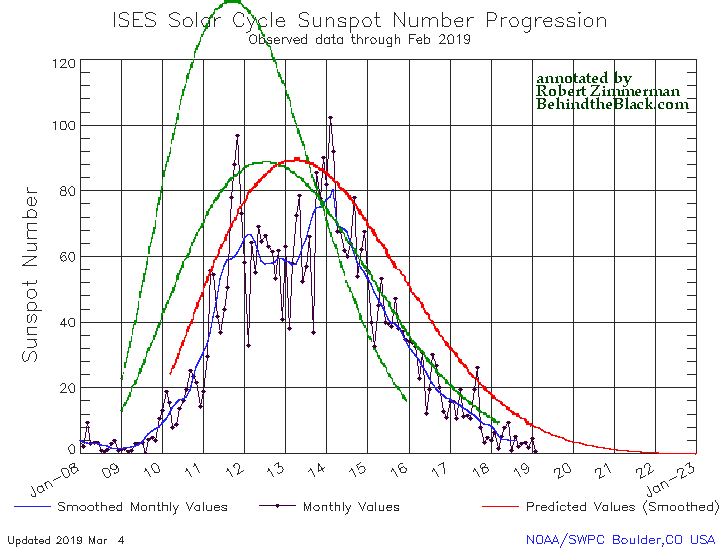
February 2019 sunspot activity

The graph above has been modified to show the predictions of the solar science community. The green curves show the community’s two original predictions from April 2007, with half the scientists predicting a very strong maximum and half predicting a weak one. The red curve is their revised May 2009 prediction.

For the second time since the beginning of the solar minimum last year, the Sun flat-lined for an month, producing no visible sunspots during the entire month of February.

That streak has continued into March. At present we are four days into March, and still no sunspots.

The big question that I will be repeating probably every month for the next two years is whether we are merely experiencing an early and possibly deep solar minimum, or the advent of a new grand minimum, with no visible sunspots for decades. During the last grand minimum in the 1600s there is evidence the Earth cooled, so much so that it was labeled the Little Ice Age. And with previous grand minimums over the past few thousand years there is evidence that similar coolings occurred. Similarly, periods where sunspot activity was high also appear to have been periods of warmer temperatures.

Why is not clearly understood, though there is some evidence that it might be related to the increasd cosmic ray flux during solar minimum.Those rays might interact with the atmosphere to produce more clouds, thus cooling the Earth. This is not proven however and remains merely a theory linked to some tentative preliminary evidence.

If we do enter a grand minimum, scientists will likely get the answers to these questions. However, we might also find ourselves experiencing significantly colder weather. I am right now flying from Chicago to Columbus, over Lake Michigan, which is filled with ice floes, something we have not seen in March for decades. Nor has this kind of cold weather been unusual for the past decade or so. Could it be because of the weak solar maximum we just experienced and the deep and extended solar minimum just before that? No one knows.

All we can do is gather data, and find out.

13 comments

More conflict on India-Pakistan Kashmir border

Gunfire this weekend from soldiers on both sides of the disputed India-Pakistan Kashmir border has resulted in more casualties.

Pakistan’s military said two of its soldiers were killed in an exchange of fire with Indian forces near the Line of Control that separates Kashmir between the rivals. It marked the first fatalities for Pakistani troops since Wednesday, when tensions dramatically escalated between the nuclear-armed countries over Kashmir, which is split between them but claimed by both in its entirety.

Indian police, meanwhile, said two siblings and their mother were killed in Indian-controlled Kashmir. The three died after a shell fired by Pakistani soldiers hit their home in the Poonch region near the Line of Control. The children’s father was critically wounded.

There appears to be an effort by politicians to ease the tensions, but it is not clear whether this effort is working.

17 comments

Dragon successfully docks with ISS

Capitalism in space: SpaceX’s Dragon capsule, designed to carry humans to space, has successfully docked for the first time at ISS.

The flight really has only one major task left, which it to return safely to Earth, which presently is scheduled for 8:45 am (eastern) on March 7. I expect that to go smoothly as well.

NASA and SpaceX will of course need to review all the test data from this unmanned test flight before okaying a manned flight. SpaceX also needs to first do a launch abort test, using this capsule. However, I do not expect either to result in any issues that should prevent a manned launch in July, as SpaceX presently plans.

NASA however might think differently. There have been strong factions within its management and bureaucracy that are hostile to this effort, and have been working to stall or stop it.

9 comments

EXOS successfully flies its reusable suborbital rocket, SARGE

Capitalsm in space: EXOS yesterday successfully completed its first full test flight, with commercial payloads, of its reusable suborbital rocket, SARGE.

The link has video of the launch and rocket plus payload recovery.

As I noted earlier this week, this company is positioning itself well to join the smallsat boom. It has developed a reusable rocket that it intends to use both as a testbed for development of an orbital reusable version, while simultaneously earning income to pay for that development.

1 comment

Dragon successfully launched on its first unmanned test flight to ISS

Capitalism in space: SpaceX tonight successfully launched its manned Dragon capsule on its first unmanned test flight to ISS.

They also successfully landed the first stage. I have embedded below the fold the video of the launch. Dragon will dock with ISS in about a day.

The leaders in the 2019:

3 SpaceX
2 China
2 Europe (Arianespace)

The U.S. now leads China and Europe 4 to 2 in national rankings.
» Read more

18 comments
1 125 126 127 128 129 156