Rogozin returns, playing a soldier in the Ukraine!

Dmitry Rogozin, about to go into battle!

Fired from his job as head of Roscosmos and exiled to the Ukraine, Dmitry Rogozin has returned to the news! He was recently interviewed on Russian television, during which the broadcast showed clips of Rogozin getting a tour from Russian troops.

The screen capture to the left show Rogozin during that tour, dressed in military gear, though most of that gear is apparently Western in make, not Russian. Go Dmitry!

According to Antoly Zak, Rogozin during the interview promised that Russia will soon occupy Kiev, Vienna, Berlin and Budapest. As I say, go Dmitry!

Since Rogozin was sent to the Ukraine in July his work there has mirrored his “successes” at Roscosmos. At Roscosmos he was instrumental in ending Russia’s deal with OneWeb, costing Putin several billion dollars in launch income while destroying any chance for years of Russia getting any international rocket business. In the four-plus months since he arrived in the Ukraine, Russia has been on a steady retreat, losing vast areas it had previously conquered.

Hat tip to BtB’s stringer Jay, who says of Rogozin, “This guy is worse than Baghdad Bob!”
4 comments

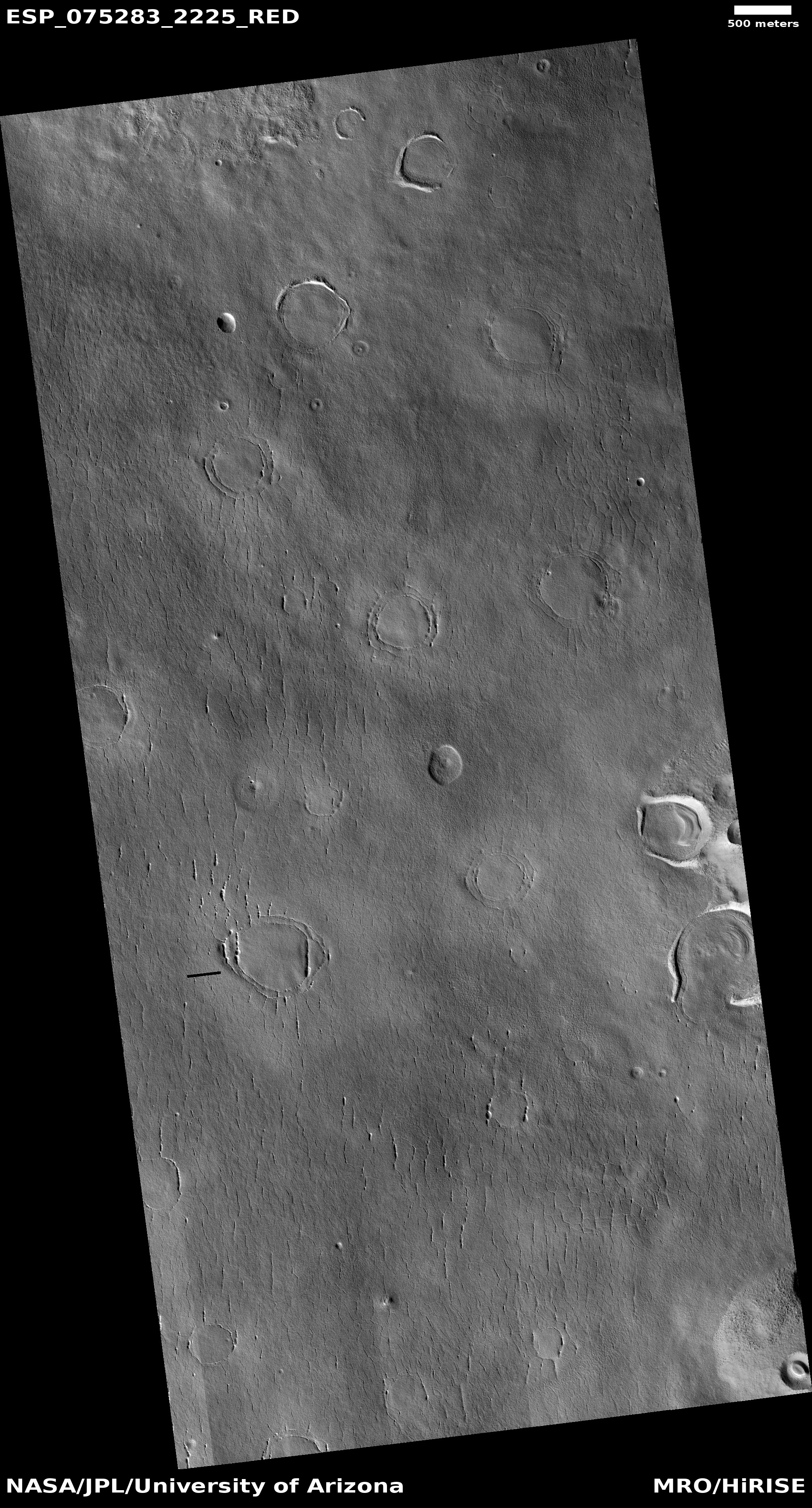
Expanded craters in Martian ice

Expanded craters in Martian ice
Click for full image.

Cool image time! The photo to the right, rotated, cropped, reduced, and sharpened to post here, was taken on August 18, 2022 by the high resolution camera on Mars Reconnaissance Orbiter (MRO). It includes a wide variety of geology related to sublimating ice, including expansion cracks as well as several different examples of what scientists call “expanded craters,” impacts that occurred in near surface ice and have been reshaped by the ice’s melting and sublimation at impact and then later. It also shows some obvious glacial fill in the two distorted craters at the center right.

A 2017 dissertation [pdf] by Donna Viola of the University of Arizona outlines nicely what we know of Martian expanded craters. As she notes in her conclusion:
» Read more

0 comments

Webb and Keck telescopes track clouds on Titan

Clouds on Titan
Click for original image.

Astronomers have used the Webb Space Telescope and the Keck Observatory in Hawaii to take infrared images days apart of the evolving clouds on the Saturn moon Titan.

The false-color infrared images to the right are those observations. From the press release:

As part of their investigation of Titan’s atmosphere and climate, Nixon’s team used JWST’s Near-Infrared Camera (NIRCam) to observe the moon during the first week of November. After seeing the clouds near Kraken Mare, the largest known liquid sea of methane on the surface of Titan, they immediately contacted the Keck Titan Observing Team to request follow-up observations.

“We were concerned that the clouds would be gone when we looked at Titan a day later with Keck, but to our delight there were clouds at the same positions on subsequent observing nights, looking like they had changed in shape,” said Imke de Pater, emeritus professor of astronomy at the University of California, Berkeley, who leads the Keck Titan Observing Team.

Using Keck Observatory’s second generation Near-Infrared Camera (NIRC2) in combination with the Keck II Telescope’s adaptive optics system, de Pater and her team observed one of Titan’s clouds rotating into and another cloud either dissipating or moving out of Earth’s field of view due to Titan’s rotation.

These images only increase my mourning for a Saturn orbiter. Since the end of Cassini’s mission in 2017, we have essentially been blind to the ringed planet and its many moons. These images, while producing excellent data, also illustrate well what we have lost.

0 comments

Scientists: Viking-1 might have landed on a field of Martian tsunami debris

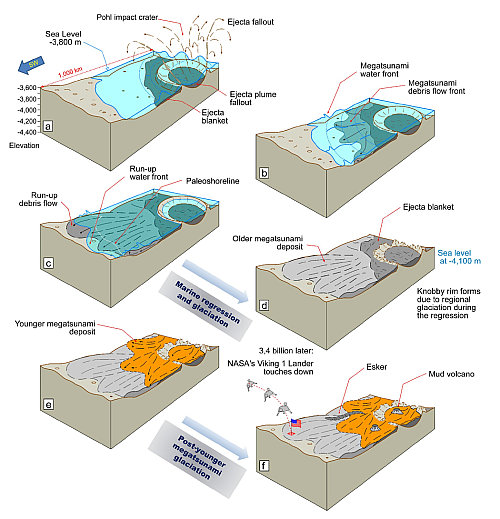
The geological history of the Viking-1 Mars landing site

As outlined in their new paper [pdf], a team of scientists now hypothesize that the features that surrounded Viking-1 when it landed on Mars in 1976 were caused by two past Martian tsunamis. Each tsunamis occurred due to an impact in the theorized ocean that is believed to have existed in this part of Mars’ northern lowland plains several billion years ago.

The graphic to the right, figure 8 from the paper, shows the hypothesized sequence of events. From the caption:

(a) Pohl crater forms within a shallow marine environment, (b) triggering tsunami water and debris flow fronts. (c) The wave fronts extensively inundate the highland lowland boundary plains, including a section ~ 900 km southwest of the impact site. (d) The ocean regresses to ~ − 4100 m, accompanied by regional glacier dissection, which erode the rims of Pohl and other craters. (e) The younger tsunami overflows Pohl and parts of the older tsunami. Glaciation continues, and mud volcanoes later source and emerge from the younger tsunami deposit. (f) ~ 3.4 billion years later, the Viking 1 Lander touches down on the edge of the older tsunami deposit.

The overview map below provides the larger context.
» Read more

4 comments

Soyuz-2 rocket launches Russian military satellite

Russia today successfully placed a military surveillance into orbit using its Soyuz-2 rocket, launching from its Plesetsk spaceport.

Like most launches from Plesetsk, the first stage and fairings landed in the interior of Russia, the drop zones in its far north.

The leaders in the 2022 launch race:

54 SpaceX
54 China
21 Russia
9 Rocket Lab
8 ULA

The U.S. still leads China 78 to 54 in the national rankings, but trails the entire world combined 85 to 78.

0 comments
1 16 17 18