ULA’s Delta Heavy successfully launches spy satellite for NRO

ULA today has successfully launched a spy satellite for the National Reconnaissance Office from Vandenberg Space Force Base in California, using its Delta Heavy rocket, its largest rocket.

With this launch, ULA retires the Delta from any further launches from Vandenberg. Future California launches will use its as yet untested Vulcan rocket.

The leaders in the 2022 launch race:

42 SpaceX
38 China
12 Russia
7 Rocket Lab
6 ULA

American private enterprise now leads China 59 to 38 in the national rankings, and the entire world combined 59 to 58. The 59 launches makes this the third most active launch year in American history, trailing only 1966 (70 launches) and 1965 (64 launches).

SpaceX has a Falcon 9 launch of 52 Starlink satellites scheduled very shortly, so these numbers will hopefully go up again before the day is out.

7 comments

Two launches from U.S. set for this afternoon

Both ULA and SpaceX have planned launches this afternoon a little over an hour apart, at 2:53 pm and 4:10 pm Pacific time respectively.

The ULA launch is first, and is the last Delta rocket launch from Vandenberg Space Force base. The company is slowly phasing this rocket out as it transitions to its not-yet-launched Vulcan rocket. The payload today is a spy satellite for the National Reconnaissance Office, using ULA’s biggest rocket, the Delta Heavy.

SpaceX will follow with another Falcon 9 Starlink launch, placing another 52 Starlink satellites into orbit.

I have embedded the live streams of both launches below.
» Read more

2 comments

Indian smallsat rocket startup hopes to complete 1st launch this year

The new colonial movement: A new Indian private commercial rocket startup, Agnikul, now hopes to complete the first launch of its Agnibaan rocket before the end of 2022.

Whether or not this launch happens this year, the important thing is the existence of this private independent rocket company in India. Up until now, India’s government space bureaucracy in ISRO, and in its new commercial arm, NSIL, has controlled all of that country’s commercial market share. Like NASA before 2008, it has worked aggressively to keep independent players out.

Agnikul’s existence suggests the Modi government’s effort to emulate the U.S. and create an independent private space industry is beginning to bear fruit. If so, expect big things over the next decade from India in space.

0 comments

NASA managers scrub September 27th SLS launch

NASA managers today decided that they had to scrub their attempt to launch SLS on September 27, 2022 due to a hurricane threatening Florida, and are instead preparing to roll the rocket back to the assembly building to protect it.

During a meeting Saturday morning, teams decided to stand down on preparing for the Tuesday launch date to allow them to configure systems for rolling back the Space Launch System rocket and Orion spacecraft to the Vehicle Assembly Building. Engineers deferred a final decision about the roll to Sunday, Sept. 25, to allow for additional data gathering and analysis. If Artemis I managers elect to roll back, it would begin late Sunday night or early Monday morning.

This will likely delay the launch until the late October launch window, or the mid-November window, as shown in this graph [pdf]. During this time engineers will certainly test and recharge the batteries that run the rocket’s flight termination system so that there will be no question they will work should the Space Force safety range officer need to destroy the rocket during launch.

NASA however now faces another quandary it has been avoiding for the past year. The stacking of the five segments of SLS’s two solid rocket strap-on boosters began in November 2020, two years ago. During the shuttle era and until last year, NASA had a rule that said a booster must launch within a year of stacking. The fear was that the weight of the solid rocket fuel could distort it over time, and possibly cause it to burn improperly once ignited. As these boosters are the equivalent of firecrackers — once you light them you can’t turn them off — NASA had chosen, until last year, to have a use-by date of one year for the boosters.

Now however NASA has abandoned that rule. The boosters have been stacked for twice that time, and the agency has to ask if it will be safe to use them. To change them out however will take at least three months, if not longer. The present set of boosters would have to be removed, and a new set stacked and installed.

I fully expect NASA to stay with these boosters, despite their age, once again violating its own safety rules, as it did routinely during the shuttle era (resulting in the loss of two shuttles and the death of fourteen astronauts). Though no humans will be on this test flight, this sloppy engineering culture clearly threatens the lives of the astronauts who will fly on the second Artemis SLS mission, around the Moon.

8 comments

The Jack Benny Show – November 4, 1951

An evening pause: This was the first episode in Benny’s second season on television, following nineteen years doing a regular radio show. The first singer is Bob Crosby, brother of Bing. The taxi driver is Mel Blanc, voice of Bugs Bunny and almost all of the characters in Warner Brothers best cartoons.

Almost everything in this episode works, but make sure especially you stay with it to see the Benny’s performance as lead fiddler of a hillbilly band.

4 comments

Above ground and underground Martian drainages

Overview map

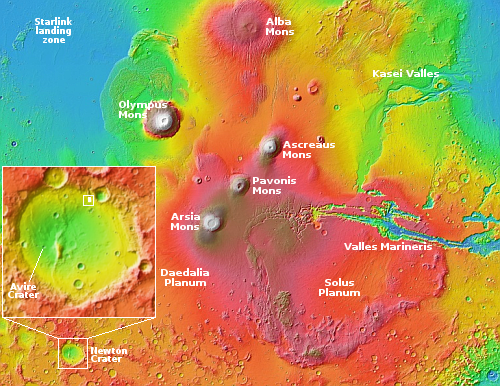
Cool image time! Today we are going to zoom into our cool image. The overview map to the right provides us the context. Our target is the small white rectangle inside the small box just below the north rim of 185-mile-wide Newton Crater, located 200 to 800 miles from the southwest edge of the lava plains dubbed Daedalia Planum that flowed down from Mars’s biggest volcanoes.

Newton Crater has a number of interesting features. Only two weeks ago I featured 4-mile-wide Avire Crater in Newton’s western quadrant, long known to have many gullies on its interior slopes as well as glacier features on its floor. Scientists have been monitoring those gullies now for more than a decade to see if they change seasonally, in a attempt to figure out their cause.

Today’s cool image looks at the very intriguing meandering canyons that appear to flow south from Newton’s north rim.
» Read more

0 comments

Range gives NASA waiver to launch SLS on September 27th, despite a questionable flight termination system

In a briefing today, NASA officials confirmed that they are proceeding with their September 27, 2022 first launch of the SLS rocket, having obtained a waiver from the Space Force’s range office on testing the batteries for the flight termination system that would destroy the rocket should it begin flying out of control.

During a Sept. 23 teleconference, NASA announced an extension for the flight termination system battery certification, which expired after 25 days on Sept. 6. Now the Space Force’s Eastern Range has granted a waiver to allow the rocket to launch as late as Oct. 2 before needing to be returned to the Vehicle Assembly building to recertify the batteries.

The flight termination system is only used in the event the rocket veers off course during a launch anomaly.

Note that the 25 day use-by limit was actually an extension itself, as these batteries had been previously required testing every 20 days. Now the range is willing to let them go for as long about 50 days without testing, a two and half times increase.

If the rules before — based on engineering — said the batteries were not reliable after 20 days, why are those batteries now considered reliable up to 50 days? What facts or data does NASA or the Space Force have to allow this waiver? And if they have no data, it seems almost criminal to allow the go-ahead of this launch of a giant untested rocket on its first lift-off. Should something go seriously wrong — which is not that unlikely — and the flight termination system fails to work, we could see a very big rocket careening out-of-control into populated areas.

We all hope SLS launches with no problem on September 27th. We now have a really serious reason for that desire.

Regardless, the launch is now scheduled for a 70-minute launch window that opens at 11:37 am (Eastern) on September 27th, with a back-up launch window on October 2nd of 102 minutes beginning at 2:52 pm (Eastern).

Meanwhile, a developing tropical storm could put a kabosh on all these plans, forcing NASA to roll SLS back to the assembly building anyway. NASA managers plan to meet again before launch to make a decision.

19 comments

Pushback: Professor fired for making joke wins $165K settlement from university

Speech that is forbidden at the University of North Texas

Nathaniel Hiers, fired by his boss as a math professor at the University of North Texas for daring to express a political opinion, has won a $165K settlement from the university.

This story is a follow-up on a previous column from March, when a judge had ruled that Hiers’ lawsuit could go forward. The judge also dismissed the university’s claim of qualified immunity for its officials, thus leaving them personally liable under any settlement.

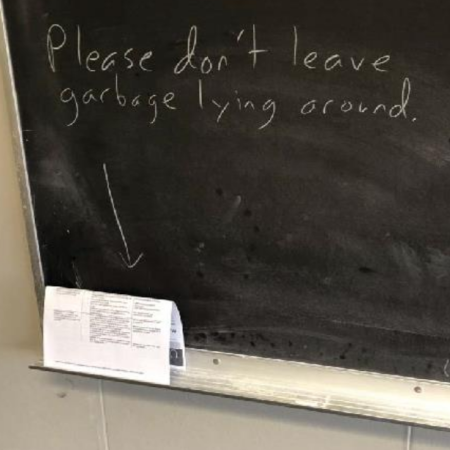
The background: Hiers’ was fired when, having found flyers in math department’s lounge warning faculty against triggering “microaggessions” in their conversations, responded as shown in the picture to the right, placing one flyer on the chalk rack of the blackboard and wrote his own opinion of it above.

It appears that though the settlement was a victory for Hiers, paying him for damages and his attorneys’ fees, it does not get him his job back. Nor does it appear the officials who fired him wrongly will pay any of the settlement. Instead, the University of North Texas is picking up the tab.

Thus, this victory is not the triumph Hiers’ legal team, the Alliance Defending Freedom, claims it is. » Read more

5 comments

A hot wave in Jupiter’s upper atmosphere has been discovered, flowing away from the pole

Jupiter heat wave

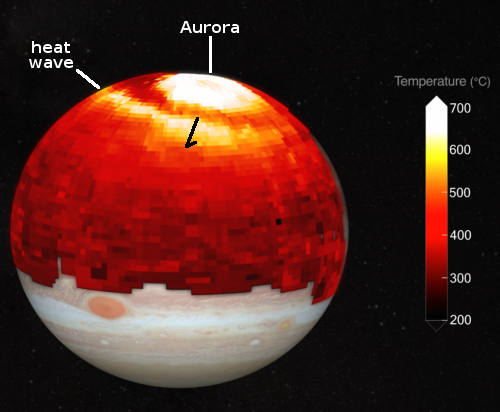
Using data obtained by ground-based telescopes, scientists have discovered a hot wave, with temperatures in the range of 700 degrees Celsius (about 1,300 degrees Fahrenheit), rolling outward from Jupiter’s hot polar atmospheric regions, believed caused by the gas giant’s intense aurora.

Jupiter’s atmosphere, famous for its characteristic multicoloured vortices, is also unexpectedly hot: in fact, it is hundreds of degrees hotter than models predict. Due to its orbital distance millions of kilometres from the Sun, the giant planet receives under 4% of the amount of sunlight compared to Earth, and its upper atmosphere should theoretically be a frigid -70 degrees Celsius. Instead, its cloud tops are measured everywhere at over 400 degrees Celsius.

…Just like the Earth, Jupiter experiences auroras around its poles as an effect of the solar wind. However, while Earth’s auroras are transient and only occur when solar activity is intense, auroras at Jupiter are permanent and have a variable intensity. The powerful auroras can heat the region around the poles to over 700 degrees Celsius, and global winds can redistribute the heat globally around Jupiter.

The graphic above, adapted from the research presentation [pdf], shows that wave propagating away from the pole. The wave’s width is about the size of the Earth, with different sections moving from about 1,000 feet per second to 8,000 feet per second.

1 comment

Watching DART impact asteroid on September 26, 2022

A NASA planetary probe, dubbed DART, is on course for a planned impact of the asteroid Dimorphos this coming Monday, September 26, 2022, at 4:14 PM (Pacific).

DART was launched from Vandenberg Space Force Base, CA on November 23, 2021 PST (November 24 EST) headed to the asteroid Didymos and its tiny moon Dimorphos 7 million miles away. The plan is for DART to ram itself into Dimorphos while scientists on Earth measure whether its orbit around Didymos changes.

Dimorphos is about 525 feet in diameter, while Didymos is much larger, about a half mile in width. The goal is to see if this method can be used in the future to adjust an asteroid’s orbit enough to shift it away from hitting the Earth.

The impact will be observed by a camera on DART, as well as an Italian cubesat dubbed LICIACube.

NASA TV will be live streaming the event, and I will embed that live stream here when it goes live. Once DART gets close, its camera will record the asteroid’s approach through impact.

5 comments

Voyager Space signs cooperative deal with Azerbaijan

Capitalism in space: Voyager Space, the subsidiary of Nanoracks that is building its Starlab private space station, has signed a cooperative agreement with Azercosmos, Azerbaijan’s space agency.

The press release is very vague about what the deal entails.

This strategic multi-year collaboration paves the way for Azercosmos and Voyager Space to proactively develop mutually beneficial space infrastructure, technology, and manufacturing initiatives, research programs, and further opportunities for innovation. With the potential to exchange experience and knowledge, the organizations will focus on commercial and educational opportunities in-country to foster a thriving local space ecosystem.

I suspect it will eventually lead to Azerbaijan sending research payloads to Starlab, once it is in orbit and operational.

The number of recent deals made by American private space companies, either to fly foreign astronauts in space, provide payload space on planetary missions, or provide space station capabilities for foreign science research, is beginning to be difficult to count. With at least four different American private space stations under construction, with at least one more proposed, the rush to sign up customers by these companies is accelerating.

Expect the business to be very brisk once these get launched. It appears that practically every government on Earth wants to claim it has a space program, and buying space and seats from these American commercial companies is going to be the quickest and cheapest way to do it.

2 comments
1 55 56 57 58 59 192