SpaceX launches another 22 upgraded Starlink satellites into orbit

Using its Falcon 9 rocket SpaceX early today successfully launched another 22 upgraded Starlink satellites into orbit, lifting off from Cape Canaveral.

The first stage completed its fifth flight, landing successfully on a drone ship in the Atlantic. The fairings completed their eighth flight.

The leaders in the 2023 launch race:

32 SpaceX
18 China
6 Russia
4 Rocket Lab

American private enterprise now leads China 36 to 18 in the national rankings, and the entire world combined 36 to 30. SpaceX by itself only trails the entire world combined, including American companies, 32 to 34.

2 comments

Zbigniew Rybczyński – The Orchestra (final scene)

An evening pause: Music is of course Ravel’s Bolero. This provides us an elegant thumbnail history of the Soviet Union using dance, choreography, and clever filming. And it is honest, showing how the whole thing was run by gangstas, as all such top-down communist/socialist societies are, and as America is now adopting. More information about the entire work here.

Hat tip Dave McCooey.

1 comment

The old blacklisting against Jews has now been enthusiastically renewed on American campuses

The goal of college diversity programs for Jews

They’re coming for you next: Rather than write a column today (I feel very burnt out by all that I read), I would instead like to point my readers to this detailed overview of the return of wide-spread and pervasive anti-Semitism at American universities, all under the guise of the “diversity, equity, and inclusion” (DEI) mantra, which in itself is merely a restatement of “critical race theory,” which is also merely a rewording of basic Marxist racism.

This quote sums the article up:

[T]he DEI regime is key to understanding the climate on college campuses for Jewish students. Our desire to quantify everything has led the network of Jewish advocacy groups in the United States to measure anti-Semitism by “incidents.” That is certainly part of it—but only part. It is unnerving to see a swastika or “from the river to the sea” scrawled in chalk on the sidewalk outside a campus Hillel. But what those incident reports don’t show are actions and thought leadership sometimes orders of magnitude more sinister.

In an atmosphere where DEI has great sway, merely to denounce anti-Semitic violence is to risk one’s job, reputation, career, livelihood. And to express one’s Judaism openly on college campuses in that atmosphere requires a dose of courage no one should be required to show just to live a day-to-day life. In 2021, the Louis D. Brandeis Center for Human Rights Under Law surveyed “openly Jewish” college students and found that nearly 70 percent “personally experienced or were familiar with an anti-Semitic attack in the past 120 days.” In addition, more than 65 percent “have felt unsafe on campus due to physical or verbal attacks, with one in 10 reporting they have feared they themselves would be physically attacked.” And, the Brandeis Center continues, roughly 50 percent “have felt the need to hide their Jewish identity.”

Of those who hid their identity on campus, 30 percent did so because they were worried about how their professors would treat them. And why wouldn’t they worry? George Washington University sided with the professor who harassed Jewish students and retaliated when they objected—all in the name of “diversity.”

The story recounts many examples of this kind of bigotry, all endorsed and even instigated by the diversity officers at the colleges, with many of those stories already specifically described by me in past blacklist columns. What makes this article useful is how it takes a wider view to clearly illustrate how the administrative culture of academia is now hand-in-glove with anti-Semitism, and is working hard to encourage it at all levels.

3 comments

May 18, 2023 Quick space links

Courtesy of BtB’s stringer Jay.


0 comments

Chaos in the southern cratered highlands of Mars

Chaos in the southern cratered highlands of Mars
Click for full image.vi

Today’s cool image takes us to a part of the cratered southern highlands of Mars that I have not featured much previously. The picture to the right, rotated, cropped, and reduced to post here, was taken on March 7, 2023 by the high resolution camera on Mars Reconnaissance Orbiter (MRO). It shows what appears to be a collection of rough hills and mesas surrounded by a sea of smooth ground that at the base of the cliffs seems to end abruptly.

The smooth ground is probably mantled by a layer of dust and debris. Since this location is at 36 degrees south latitude, there is also probably near surface ice under that layer. The abrupt edges likely indicate where the increasing slope next to the mesas and mounds caused that ice to be exposed and thus sublimate away.

As for the location, we must go to the overview map.
» Read more

0 comments

Astronomers discover Earth-sized planet 90 light years away

Using data from a variety of space- and ground-based telescopes astronomers have discovered Earth-sized exoplanet orbiting a red dwarf star 90 light years away.

The exoplanet is dubbed LP 791-18 d, and is thought to be slightly bigger than the Earth. Its orbit, close to the star, causes it to be tidally-locked, with one hemisphere always facing the star. In addition, the presence of another much larger exoplanet in the system causes other tidal effects.

Astronomers already knew about two other worlds in the system before this discovery, called LP 791-18 b and c. The inner planet b is about 20% bigger than Earth. The outer planet c is about 2.5 times Earth’s size and more than seven times its mass.

During each orbit, planets d and c pass very close to each other. Each close pass by the more massive planet c produces a gravitational tug on planet d, making its orbit somewhat elliptical. On this elliptical path, planet d is slightly deformed every time it goes around the star. These deformations can create enough internal friction to substantially heat the planet’s interior and produce volcanic activity at its surface. Jupiter and some of its moons affect Io in a similar way.

The press release makes a big deal about the volcanism, even suggesting it could produce an atmosphere that, because the exoplanet sits on the inner edge of the habitable zone, could make the exoplanet habitable. These speculations are silly, considering the uncertainties, the exoplanet’s evolving orbit, and the star it orbits, and are being pushed mostly because the press office thinks this will be the only way the public will have any interest in the discovery.

While there is an infinitesimal chance there could be life here, a more likely scenario is that it is a lifeless volcano world like Jupiter’s moon Io. Even more probably however is that it is completely different than anything we have yet observed, in ways we can’t yet predict. To find out however we would need close-up observations that will likely not be possible without an interstellar mission.


4 comments

Final assembly of Chandrayaan-3 begins for launch still targeting mid-July


Click for interactive map.

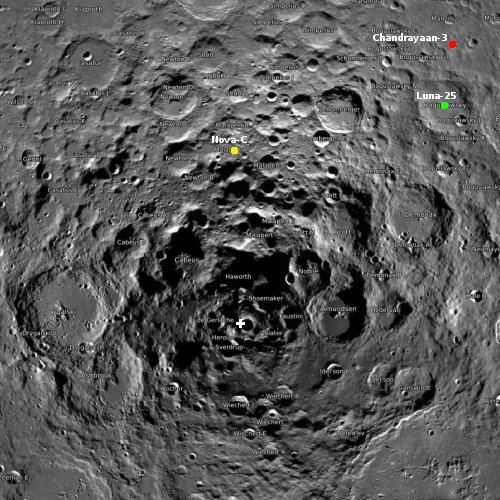
Engineers at India’s space agency ISRO have begun the installation of the payloads onto its lunar lander/rover, Chandrayaan-3, which is still targeting a mid-July launch.

The map shows the landing location (red dot) near the Moon’s south pole (indicated by the cross). Nova-C is Intuitive Machines private lander, now aiming for a late summer launch at the earliest. Luna-25 is Russia’s first lunar lander since the 1970s, and is also targeting a launch in July.

India’s first attempt, Chandryaan-2, to land a rover at this spot on the Moon failed in 2019. This new mission is essentially a re-do, except that it does not include an orbiter, since the orbiter from Chandrayaan-2 is still operational and can do the job.

All in all, it increasingly looks like the next six months will see a lot of new landing attempts on the Moon.

0 comments

Student model rocket doubles altitude record

On April 16, 2023 students from the Embry-Riddle Aeronautical University launched a model rocket that more than doubled the altitude record for liquid-fueled model rockets.

The rocket reached an altitude of 47,732 feet, setting multiple records, including the highest undergraduate and collegiate amateur liquid rocket launch in the United States. It more than doubled the previous record of 22,000 feet.

Named Deneb after one of the brightest stars in the northern hemisphere, the rocket had a total burn time of 26.1 seconds, reaching a velocity of 1,150 mph (Mach 1.5).

I have embedded the live stream below, set to begin just before launch.
» Read more

2 comments

May 17, 2023 Quick space links

Courtesy of BtB’s stringer Jay.


7 comments

Alien textured Martian lava

Alien textured Martian lava
Click for original image.

Cool image time! The picture to the right, cropped to post here, was taken on February 17, 2023 by the high resolution camera on Mars Reconnaissance Orbiter (MRO), and shows what the science team labels “regularly textured ground on Pavonis Mons.”

The arrow in the picture indicates the downhill trend. If you look at the full image, you will see that this texture pattern extends in all directions for a considerable distance, both uphill and down, and even covers the entire floor of a depression that appears to contour along the grade instead of going downhill.

The latitude here is very close to the equator. So, even though the elevation is high, being on the slopes of a giant volcano, there is probably no near surface ice here.
» Read more

1 comment
1 122 123 124 125 126 196