China launches two satellites yesterday, one for Macau

China yesterday used its Long March 2C rocket to launch two satellites into orbit, with one the first science satellite by Macau, designed to study the Earth’s magnetic field in conjunction with other satellites already in orbit.

No information that I could find was released about the second satellite. The launch, from China’s interior Jiuquan spaceport, dropped the rocket’s first stage somewhere in China. No word on whether it landed near habitable areas.

The leaders in the 2023 launch race:

34 SpaceX
19 China
6 Russia
4 Rocket Lab (with a launch scheduled for tomorrow)

American private enterprise still leads China 38 to 19 in the national rankings, and the entire world combined 38 to 31. SpaceX by itself now tied trails in total launches with the rest of the world, including American companies, 34 to 35.


0 comments

SpaceX launches Axiom’s second commercial manned mission to ISS

SpaceX today successfully used its Falcon 9 rocket to launch its Freedom manned capsule on its second flight, carrying four passengers on Axiom’s second commercial manned mission to ISS.

The Axiom crew included three paying passengers, one from the U.S. and two from Saudi Arabia, with the fourth crew member former NASA astronaut Peggy Whitson, now acting as Axiom’s commander. They plan to spend eight days docked to ISS. Making this commercial flight even more interesting is that the station already has a Middle Eastern commercial astronaut, from the United Arab Emirates. The Arab space race is clearing heating up.

The first stage was making its first flight, and successfully landed back at Cape Canaveral.

Were you aware this was happening? With my readers I expect so, but I am willing to bet that we are a very small minority. SpaceX has now made American manned spaceflight so routine almost no one pays attention.

The leaders in the 2023 launch race:

34 SpaceX
18 China
6 Russia
4 Rocket Lab

American private enterprise now leads China 38 to 18 in the national rankings, and the entire world combined 38 to 30. SpaceX by itself is now tied in total launches with the rest of the world, including American companies.

14 comments

SpaceX launches 5 Iridium and 16 OneWeb satellites

SpaceX early today successfully used its Falcon 9 rocket to put five Iridium and sixteen OneWeb satellites into orbit, lifting off from Vandenberg Space Force Base.

The first stage successfully completed its eleventh flight, landing on a drone ship in the Pacific. The two fairings completed their third and sixth flights respectively.

The leaders in the 2023 launch race:

33 SpaceX (with a launch scheduled for tomorrow)
18 China
6 Russia
4 Rocket Lab (with a launch scheduled for tomorrow)

American private enterprise now leads China 37 to 18 in the national rankings, and the entire world combined 37 to 30. SpaceX now trails the entire world combined, including American companies, by only 33 to 34.

8 comments

May 19, 2023 Quick space links

Courtesy of BtB’s stringer Jay.


  • Russia and Uganda sign deal not to deploy weapons in space
  • This agreement, like the Biden administration’s call for a similar ban, is worthless. When it comes time that someone wants to use force in space, force will be used, whether morally right or not. And the victim will have no choice but to respond in kind. That simply is the way of all things.

6 comments

Buried dying glacier in the Martian dry equatorial regions?

Buried glacial ice in dry equatorial regions?
Click for original image.

Today’s cool image from Mars is not so much unique visually as it is unique in terms of its location. The picture to the right, rotated, cropped, reduced, and sharpened to post here, was taken on January 31, 2023 by the high resolution camera on Mars Reconnaissance Orbiter (MRO). It shows the northern rim of a small crater, with its floor filled with an intriguing mound of material.

The picture was labeled a “terrain sample”, which suggests it wasn’t taken as part of any specific research project by instead to fill a gap in the camera’s schedule. To maintain the camera’s proper temperature, it is necessary to take pictures regularly, and when the camera team finds a gap that is too long, they fill it by choosing some almost random target in that gap that might be interesting. Sometimes it is, sometimes not.

In this case I strongly suspect this target was hardly random. The picture title also mentions MRO’s now retired radar CRISM instrument, which was used to detect evidence of underground ice. My guess is that the camera team thus likely decided to image this crater in high resolution because that radar data suggested the presence of underground ice.

This guess is strongly confirmed by a context camera picture taken of this crater on September 1, 2008. The crater appears surrounded by the typical splash apron one routinely sees around impact craters in the mid- and high-latitude northern lowland plains, where there is a lot of near surface ice.

The bumpy mound seen in high resolution on the floor of this crater could very well be buried glacial ice, as it mimics similar features in the many craters in the mid-latitudes of Mars. But is it buried ice? The location says otherwise.
» Read more

1 comment

Pushback: Arizona drops trespassing charges against student for handing out the Constitution at Arizona State U

Tizon's evil table at ASU
Tim Tizon (r) discussing free speech with another student on
March 3, 2022 at that banned YAL table on the ASU campus.

They’re coming for you next: Today’s story is a followup of a February blacklist story. Tim Tizon, a Arizona State University (ASU) student at the time of the incident in March 2022, had been charged with trespass by the university when he set up a Young Americans for Liberty (YAL) table on campus to hand out free copies of the U.S. Constitution.

The location was a designated space for free speech and had not been reserved by anyone. His table was not blocking anything, as numerous witness testified. Yet, school officials showed up and demanded he leave, moving his table to a remote part of the campus where no one would see it. Apparently, Arizona State University officials were uncomfortable with the ideals of freedom and law as stated by Constitution and the Bill of Rights.

Tizon however refused to move, and was charged with trespass, convicted, and sentenced to a fine $300 plus fifteen hours of community service.
» Read more

12 comments

Starship prototype #25 is rolled to launchpad for static fire engine tests

Starship prototype #25 on the way to launchpad
Click for original image.

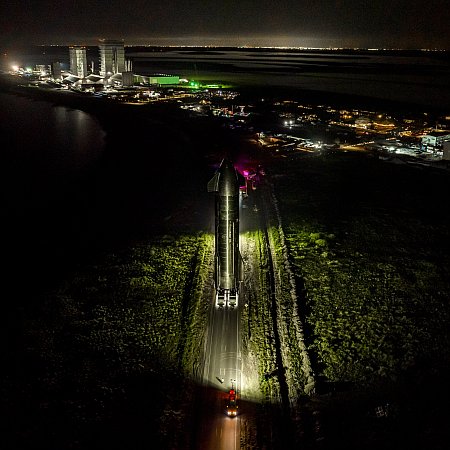
SpaceX yesterday evening rolled its 25th prototype of its Starship spacecraft to its suborbital launchpad at Boca Chica, as shown on the image to the right, for a planned static fire engine test of its six Raptor engines.

If all goes well, the company hopes to stack this prototype on top of the ninth prototype of Superheavy and complete the second test orbital flight of the entire rocket as early as June 15, 2023, with a launch window as long as six months according to the company’s FCC communications license application.

The actual launch date however remains very uncertain, for several reasons. The FAA must issue a launch license, and it won’t do that until it is satisfied the investigation into the first launch failure is complete. That launch approval will also likely be delayed because of the lawsuit against that agency for issuing the previous launch license.

8 comments

Capstone does lunar fly-by, takes first lunar pictures, completes main mission

The Moon as seen by Capstone
Click for original image.

The smallsat engineering test lunar orbiter Capstone has now successfully ended its primary mission, completing six months of operation in the near-rectilinear halo orbit that NASA’s Lunar Gateway manned space station intends to fly.

To put a final touch on that main mission, in May mission managers at the private company Advanced Space also completed two additional experiments. On May 3, 2023 they performed a close-fly of the Moon, using the spacecraft’s camera for the first time to take the picture of the Moon to the right.

Then, on May 9 Capstone successfully tested navigation technology in conjunction with NASA’s Lunar Reconnaissance Orbiter (LRO), also in orbit around the Moon.

During the May 9 experiment, CAPSTONE sent a signal to LRO designed to measure the distance and relative velocity between the two spacecraft. LRO then returned the signal to CAPSTONE, where it was converted into a measurement. The test proved the ability to collect measurements that will be utilized by CAPS software to determine the positioning of both spacecraft. This capability could provide autonomous onboard navigation information for future lunar missions.

The mission now enters its extended mission, planned to last at least a year.

3 comments

Lucy makes course correction in preparation for 1st asteroid fly-by

Lucy's route through the solar system
Lucy’s route through the solar system

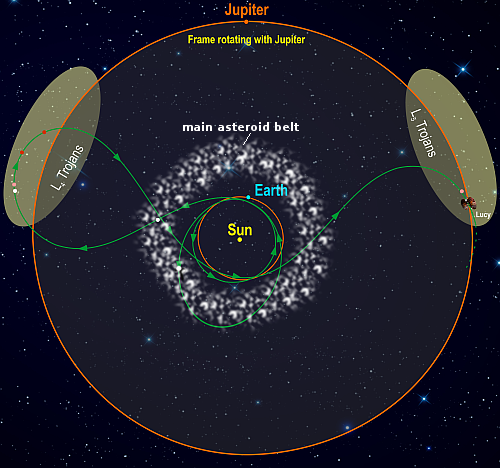
The asteroid probe Lucy on May 9, 2023 fired its engines to successfully make a minor course correction in preparation for a fly by of the asteroid Dinkinesh, located in the main asteroid belt between Mars and Jupiter.

Even though the spacecraft is currently travelling at approximately 43,000 mph (19.4 km/s), this small nudge is enough to move the spacecraft nearly 40,000 miles (65,000 km) closer to the asteroid during the planned encounter on Nov. 1, 2023. The spacecraft will fly a mere 265 miles (425 km) from the small, half-mile- (sub-km)-sized asteroid, while travelling at a relative speed of 10,000 mph (4.5 km/s).

Dinkinesh, the white dot inside the main asteroid belt in the lower left of the map to the right, is the first of eight asteroids Lucy will fly past.

1 comment

NASA picks Blue Origin’s partnership for building second manned lunar lander

Artist's concept of Blue Moon
An artist’s concept of Blue Moon

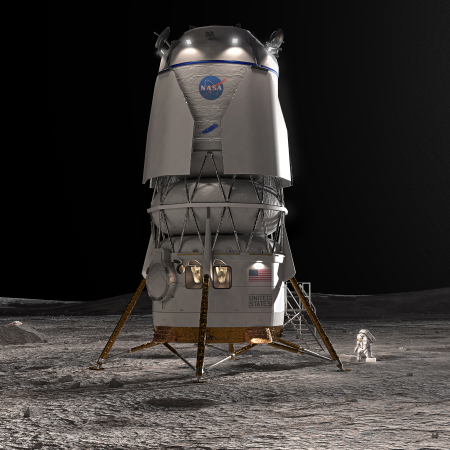
NASA today announced that it has chosen the partnership led by Blue Origin to build a second manned lunar lander for its Artemis program.

Blue Origin will design, develop, test, and verify its Blue Moon lander to meet NASA’s human landing system requirements for recurring astronaut expeditions to the lunar surface, including docking with Gateway, a space station where crew transfer in lunar orbit. In addition to design and development work, the contract includes one uncrewed demonstration mission to the lunar surface before a crewed demo on the Artemis V mission in 2029. The total award value of the firm-fixed price contract is $3.4 billion.

The other partners in the contract are Draper, Astrobotic, and Honeybee Robotics.

This is NASA’s second contract for a lunar lander, with SpaceX’s Starship the first. The idea is to have two landers available from competing companies for both competition and redundancy, similar to the approach the agency has used for its manned ferry service to ISS, using SpaceX and Boeing. I wonder if NASA’s experience on the Moon will be similar to that ferry service, whereby only SpaceX so far has been able to deliver. The track record of Blue Origin suggests it will do about as poorly as Boeing has with Starliner.

28 comments
1 121 122 123 124 125 196