Ingenuity completes 48th flight on Mars

Overview map
Click for interactive map.

On March 21, 2023 the Mars helicopter Ingenuity successfully completed its 48th flight on Mars, flying 1,305 feet for 149.9 seconds with a top altitude of 39 feet. As has now become routine on all the recent flights, the distance and time in the air exceeded slightly the planned amounts, probably because Ingenuity needed slightly more time to find a good landing spot.

The link provides a very short movie created from images looking down during the flight.

The map to the right provides the context. The green dot and line indicates Ingenuity’s new position and flight path respectively. The blue dot marks Perseverance’s present location, a spot the mission planners had previously targeted as a prime place for obtaining core samples. The red dotted line shows the rover’s planned route.

Since the science team is now using Ingenuity for scouting purposes, its turn towards the rim of Belva Crater suggests they are considering this detour for Perseverance as well.


1 comment

NASA engineers continue to struggle to save the Flashlight lunar probe

In an update today, NASA reports that engineers continue to troubeshoot the failure of the experimental thrusters on the Lunar Flashlight cubesat, in an effort to improvise a way to get the probe into lunar orbit.

Shortly after launch on Dec. 11, 2022, the operations team for NASA’s Lunar Flashlight determined that three of the four CubeSat’s thrusters were underperforming. This cast doubt on whether the mission could complete its stretch science goal of detecting surface ice at the Moon’s South Pole. After analyzing the situation, team members at NASA’s Jet Propulsion Laboratory and Georgia Tech arrived at a creative maneuvering technique that would use the one fully-functioning thruster to get into planned orbit. But when attempting the modified maneuvers in January, that thruster also experienced a rapid loss in performance and the team determined that Lunar Flashlight would likely be unable to reach its planned near-rectilinear halo orbit around the Moon.

After further troubleshooting, the operations team has been working on ways to restore partial operation of one or more thrusters to keep the spacecraft within the Earth-Moon system. They have had some success but continue to try new things to clear the suspected obstructions in the thruster fuel lines. They have until the end of April to generate the required thrust to preserve the opportunity to allow for monthly flybys of the lunar South Pole.

Though it increasingly appears Lunar Flashlight will not make lunar orbit, the mission is not a failure, since it was first and foremost an engineering mission testing a variety of new cubesat technologies, including the failed thrusters. Their failure and the efforts by engineers to recover them is important data for developing better cubesat thrusters on future such planetary probes.

0 comments

SpaceX might get investment capital from Saudi and UAE investors

According to several reports in the business press, SpaceX is presently negotiating with investment companies in Saudi Arabia and the United Arab Emirates (UAE) to possibly provide additional investment capital to the company.

Citing two individuals reportedly familiar with the matter, The Information noted that Saudi Arabia’s Water and Electricity Holding Company, Badeel, and the United Arab Emirates’ Alpha Dhabi are participating in the funding round. Morgan Stanley is reportedly organizing the investment effort.

At present it is unknown how much would be invested. It is also unclear if this foreign investment in an American rocket company can pass muster with the U.S. State Department.

SpaceX has already raised about $10 billion in private investment capital as well as $4 billion from NASA for the development of Starship/Superheavy.

7 comments

Italy funds development by Avio of smallsat rocket and methane engine

In a move that might eventually separate Italy from the European Space Agency’s (ESA) Arianespace commercial division, the Italian government on March 13, 2023 announced that it has committed $308 million to the Italian company Avio to develop both a methane-fueled engine and the smallsat rocket to go with it.

The money will be used by Avio on two projects, one to develop an upgraded version of its M10 methane-fueled engine that has already completed two dozen static fire tests, and the other to develop the smallsat rocket, with a targeted first launch in 2026.

While the investment is officially in partnership with the ESA, its wholly-Italian nature suggests in the end it will not be part of Arianespace, but function as an independent competing rocket operated and owned by Avio, which is also the company that developed Arianespace’s Vega family of rockets.

If Italy allows Avio to pull free of ESA and operate as a separate competing rocket company, it will do Europe a favor. Right now the monopolistic nature of ESA is preventing it from competing successfully in the new commercial launch market. Having separately owned and competing private companies will only energize this European industry, which has generally been moribund for years.

0 comments

First set of SpaceX’s second generation Starlink satellites experiencing issues

According to a tweet from Elon Musk yesterday, the first set of 21 larger second generation Starlink satellites, launched on February 27, 2023 by a Falcon 9 rocket, have experiencing “some issues.”

Some sats will be deorbited, others will be tested thoroughly before raising altitude above Space Station.

More information here.

Starting around March 15, their orbital altitude started to decrease at varying rates: most gradually, but at least two more steeply, descending to about 365 kilometers. All 21 remain in orbit, but that unusual behavior prompted speculation of problems with the satellites.

The second set of new Starlink satellites is scheduled for launch no earlier than March 30, 2023, but expect that launch to be delayed in order for SpaceX engineers to troubleshoot these issues and then apply what they have learned on the new satellites.

2 comments

Russia launches military satellite

Using its Soyuz-2 rocket, Russia today launched a classified military satellite into orbit, lifting off from its Plesetsk spaceport in northern Russia.

The rocket flew north over the Arctic, with its first and second stages falling into the ocean.

The leaders in the 2023 launch race:

19 SpaceX
11 China
5 Russia
2 Rocket Lab

American private enterprise still leads China in launches 21 to 11 in the national rankings, and the entire world combined 21 to 18. SpaceX now trails the entire world combined, including American companies, 19 to 20.

0 comments

Second stage on Relativity’s first launch fails to fire

The first test launch of Relativity’s 3D rocket, Terran-1, achieved the mission’s minimum goals, with the first stage performing exactly as planned and the 3D-printed rocket successfully completing engine cut-off and stage separation.

At that point the second stage engine failed to fire, and the upper stage fell into the ocean.

I have embedded the live stream from last night below. The company had made it clear that their number one goal for this flight was getting that 3D-printed rocket through max-q, the time when the atmospheric pressures on the rocket are their greatest. In this area the launch was a success.

This was also the first American launch of a methane-fueled rocket, and it was fascinating seeing the difference in the rocket’s plumes from other fuel types. Terran-1’s engine plumes were a clear distinct blue, quite different from the white and smokey plumes produced by solid-fueled and kerosene-fueled rocket engines, and the almost invisible plume of space shuttle’s hydrogen-fueled engines.

As yet, no methane-fueled rocket has reached orbit, though two Chinese companies and Relativity have tried. SpaceX will try itself when it launches Superheavy/Starship.
» Read more

3 comments

Nena – 99 Luftballons

An evening pause: This pretty 1983 German pop song so perfectly predicts the Biden administration’s silly overreaction to the Chinese spy balloons last month, and the really dangerous consequences that could have resulted.

The lyrics of the original German version tell a story: 99 balloons are mistaken for UFOs, causing a military General Officer to send pilots to investigate. Finding nothing but balloons, the pilots put on a large show of fire power. The display of force worries the nations along the borders and the war ministers on each side encourage conflict to grab power for themselves. In the end, a cataclysmic war results from the otherwise harmless flight of balloons and causes devastation on all sides without a victor.

Hat tip Jay, who is still off in the tropics doing ham radio stuff.

2 comments

Confused glaciers in a Martian crater

Confused glaciers in a Martian crater
Click for original image.

Cool image time. The picture to the right, cropped to post here, was taken on February 2, 2023 by the high resolution camera on Mars Reconnaissance Orbiter (MRO), and shows a strangely blobby crater in the northern mid-latitudes where glacial features are frequently found inside craters.

In this case however the glacier seems very confused. As this is in the northern hemisphere, you would expect glacial material to survive on the north-facing southern interior slopes of the crater, where there is year-round less sunlight. The mottled eroded terrain in the south part of the crater floor suggests this. However, the crater also clearly has a terraced glacier on its south-facing northern interior slopes.

Why has the glacial material survived in both places, but not in the center of the crater?

In addition, there is that strange roughly circular feature attached to the south side of the crater. What formed it? Is it a glacier on the plains surrounding the crater? Or are we looking at volcanic material?

This crater is also unique. The crater just to its southwest (partly seen in the cropped image above), is a much more typical glacial-filled mid-latitude crater, its interior material more evenly distributed and its circular rim only slightly distorted.
» Read more

0 comments

Pushback: Doctors blacklisted by government for disagreeing on its COVID mandate policies now fighting back

Written by many of the doctors of the Norfolk Group
Correct from the start despite government censorship,
and written by many of the same doctors of the Norfolk Group

Bring a gun to a knife fight: Eight high-ranking doctors, many who were censored and blacklisted by the government and big social media outlets for daring to disagree with the government’s lockdown, masking,, and COVID jab mandates, have now issued a detailed report, dubbed the Norfolk Group report, outlining the many errors of those policies, as well as offering what the scientists call “a blueprint” for moving forward. From their introduction:

In separate chapters we summarize key background information and propose specific questions about failures to protect older high-risk Americans, about school closures, collateral lockdown harms, lack of robust public health data collected and/or made available, misleading risk communication, downplaying infection-acquired immunity, masks, testing, vaccine efficacy and safety, therapeutics, and epidemiological modeling.

We chose not to discuss economic issues, although we recognize that negative effects on the economy have long-term negative effects on public health. We have also chosen not to engage in issues regarding media handling of the pandemic, nor questions of how, when and why the SARS-CoV-2 virus originated. Public health responses to a pandemic are devised and implemented independently of viral origin.

» Read more

5 comments

No ice inside permanently shadowed crater near Moon’s south pole?

Marvin crater as seen by Shadowcam
Click for original image.

Overview map

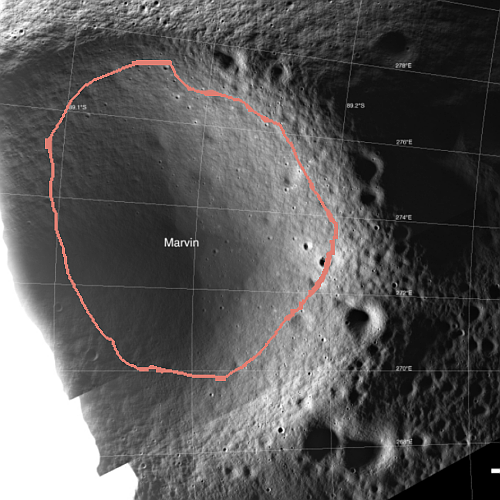
Using a camera on South Korea’s lunar orbiter Danuri, dubbed Shadowcam and designed to look into the permanently shadowed craters at the Moon’s poles, scientists have taken an image that sees into the forever dark region of one such crater.

The picture to the right, released on March 13, 2023 by the Shadowcam science team, is of the crater Marvin, located about 16 miles to the east of the south pole. The pink outline indicates the area that is thought to be permanently shadowed.

The second image to the right provides a wider view of the south pole region, with the craters labeled and outlined by the green lines. The orange lines mark permanently shadowed areas. The white box indicates the approximate area covered by the Shadowcam picture. One of the candidate landing sites for Starship, as part of NASA’s Artemis program, is the eastern rim of Shackleton, essentially at the south pole itself.

Previous data suggests that ice should be found in those permanently shadowed areas, because other orbiters have detected evidence of hydrogen there. The Shadowcam picture above however shows nothing that strongly suggests the presence of ice, unless that darker flat area on the floor of the crater is ice-infused dust. If so however, it is quite ancient and solid, based on the presence of several craters within it.

The press release makes no mention of this question, probably because the scientists are still analyzing the data. This first look however suggests the ice is not there, or is in a form that is going to require a lot of processing to extract the water from it.

1 comment
1 152 153 154 155 156 196