Scientists detect water inside lunar samples returned to Earth by Chang’e-5

Chinese scientists have found water molecules trapped within glass beads found within the lunar samples returned to Earth by the lunar lander Chang’e-5.

The team polished and analysed 117 glass beads which were scooped up by China’s Chang’e-5 spacecraft in December 2020 and brought back to Earth. The beads are formed by tiny meteorites that bombard the surface of the Moon, which lacks the protection of an atmosphere. The heat of the impact melts the surface material, which cools into round glass beads around the width of a strand of hair.

…The glass beads may make up around three to five percent of lunar soil, according to the study. A “back of the envelope” calculation suggested that there could be around a third of a trillion tonnes of water inside all the Moon’s glass beads, he added. And it only takes mild heat of around 100 degrees Celsius (210 Fahrenheit) to liberate the water from the beads, Anand said.

According to the paper, the water’s origin might be tied to the solar wind, and might have been implanted in the beads after their impact formation.

If this analysis is correct, it might explain the hydrogen signature found in large parts of the lunar surface, where it is believed water simply couldn’t exist. It also might explain why the first images inside permanently shadowed lunar craters show no obvious ice, only what appear to be ponds of dark dust. The dust might contain these beads, and thus explain the hydrogen signature detected there as well.


0 comments

A Martian crater with a surface pattern that resembles hanging draperies

A Martian crater with a surface pattern like hanging draperies

Cool image time! The picture to the right, rotated, cropped, reduced, and enhanced to post here, was taken on January 27, 2023 by the high resolution camera on Mars Reconnaissance Orbiter (MRO), and shows what the scientists label a “streak-spoke pattern” inside the crater. To my eye, the pattern more resembles hanging draperies, neatly tied near the top and then pulled apart as they descend to the ground.

This photo was a follow-up to a previous picture by MRO on February 4, 2008, more than seven Martian years ago, to see if there had been any identifiable changes in that time. Both images were taken in springtime, and despite the passage of time, the 2023 image shows no obvious changes from the 2008 photo.

What caused this distinct pattern? The first guess would be the wind, except if so shouldn’t there have been some change over seven Martian years?
» Read more

1 comment

Pushback: One doctor’s experience gives us all a ray of hope

In the three years since the beginning of what I think should be called the Wuhan panic, the civilized world was overwhelmed by a tidal wave of mindless emotional terror, resulting in a never-ending stream of terrible COVID policy decisions — from social distancing to masks to lockdowns to jab mandates — that ended up killing tens of thousands unnecessarily, while trampling on the liberties and rights that western civilization had once consider sacrosanct.

During that panic a large number of individuals, including myself and most of the conservative press, desperately tried to fight that panic with hard data, noting repeatedly that masks accomplished nothing, that social distancing was a sham, that lockdowns only destroyed lives and businesses, and that mandates of any kind (especially in connection with the COVID jab) were misguided and dangerous.

All to no avail. The power-hungry were in charge, controlling all the major branches of government as well as its health bureaucracy, and these people were eager to use COVID epidemic as a vehicle for gaining power. The fear they engendered in the general public, long used to relying on these people for accurate information, caused that public to buy into that fear, and accede to the power grab by these government officials.

Doctor Robert Lending
Doctor Robert Lending.

One person who tried mightily throughout the panic to focus solely on the data was my own doctor, Robert Lending. Each week he would issue a detailed COVID report, documenting at length the actual statistics as well as the most recent research on the best treatment methods as well as those that were failures. I have quoted his reports several times previously on Behind the Black, always with permission, because his approach was so fact-based and devoid of partisan politics. His only concern was to find the best way to treat his patients.

I have also quoted Lending repeatedly because he contrasted so starkly with my previous doctor, Charles Michieli, who when I asked his assistant in April 2020 if I could work out some accommodation for me regarding masks, as I had both health and ethical reasons for not wearing one, Michieli simply responded by sending me a letter firing me as a patient. So much for putting patients first, and doing no harm.

Lending’s own experience during the entire panic was sometimes as disturbing. Though he always treated all patients regardless of politics or their own COVID fears, his insistence on logic sometimes enraged some patients to the point that they quit his practice. For example, back in June 2020, when the George Floyd riots were occurring, he wrote the following in his twelfth update:
» Read more

11 comments

A multitude of strange galaxies

A multitude of strange galaxies
Click for original image.

Cool image time! The picture to the right, reduced and sharpened to post here, was taken by the Hubble Space Telescope and released today. From the caption:

Z 229-15 is one of those interesting celestial objects that, should you choose to research it, you will find defined as several different things: sometimes as an active galactic nucleus (an AGN); sometimes as a quasar; and sometimes as a Seyfert galaxy. Which of these is Z 229-15 really? The answer is that it is all of these things all at once, because these three definitions have significant overlap.

All three classifications involve galaxies with nuclei that are brighter, more energetic, and more massive than the rest of the galaxy. Z229-15 itself is estimated to be 390 million light years away.

Normally I would have cropped the image to center on Z229-15. However, I was struck by the number of other strange galaxies in the distance and on the periphery of the picture. Near the top is a trio of three, none of which appear spiral- or elliptical-shaped. On the right is a galaxy that could be a standard spiral seen edge-on, but its red nucleus is very unusual. And scattered across the bottom half of the image are a number of weirdly shaped galaxies of all types, none of which appear typical.

Be sure to look at the high resolution original. There are more weird galaxies visible there.

1 comment

Curiosity heads to the west of the Hill of Pillows

Panorama on March 27, 2023 (Sol 3781)
Click for full resolution panorama. The original images can be found here, here, here, here, and here.

Overview map
Click for interactive map.

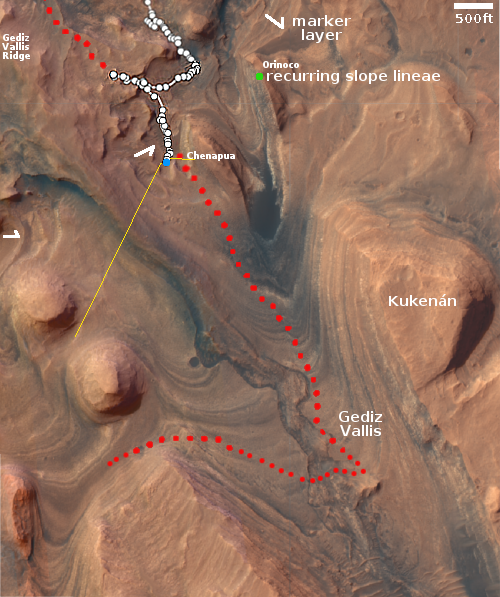
In my previous post on March 11, 2023 showing Curiosity’s spectacular view at that time in the foothills of Mount Sharp, the main question was: Which route will the rover take in the next few weeks? Based on the panorama above, created from five pictures taken by Curiosity’s right navigation camera today, it now appears that the science team has made its decision and will have the rover traverse to the west of what I label the Hill of Pillows.

The overview map to the right gives the context. The blue dot marks Curiosity’s position three days ago, with the yellow lines indicating the approximate area covered by the panorama. The red dotted line shows the planned route going past the Hill of Pillows to the east.

The science team took a careful look at the terrain in both directions, and decided the route to the west was both more gradual and less rough. This set of images by the navigation camera was now taken to better plan the route up in this hollow among its rock-strewn ground.

Make sure you look at the full resolution version of the panorama. You can see on the horizon the high mesas in the south just beginning to appear.

0 comments

Are launch prices up, or is the demand continuing to be high?

According to a Space News yesterday, high demand and inflation have resulted in an overall increase in launch prices in recent months.

At the recent Satellite 2023 conference, industry officials said they saw evidence of growing prices in the last year. Growing demand along with a constrained near-term supply that some have dubbed a โ€œglobal shortageโ€ is a factor, they say, along with inflation that has remained historically high for more than a year.

The only evidence of this increase that the article presents however is a 10% increase in SpaceX’s launch price, which the company claims is almost entirely due to inflation, not demand. Furthermore, this increase still leaves SpaceX’s launch prices well below the lowest prices that other launch companies can yet offer, which means the competition can’t really raise its prices significantly.

The important take-away from the article is not that the cost of rockets has gone up, but that the demand remains very high, which bodes well for the new startups trying to enter the market. For example, the article notes that the next SpaceX smallsat launch opportunity is 2025. There thus remains plenty of business for the many new rocket companies trying to enter the market in the next two years.

8 comments

Momentus reports successful use of its new water-based thrusters on its orbiting Vigoride-5 tug

The orbital tug startup Momentus on March 23, 2023 reported the successful use of its new water-based thrusters on its orbiting Vigoride-5 prototype tug, proving the design works.

The Reaction Control System operates using the same propellant and tank with water as the Vigoride spacecraftโ€™s primary MET propulsion system. The MET is designed to use water as a propellant and produce thrust by expelling extremely hot gases through a rocket nozzle. Unlike a conventional chemical rocket engine, which creates thrust through a chemical reaction, the MET is designed to create a plasma and thrust using microwave energy. When operational, the MET will be used to raise the orbital altitude and inclination of Vigoride-5.

Essentially this is a variation of an ion engine. The thrust will be low, but very efficient. The thrusters can therefore fire for a very long time, building up accelerations infeasible for chemical engines, and thus allowing the tug to significantly change the orbits of satellites in ways that was previously impossible.

This release came out the day before NASDAQ announced that Momentus has six months to raise the price of its stock above one dollar or be delisted from the stock exchange. Since its release, the stock price rose from $0.54 to $0.63, still below a dollar but going in the right direction, despite the NASDAQ announcement.

4 comments

NASDAQ gives two more space companies delisting warning

NASDAQ yesterday told the space companies Momentus and Spire they have six months to get their stock price over $1 or the stock exchange will delist each.

Small satellite builder and data specialist Spire Global received a notice from the New York Stock Exchange, while spacecraft delivery company Momentus received a notice from the Nasdaq. Under the respective exchanges’ compliance rules, the companies have 180 days, or about six months, to get their stock prices back above $1 a share.

Spire’s stock closed at 69 cents a share on Friday, having first slipped below $1 a share on Mar. 7. Momentus’ stock closed at 63 cents a share, slipping below $1 a share on Feb. 7.

Both companies now join Astra under the same threat. Both also have indicated they will consider a reverse-stock split, combining stocks to reduce the total number in order to bring the price above one dollar.

2 comments

India launches 36 OneWeb satellites

India’s space agency ISRO tonight successfully launched 36 OneWeb satellites using its LVM-M3 rocket, the largest version of its GSLV family of rockets.

This launch completes OneWeb’s constellation, with 618 satellites now in orbit, allowing them to now offer internet access worldwide in competition with Starlink. After Russia broke its contract and confiscated 36 OneWeb satellites, the company contracted SpaceX and ISRO to launch the satellites necessary to complete the constellation, with SpaceX doing three launches and ISRO two.

This was India’s second launch in 2023. The leaders in the 2023 launch race remain the same:

20 SpaceX
11 China
5 Russia
3 Rocket Lab

American private enterprise still leads China 23 to 11 in the national rankings, and the entire world combined 23 to 19. SpaceX by itself now trails the entire world, including other American companies, 20 to 22.

4 comments
1 150 151 152 153 154 196