SpaceX launches 55 more Starlink satellites

Using its Falcon 9 rocket, SpaceX tonight successfully launched 55 Starlink satellites into orbit, lifting off from Cape Canaveral.

The first stage successfully completed its 12th flight, landing on a drone ship in the Atlantic. (These 1st stage landings have become so routine that no one at SpaceX even cheered tonight when the stage landed.) The fairing halves completed their 6th and 8th flights respectively. As of posting, the satellites had not yet been deployed.

The 2023 launch race:

10 SpaceX
5 China
2 Russia
1 Rocket Lab
1 Japan
1 India

American private enterprise now leads China 11 to 5 in the national rankings, and the entire globe combined 11 to 9.

5 comments

Shortly after new Progress freighter docks with ISS, older Progress loses internal pressure

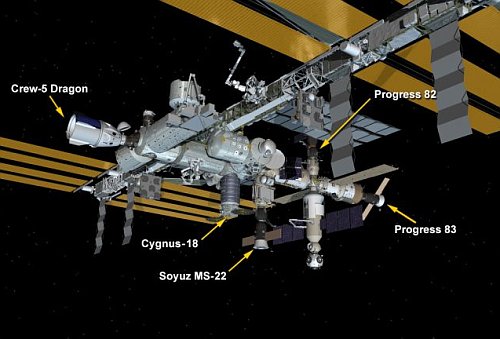
ISS as of February 11, 2023

Shortly after a new Progress freighter docked with ISS early today (shown as Progress 83 in the graphic to the right), the older Progress 82 lost internal pressure, possibly in its coolant system.

On February 11, Roskosmos, citing data from mission control, said that the Progress MS-21 cargo ship docked at the station lost pressure. According to the State Corporation, the hatch connecting the ship’s pressurized compartment with the rest of the station was closed and the vehicle was fully isolated from the ISS’ habitable volume.

…According to unofficial sources, the spacecraft lost all its cooling fluid from its Thermal Control System, SOTR. Several hours after the incident, NASA confirmed that the breach had been limited to the cooling system. At the same time, the US space agency said that the hatches between the cargo ship and the station had remained open, while temperatures and pressures aboard the outpost had remained normal. The subsequent publicly available exchange between the NASA mission control in Houston and a US astronaut Frank Rubio, aboard the ISS, indicated that the coolant system of the Progress MS-21 spacecraft had been completely emptied before the leak stopped.

The report is very unclear. In the first paragraph it suggests the freighter’s atmosphere had leaked out, while its hatches were closed and it was isolated from the station. The second paragraph suggests it only lost pressure and coolant from its coolant system, and the hatches had been open during the event.

Either way, this is the second Russian ferry spacecraft to experience such an event since mid-December, when the Soyuz capsule attached to ISS lost its coolant from what is believed to have been a small impact.

This particular Progress freighter is slated to be undocked from ISS on February 18th, when it will be de-orbited, burning up in the atmosphere over the Pacific. Thus, this leak appears to pose a relatively small risk to the station, as it probably has already been filled with station garbage and was likely ready for disposal anyway.

This incident however raises larger concerns. If it was caused by an impact from an external object, either micrometeorite or space junk, it suggests that the station might face a new increased risk of such events, quite possibly from debris from the Russian anti-satellite test in November 2021. As of November 2022 it was estimated that there were 444 objects still in orbit, with all but 18 expected to fall back to earth by 2025. It could be that one of those tracked objects hit ISS, or a different object that has not been tracked.

Or possibly we are seeing evidence of some quality control problem in the construction of these spacecraft, in Russia. Russia and NASA have still not revealed the results of the investigation into the hole that was drilled into the hull of a Soyuz capsule in 2018. Could there be some sabotage going on the ground in Russia that has not been identified that is designed to cause such leaks sometime after launch?

Some clarity on this issue is now becoming essential.

11 comments

February 10, 2023 Quick space links

Courtesy of BtB’s stringer Jay.


  • An update on the Epsilon F6 failure last October.
  • The release at the link is entirely in Japanese. According to Jay, “As of February 3 JAXA has now narrowed the cause of the RCS [reaction control system] failure to blockage of the diaphragm at the helium tank outlet.”


No blacklist column today. Been too busy with personal matters.

7 comments

Terraced serrated layered mesas on Mars

Terraced mesas on Mars
Click for original image.

Cool image time! The picture to the right, rotated, cropped, reduced, and sharpened to post here, was taken on November 19, 2022 by the high resolution camera on Mars Reconnaissance Orbiter (MRO). It shows a collection of terraced mesas covered with dust of a variety of colors.

The bluish colors suggest exposed bedrock, while the different shades of tan suggest areas covered by dust and volcanic ash. That the tan areas are likely dust is strengthened in that it is found between and on these rough mesas, where dunes are also seen. The dust gets blown in but gets trapped there.

The tan colors however could also indicate different types of bedrock, especially because different terraces seem to be of different shades. We will need more data to determine which, or whether this is a combination of all these geological processes.
» Read more

0 comments

Curiosity takes high resolution panorama of the canyon it will soon enter

Curiosity looks into Gediz Valles
Click for original image.

Using its high resolution camera, the Curiosity science team has now released a November 2022 panorama looking south into Gediz Vallis, the Martian slot canyon that the rover will be entering in the near future.

The panorama above, cropped and reduced to post here, shows that canyon. The red dotted line indicates Curiosity’s approximate path since the panorama was taken, circling around behind Chenapua.

The mosaic is made up of 18 individual images that were stitched together after being sent to Earth. The color has been adjusted to match lighting conditions as the human eye would see them on Earth.

Not only should you definitely look at the original, at full resolution, but also compare it with the black and white mosaic I posted in December 2022, taken by the rover’s navigation camera looking in the same direction though from a slightly different position. The color definitely underlines the spectacular nature of the landscape.

7 comments

NASA awards launch contract to Blue Origin’s unlaunched New Glenn rocket

NASA yesterday awarded Blue Origin the launch contract for its smallsat ESCAPADE Mars orbiter mission, set to launch in late 2024.

ESCAPADE will launch on Blue Originโ€™s New Glenn rocket from Space Launch Complex-36 at Cape Canaveral Space Force Station in Florida. Launch is targeted for late 2024. Blue Origin is one of 13 companies NASA selected for VADR contracts in 2022. NASAโ€™s Launch Services Program, based at the agencyโ€™s Kennedy Space Center in Florida, manages the VADR contracts. As part of VADR, the fixed-price indefinite-delivery/indefinite-quantity contracts have a five-year ordering period with a maximum total value of $300 million across all contracts.

NASA’s VADR program is designed to give contracts to higher risk contractors to help those launch companies develop their rockets. Since New Glenn is years behind schedule and as-yet unlaunched, this contract is an attempt to help change that. Note however that it is fixed price, and does not set a deadline for Blue Origin to launch.

ESCAPADE will actually be two orbiters designed to study the faint artifacts of Mars’ magnetosphere left over from its past.

7 comments

India successfully launches its SSLV rocket on 2nd attempt

On its second launch attempt tonight, India’s SSLV rocket (Small Satellite Launch Vehicle) successfully reached orbit and deployed all three of its smallsat payloads.

On the first launch attempt in August 2022, the engine on the fourth stage, used to put the satellites in their preferred orbits, shut down prematurely due to a failure of its guidance system. Today, all worked as planned.

The hope of India’s space agency ISRO is that this rocket can garner some of the growing smallsat business. That it is three years delayed because of ISRO’s panic over Wuhan makes fulfilling that hope more difficult, because so much of that business has now been grabbed by other companies.

The 2023 launch race:

9 SpaceX
5 China
2 Russia
1 Rocket Lab
1 Japan
1 India

American private enterprise still leads China 10 to 5 in the national rankings, and the entire world combined 10 to 9.

1 comment

February 9, 2023 Quick space links

Courtesy of BtB’s stringer Jay.


1 comment
1 173 174 175 176 177 196