Today’s blacklisted Americans: Religious pro-lifers prevented from viewing Bill of Rights because National Archives forbids free speech

The evil hat that Air & Space banned
An example of the evil pro-life clothing
banned by the National Archives

They’re coming for you next: Students and parents and others who had just attended the January 20, 2023 March for Life event in Washington were told by numerous National Archives security officials that day that they must remove or cover any pro-life shirts, jackets, hats, or buttons or they would be ejected from the museum.

From the lawsuit [pdf] filed by three of those pro-life individuals:

Plaintiff L.R., her mother, and her fellow classmates [about 35 people] were ushered through security and into the first group of visitors to enter the Rotunda where the Constitution and Bill of Rights are on exhibit.

…Approximately five minutes later, Plaintiff L.R. and her fellow classmates were suddenly approached by Defendant John Doe 1 who instructed Plaintiff L.R. and her classmates to remove all pro-life attire. John Doe 1 specifically instructed Plaintiff L.R. that she could not be wearing anything pro-life and that she must cover her shirt and not unzip it until she had left the National Archives. John Doe 1 also instructed Plaintiff L.R. and her other classmates to remove their pro-life buttons. John Doe 1 made other classmates standing near Plaintiff L.R. remove their pro-life hats. One such hat contained the inscription, “LIFE always WINS.” Another hat contained the inscription, “ProLife.” Plaintiff L.R. witnessed another guard participate in these instructions to her classmates and at no time did any of the other guards in the Rotunda intercede and provide contrary instruction.
» Read more

21 comments

Winter finally ends for Ingenuity

According to a detailed update today by Travis Brown, Chief Engineer of the Mars helicopter Ingenuity, the helicopter has now finally exited its difficult winter conditions that began in May 2022 and only ended at the end of January 2023.

One month to the day after the Dec. 24 flight attempt, Ingenuity did something it hadn’t done during the previous 260 sols – it slept “warmly” through the entire night. Data leading up to this event had suggested that such a survival was possible, but 8 long months of winter had tempered the team’s optimism. When Ingenuity’s team reviewed the downlinked data, they found that not only had it started living through the night, but had actually begun to bank power in its batteries. We’ve now seen end-of-sol states of charge in our batteries of more than 90% — an unbelievable number just days earlier. All the above means our sleepy friend has finally awoken from its long winter malaise, just in time to race up the Jezero Crater Delta and provide valuable advanced imaging for Perseverance.

Brown describes in detail their struggle for the past eight months to keep Ingenuity alive. That information is going to be crucial in designing future Mars helicopters, including the ones that will return to Jezero Crater sometime in the next decade to grab the core samples Perseverance has deposited for pick up and return to Earth.

1 comment

Canadian rocket startup dies because of opposition to noise produced by its engine tests

Though there were likely other issues, according the CEO of the now defunct rocket startup SpaceRyde the company died when the local government blocked engine tests on a piece of rural land it had purchased because of local protests.

The Trent Hills municipality of Ontario asked SpaceRyde to stop engine tests from a lot in the region Oct. 7 after their noise brought attention to how an industrial application was operating on rurally zoned land. When SpaceRyde bought the land, “the understanding at the time was it would be a temporary operation that focused on supporting the business of testing balloon technology to deliver satellites into orbit,” Trent Hills mayor Bob Crate said during a Sept. 13 council meeting.

A petition started last year to stop SpaceRyde rocket engine tests it says can be “heard for many miles” has received more than 800 signatures.

We are clearly entering a dark age when the general public cannot tolerate the noise produced during short static fire engine tests lasting generally no more than one or two minutes.

2 comments

China aiming to complete 80 launches in 2023

According to this Space.com article, China’s many pseudo-company rocket startups are hoping to complete a total of approximately 19 to 21 launches in 2023, which when combined with the 60-plus launches the government hopes to complete, will give China a total of approximately 80 launches in 2023, a new record.

The article provides a good review of all of the pseudo-companies hoping to launch in the next few years. This list includes the following:

  • Galactic Energy: 8 to 10 launches in ’23 with its Ceres-1 solid fueled rocket
  • Space Pioneer: The first launch of its liquid-fueled Tainlong-2 rocket
  • Exspace: 7 launches with its Kuaizhou-1A and larger Kuaizhou-11, both solid-fueled
  • Landspace: A second launch attempt of its liquid-fueled Zhuque-2 rocket after a launch failure in ’22
  • Orienspace: The first launch of its Gravity-1 solid fueled rocket
  • Rocket Pi: The first launch of its Darwin-1 liquid fueled rocket
  • Ispace: Unknown after three consecutive launch failures of its Hyperbola-1 solid-fueled rocket

The article also adds launches from two government “private” spinoffs, CAS Space, planning 3 launches of its PR-1solid fueled rocket, and China Rocket, planning at least one launch of its Jielong-3 solid fueled rocket. Though both are touted as private, they are both really separate divisions created by China’s space agency CASC, with their launch counts likely included in the government’s hope-for 60 launches.

The pseudo private companies are somewhat more independent as they were founded by private individuals. All appear to have obtained private Chinese capital — in addition to government funding — to fund their development. All however are also entirely supervised in all actions by the government. None could build anything without government approval, and all are depending on government rocket technology that can be withdrawn at any time. These pseudo companies don’t really own their rockets. Furthermore, while they are able to sell their products to other private entities, their market appears almost entirely confined to China.

12 comments

Intuitive Machines completes merger with SPAC as it goes public

Intuitive Machines, one of a handful of American companies building lunar landers for NASA and others, has completed its merger with a special purpose acquisition company (SPAC), thus becoming a publicly traded stock but raising less money than expected in the process.

Intuitive Machines said Feb. 13 it had closed its merger with Inflection Point Acquisition Corp., a SPAC that trades on the Nasdaq. The merged company, retaining the Intuitive Machines name, will trade on the Nasdaq starting Feb. 14 under the ticker symbol LUNR.

The companies announced the merger in September 2022, long after the mania surrounding SPACs has cooled both in the space industry and the overall market. Inflection Point had $301 million of cash in trust, and the companies said they had arranged an additional $55 million in investment from the SPAC’s sponsors and a founder of Intuitive Machines, along with $50 million CF Principal Investments LLC, an affiliate of Cantor Fitzgerald & Company. In an investor presentation linked to the merger announcement, the companies anticipated having more than $330 million in cash after transaction expenses.

However, in the Feb. 13 announcement that the merger had closed, the companies announced only $55 million of “committed capital from an affiliate of its sponsor and company founders.”

It appears that many investors in Inflection Point itself (30% of whom had voted against this merger) had pulled their money from the fund, depleting the $301 million that was originally promised. In addition, yesterday’s announcement made no mention of the $50 million that CF had also committed.

Essentially, the company’s future hinges on the success of its first lunar mission, presently scheduled for June. Should it succeed, the company should be able to replace from other investors the funds that it failed to raise in this merger. Should it fail, it is very possible it will go belly up, as it is likely it will find it difficult if not impossible to find further investment capital.

There is of course the possibility that NASA will keep the company afloat with additional funding, but if so it might be a case of throwing good money after bad, something our government is very good at doing.

1 comment

February 13, 2023 Quick space links

Courtesy of BtB’s stringer Jay, who also clued me into to the updates on the Russian spacecraft leak situation on ISS.

  • Blue Origin says it has made both solar cells and electricity transmission wires from simulated lunar soil
  • The article claims this is a major breakthrough, but I am sincerely underwhelmed. Though eventually such technology might be important for lunar colonists, right now it makes no sense to spend private capital on it. For at least the next two decades, power on the Moon is going to from solar panels shipped there. Other companies such as Astrobotics are developing cheap and easy-to-ship-and-install panels for those first missions, and they, not Blue Origin, are going to reap the profits.


  • Pseudo Chinese rocket startup Space Pioneer gearing up for first launch of Tianlong-2 rocket by end of March
  • If successful, it would be the first liquid fueled rocket by a Chinese pseudo company to reach orbit. Others have tried and failed.


7 comments

Cracked ash-filled Martian terrain

Cracked ash-filled fissures on Mars
Click for original image.

Cool image time! The photo to the right, cropped, reduced, and sharpened to post here, was taken on September 26, 2022 by the high resolution camera on Mars Reconnaissance Orbiter (MRO). The science team labeled this “Possible Pit,” but other than a small dark stain on the rim of a crater north of the section cropped to the right, I could find nothing that even closely resembled a pit. More likely the scientists were referring to the large circular depression in the top center of this picture. It does not at first glance look like a crater, as it has no obvious rim. In fact, almost none of the circular depressions in this image look like craters, as almost none have uplifted rims.

However, it is not clear what caused these dust-filled fractures as well as the image’s many circular depressions. The location, as indicated by the overview map below, does not really help.
» Read more

1 comment

First picture of hole that occurred on Soyuz in December

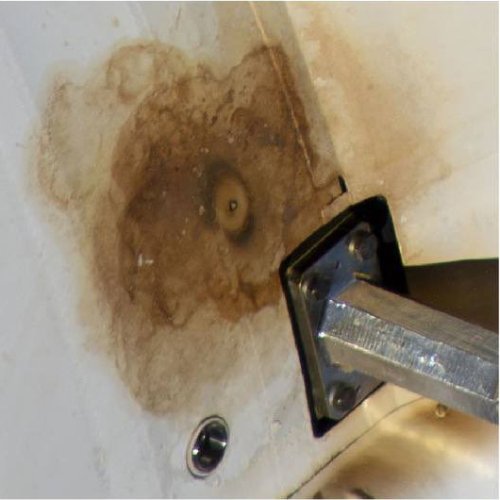
Hole in First picture of hole that occurred on Soyuz in December

Russia has now released an image taken using the robot arm on ISS of the leak that occurred on its Soyuz capsule docked to ISS in December.

The picture to the right, cropped and reduced to post here, is that image. This is not the coolant leak hole on the Progress freighter on February 11th, this past weekend. As of now no image of that hole has ever been released.

No interpretation of this hole and the stain around it has as yet been released. However, Russia has now postponed the launch of the next Soyuz capsule from February 19th until early March in order “to give investigators time to rule out similar issues in the upcoming mission.” This Soyuz was to launch unmanned to replace the Soyuz that leaked in December and provide the astronauts that launched on that leaking Soyuz a safe lifeboat that they could come home on.

Meanwhile, all communications with ISS have now been shifted to the private channels, so the public cannot hear them.

All these actions strongly suggest that both the Russians and Americans are now seriously considering the possibility of sabotage or damage to the coolant systems on all Russian spacecraft, before they leave the factory and are launched.

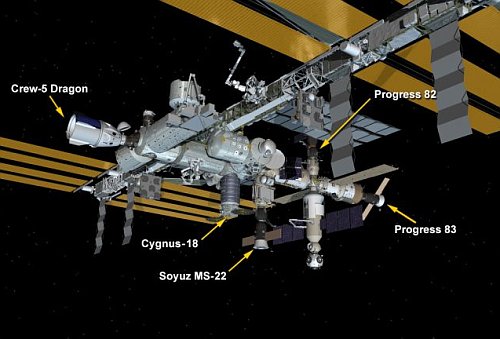
ISS as of February 11, 2023

To clarify the situation, the image to the right shows all the spacecraft presently docked to ISS. Progress 82 is the spacecraft that experienced a leak in its coolant system on February 11th. Soyuz-MS22 experienced a leak in its coolant system in December. At the moment the only safe vehicle for returning the seven astronauts on ISS is Crew-5 Dragon, SpaceX’s Endurance spacecraft. Should a major catastrophe occur requiring an immediate evacuation of the station, the plan right now is for five astronauts to come home on Endurance, and two Russians to come home on the damaged Soyuz. (The thinking is that having only two men on board will prevent too much of a temperature rise during the return to Earth because of the lack of its coolant system.)

With the delay in the launch of the replacement Soyuz lifeboat, this emergency plan will be in place for at least three weeks longer.

15 comments

A real blacklist designed to choke ad profits from conservative and legitimate news organizations

Blacklisted conservative news outlets
Conservative news outlets blacklisted by Microsoft’s Xandr,
based on advice from GDI

They’re coming for you next: Using American federal funds, a British “disinformation” group called the Global Disinformation Index (GDI) has created a real blacklist of valid and longstanding conservative news organizations and fed that list to internet ad companies to encourage them to cut ad revenue from those news organizations.

A sampling of the blacklisted news companies that have actually been punished financially by this effort is shown to the right

Of the ad companies, a Microsoft company named Xander appears to be the most enthusiastic about using GDI’s blacklist to choke ad sales to conservatives sites.

GDI’s “dynamic exclusion list” includes at least 2,000 domains, many of which are “foreign state-sponsored news and opinion sites, forums that traffic in disinformation, and explicitly sanctioned websites,” according to a second source close to Microsoft. Each month, GDI sends Xandr a list of websites on this blacklist, said the source.

The Washington Examiner revealed on Thursday that it is on GDI’s list and spoke to an ad-buying source who said Breitbart News is also. Separately, GDI has said that the 10 “riskiest” news outlets for purported disinformation are the American Spectator, Newsmax, the Federalist, the American Conservative, One America News Network, the Blaze, the Daily Wire, RealClearPolitics, Reason, and the New York Post.

All those news outlets are legitimate, well established, and reasonable and reliable sources of information. No one should rely solely on them for their news, but to call their reporting “false,” “misleading,” “hate speech,” “reprehensible,” or “offensive” merely because they publish news from a conservative perspective is fundamentally dishonest. To then blacklist them because they have a different perspective is pure censorship by the left against its political opponents.

That the blacklist is definitely partisan is proven by the news outlets GDI has determined are acceptable.
» Read more

18 comments

Trio of colliding galaxies

Trio of colliding galaxies
Click for original image.

Cool image time! The picture above, cropped and reduced to post here, was taken by the Hubble Space Telescope and released today. From the caption:

Three galaxies stand together just right of centre. They are close enough that they appear to be merging into one. Their shapes are distorted, with strands of gas and dust running between them. Each is emitting a lot of light. Further to the left is an unconnected, dimmer spiral galaxy. The background is dark, with a few smaller, dim and faint galaxies and a couple of stars.

Astronomers estimate the colliding galaxies are about 50,000 light years from each other, which for galaxies is quite close. Eventually gravity will cause all three to merge into a single very large galaxy, its shape distorted by the merger. What that shape will be is one of the things astronomers are trying to figure out. At present their theories for galaxy evolution states that as galaxies grow by absorbing smaller nearby neighbors, they evolve from spirals to ellipticals, giant blobs lacking a distinct obvious structure.

3 comments

One of Saudi Arabia’s two Axiom passengers later this year will be a woman

In announcing the two astronauts who will fly as passengers on Axiom’s commercial Ax-2 flight to ISS in the second quarter of 2023, Saudi Arabia also revealed that one will be the first female Arabian to fly in space.

Saudi nationals Rayyanah Barnawi and Ali al-Qarni will join the crew of the AX-2 space mission in an accomplishment that comes in line with the Kingdom’s Vision 2030. The spaceflight is set to launch from the United States to the ISS.

There is an aggressive space race now in the Middle East between Arab nations. The UAE started it by making space exploration a major goal for diversifying its economy. Saudi Arabia has now followed with its own program. Turkey, Bahrain, and Oman have also joined in.

1 comment
1 172 173 174 175 176 196