Australian rocket startup raises $36 million in private investment capital
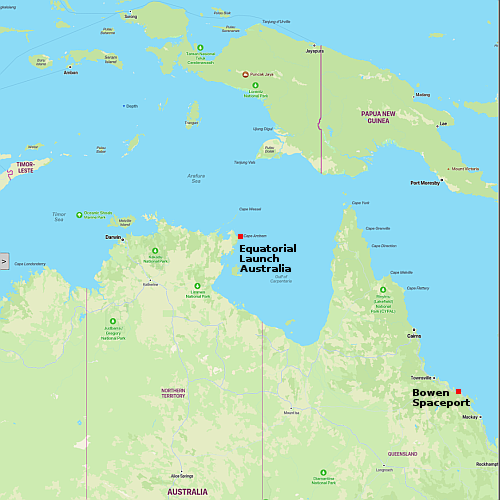
Proposed Australian commercial spaceports

The Australian rocket startup Gilmour Space has now raised $36 million in private investment capital in its most recent fund-raising round. The company had previously raised $46 million.

The funding supports the small launch vehicle startupโ€™s campaign to manufacture, test and begin launching rockets and satellites from the Bowen Orbital Spaceport in North Queensland.

Gilmour Space, founded in 2012, is developing a three-stage rocket called Eris. The first Eris test flight is expected โ€œin the coming months, pending launch approvals from the Australian Space Agency,โ€ according to the Gilmour Space news release. A second test flight is expected later this year and commercial launches are scheduled to begin in 2025. [emphasis mine]

The map to the right shows both the location of Gilmour’s Bowen launch site, but also that of Equatorial Launch Australia (ELA), which is building a spaceport open to all rocket companies.

Gilmour had originally announced plans for an April 2023 launch. Though it is not surprising for a new rocket company to experience delays in developing a new rocket, the highlighted phrase in the quote above, which has appeared in a previous story in September 2023 about the delays at Gilmore, strongly suggests Australia’s government might be a problem as well. Its legal framework is strongly influcenced by Great Britain’s, which has turned out to be a nightmare for both rocket companies and spaceports. That approvals have been pending now for many months is further evidence this is so.


1 comment

Roscosmos: Russia will do 40 launches in 2024

Yury Borosov, the head of Roscosmos, the agency that controls all of Russia’s aerospace industry, announced today that it intends to complete 40 launches in 2024.

“Over 40 [space launches]. However, plans always remain just plans. Last year, we also planned a large number of launches. But, unfortunately, we could not implement the launch program in full due to some objective circumstances,” the Roscosmos head said.

Roscosmos took efforts last year and keeps taking them this year to ensure the smooth joint operation of its enterprises, Borisov stressed. “This is being done to rule out delays. The main task for this year is to fulfil the entire launch program,” the Roscosmos chief said.

The last time Russia completed 40 launches in a single year was 1994. Since 2015, when SpaceX essentially began full launch operations and began taking away its share of the commercial launch market, Russia has struggled to manage 20 launches a year. Furthermore, since 2022 and its invasion of the Ukraine, it has lost almost all of its remaining international customers. Unless its military has suddenly found money to increase its launch rate significantly, Borosov’s prediction seems absurd. Nor is there any reason to believe Russia’s government has the cash to increase its military launch rate.

Note too that the year is already seven weeks old, and Russia has only launched twice. At that pace it will only launch about 12 times this year.

0 comments

There is no diversity in American academia, none at all

Banned on campuses nationwide

The modern academic racist bureaucracy that is usually called “Diversity, Equity, and Inclusion” (DEI) attempts over and over again to gaslight us into believing its goal is to welcome everyone. For example, on Yale’s DEI webpage is this statement in outlining its “Belonging” program:

Advancing Yaleโ€™s mission in vibrant community life, in which members encounter and appraise a broad array of ideas, are treated with dignity and respect, and feel welcome to make their voices heard;

Nothing about Yale’s belonging program however encourages free expression, and in fact it works agreesively to discourage it. On a related DEI webpage, it states the following about free expression:
» Read more

14 comments

Alternating dark and light terraces inside Valles Marineris

Overview map

Alternating dark and light layered terraces in Valles Marineris
Click for original image.

Cool image time! The picture to the right, cropped and enhanced to post here, was taken on October 9, 2023 by the high resolution camera on Mars Reconnaissance Orbiter (MRO), and shows what appear to be the somewhat typical terrain at this location, in a part of the giant Martian canyon Valles Marineris dubbed West Candor Chasma. For example, I featured similar swirls in August 2022 at a place only about six miles to the east, that spot indicated by the green dot on the overview map above. The white dot marks the location of today’s image.

So, what are we looking at? The elevation drop from the high and low points is only about 180 feet, but in that short distance it appears there are more than two dozen visible layers, and those layers form terraces that alternate between bright and dark material.

The shape of the swirls also suggest that a flow of some kind, either water, ice, or wind, moved from the northwest to the southeast, carving these terraces as it descended the stair steps downward. It is also just as likely that we are seeing repeated lava flows going downhill to the southeast, each even laying another layer on top of the preceeding one. And it is also possible that we are looking at a combination of both.

The alternating dark and light layers suggest that each dark layer was an event that put down dark material, such as volcanic dust, that was subsequently covered with light material, with this process repeating itself many times over the eons.

That the floor of this part of Valles Marineris is uniquely covered in this manner is in itself intriguing. Why here, and not elsewhere within the canyon?

1 comment

ESA awards Spanish launch startup PLD a million-plus development contract

Capitalism in space: The European Space Agency (ESA) today awarded the Spanish launch startup PLD a โ‚ฌ1.3 million contract to develop a payload deployment system for its Miura-5 orbital rocket, expected to make its first launch in 2025.

Designed to release all types of satellites with as much flexibility as possible, the payload system โ€“ called MOSPA for Modular Solution for Payload Adapter โ€“ will allow PLD Space to offer its customers a wider range of missions and services, including accommodation of CubeSats, nanosatellites and microsatellites. The development of the modular payload adapter will be done in partnership with OCCAM Space. The goal is to create the hardware to be as light as possible while also being as adaptable as possible to launch more satellites and meet market demands.

โ€œPLD space has proven itself with its first launch last year, and we look forward to seeing the experience applied to the Miura 5 launch services development,โ€ says ESA’s Jorgen Bru, โ€œThe payload adapter development engaged today was chosen to increase market competitiveness and ensure that many different types of satellites and customers can fly.โ€

This contract once again signals ESA’s shift from depending solely on its own launch company, Arianespace, to instead obtaining launch contracts from as many private, independent, and competing European companies as possible. Arianespace, for many reasons (some not its fault), failed to develop rockets capable of competing with SpaceX, and also failed to get them developed on time. ESA presently has no launch capability, and has had to sign contracts with SpaceX to get its payloads into orbit.

The shift is ground-shaking. It suggests that in the next two decades Europe should have a half dozen competing rocket companies of its own, all striving for business and thus all working hard to come up with ways to reduce launch costs. Under the Arianespace monopoly, little innovation took place, launch costs never dropped, and though for many years it controlled a majority of the launch market, it could never make a profit.

3 comments

Rocket Lab successfully launches Japanese commercial space junk demo satellite

Rocket Lab today successfully launched a commercial test mission of commercial space junk removal satellite, dubbed ADRAS-J and built by the Japanese company Astroscale, in partner with Japan’s space agency JAXA. It is designed to demonstrate the ability to make a close rendezvous of a large piece of space junk and then photograph and inspect it closely to determing it precise condition to facilitate later removal efforts.

The leaders in the 2024 launch race:

15 SpaceX
8 China
2 Iran
2 Russia
2 Japan
2 India
2 Rocket Lab

A lot of launch entities grouped at 2. Expect Iran and Japan to fall away as Russia, India, and Rocket Lab continue to launch regularly this year, with Russia and Rocket Lab eventually outpacing India.

American private enterprise now leads the entire world combined in successful launches 18 to 16, with SpaceX still trailing the entire world combined (excluding American companies) 15 to 16.

2 comments

Japan and India successfully complete launches

Japan and India today completed launches of different rockets, one on its first successful test launch.

First, early this morning Japan’s new H3 rocket successfully reached orbit for the first time, on its second attempt. The first attempt had problems, first with a launch abort at T-0 when the solid-fueled strap-on boosters failed to ignite. On the launch attempt the upper stage failed. Today’s launch was a complete success, placing a dummy payload into orbit.

Japan’s space agency JAXA however needs to learn how to run a launch in a professional manner. Minutes prior to launch an announcer began a second-by-second countdown, and continued this for minutes after the launch. Not only was this unnecessary and annoying, it made the real updates impossible to hear. India used to do this in its first few live streams, but quickly recognized the stupidity of it. In addition, the person translating the updates clearly knew nothing about rocket launches, so her translations were tentative and often completely misunderstood what had just happened.

All of this makes JAXA look like a second rate organization, which might also help explain its numerous technical failures in recent years.

About twelve hours later, at mid-day in India, India’s space agency ISRO successfully launched its GSLV rocket, placing a commercial radar environmental satellite into orbit.

The leaders in the 2024 launch race:

15 SpaceX
8 China
2 Iran
2 Russia
2 Japan
2 India

American private enterprise still leads the entire world combined in successful launches 17 to 16, with SpaceX trailing the entire world combined (excluding American companies) 15 to 16.

6 comments

Maurice Jarre – Lawrence of Arabia

An evening pause: Performed by the BBC Concert Orchestra. I think this makes for a good way to start the weekend. If you have time, get the movie and watch it. One of the greatest ever made.

Hat tip Doug Johnson.

0 comments

Enrollment drops force major cuts to academic but not DEI programs at UNC Greensboro


What the modern college education is becoming: “But
Brawndo’s got what plants crave. It’s got electrolytes!”

Because of an approximate 10% drop in enrollment since 2017, the University of North Carolina at Greensboro has now announced major cuts to many academic programs, while leaving untouched its many racially-based programs.

Five majors are being completely eliminated, according to a recent announcement from Chancellor Franklin Gilliam: anthropology, geography, physics, physical education and religious studies. Three language minors โ€” Chinese, Russian, and Korean โ€” are also on the chopping block. The university is also ending 12 graduate programs and is pausing admissions in its masters drama program.

These cuts were detailed in an announcement by the university’s chancellor, Franklin D. Gilliam, Jr. Interestingly, his announced cuts left entirely untouched the small Diversity, Equity, and Inclusion (DEI) office is he runs from within his office. Nor did the cuts include the university’s Office of Intercultural Engagement, which appears entirely focused on favoring the queer agenda and students who advocate it. The cuts also left intact the college’s black studies and its women’s, gender, and sexuality departments, both of which might be popular but neither contribute much to providing students a real education.
» Read more

18 comments

The alien surface of Mars

The alien surface of Gediz Vallis
Click for original image.

Overview map
Click for interactive map.

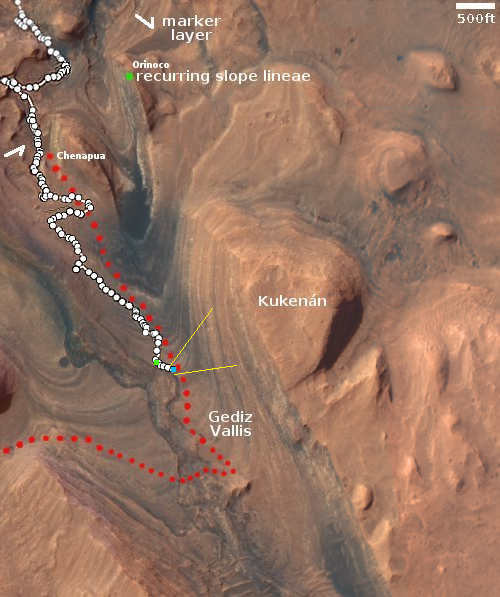
Cool image time! The picture above, brightened slightly to post here, was taken on February 15, 2024 by the right navigation camera on the Mars rover Curiosity. It looks east at the looming cliff face of the mountain Kukenan that the rover has been traveling beside for the last six months. On the overview map to the right the yellow lines indicate roughly the area covered by this picture. The blue dot marks Curiosity’s present position, while the green dot marks its position on February 5, 2024. As you can see, the rover is making slow but steady progress uphill into Gediz Vallis.

This image illustrates the alien landscape of Mars quite beautifully. First, there is absolutely no life in this picture. On Earth you would be hard pressed to find any spot on the surface that doesn’t have at least some plant life.

Second, there is the rocky layered nature of this mountain. When the Curiosity science team first announced its future route plans (the red dotted line) to drive into this canyon back in 2019, the orbital images of these layers from Mars Reconnaissance Orbiter (MRO) had suggested the terrain here would be reminiscent of The Wave in northern Arizona, a smooth series of curved layers smoothed nicely over time by the wind.

As you can see, there is no smoothness here. Instead, every single layer here is infused with broken rock, suggesting that each layer is structurally weak. As erosion exposes each, the layer breaks up, crumbling into the chaos in this picture. The curved nature of the terrain at the bottom of the picture however does suggest that some sort of flow once percolated down this canyon, either liquid water or glacial ice, carving the layers into this curved floor.

3 comments
1 164 165 166 167 168 191