February 1, 2024 Quick space links

Courtesy of BtB’s stringer Jay. This post is also an open thread. I welcome my readers to post any comments or additional links relating to any space issues, even if unrelated to the links below. I also apologize for the lack of posting today, as I have been dealing with eye doctors.


5 comments

A soft but dim spiral

A soft but dim spiral
Click for original image.

Cool image time! The picture to the right, cropped, reduced, and sharpened to post here, was taken by the Hubble Space Telescope as part of a survey of nearby galaxies in which supernovae had previously been detected.

This softly luminous galaxy โ€” lying in the constellation Hercules, about 110 million light-years from Earth โ€” seems outshone by the sparkling foreground stars that surround it. The type II supernova which took place in this galaxy in 2019, while no longer visible in this image, definitely outshone the galaxy at the time!

What amazes me about this somewhat dim spiral galaxy is its beautiful structure, its two spiral arms coiling outward in perfect symmetry. And yet, we are looking at a object that is almost entirely empty space, hundreds of thousands of light years across. Somehow the almost infinitesimal force of gravity at those distances is still able to shape the arms, and the spirals.

3 comments

Another exoplanet found in habitable zone

Astronomers using both space- and ground-based telescopes have confirmed the existence of another rocky exoplanet inside the habitable zone of its star.

The star is a red dwarf 137 light years away. The exoplanet, dubbed TOI-175 b, is estimated to be larger than Earth, with a diameter 1.5 times that of our home planet. It orbits its star every nineteen days. Even more intriguing, the data suggests this star has a second exoplanet even better positioned in the habitable zone that would be the smallest habitable-zone exoplanet so far found, about the size of Earth.

The second planet however is not yet confirmed.

This discovery is no longer very unique. In the past few years astronomers have discovered a plethora of Earth-sized exoplanets, many in the habitable zone.

1 comment

Japan and India team up for unmanned lunar lander mission

Japan and India are now partnering to put a lander/rover on the Moon in 2025, dubbed LUPEX.

Set tentatively for 2025, LUPEX will be launched on JAXAโ€™s H3 launcher, with a 350-kg rover developed by the Japanese agency. ISRO is developing the lander. The instruments will be on the lander and the rover. Initial feasibility studies and the landerโ€™s configuration have been completed. The rover will sample the soil with a driller and the samples will be analysed using equipment on the rover,

Unlike the previously successful lunar landers from both countries (India’s Chandrayaan-3 and Japan’s SLIM), LUPEX is being designed to survive the 14-day-long lunar night, with a mission that is aiming to last three to six months.

0 comments

Update on Jared Isaacman’s upcoming Polaris Dawn manned mission

Link here. Bottom line is that they still hope to launch on a five day orbital mission in SpaceX’s Resilience Dragon capsule later this year, during which they will do the first privately funded non-government spacewalk.

Developing new spacworthy spacesuits remains the biggest task before the mission can fly.

In a series of social media updates on Friday and Saturday, Isaacman answered some questions from the public about the progression of the suit development and the mission overall. He stated that over the past week, they โ€œspent a lot of time pressurized in the EVA suits working contingencies.โ€

Isaacman clarified as well that, unlike missions to the International Space Station chartered by either NASA or Axiom Space, the crew members of the Polaris Dawn mission wonโ€™t launch and land while wearing IVA suits. He said because they are limited with space on this flight, they will only have their EVA suits.

No launch date has yet been set.

0 comments

January 31, 2024 Quick space links

Courtesy of BtB’s stringer Jay. This post is also an open thread. I welcome my readers to post any comments or additional links relating to any space issues, even if unrelated to the links below.


10 comments

Voyager signs SpaceX’s Starship to launch its Starlab space station

Voyager Space, one of three commercial space stations being built in partnership with NASA, has awarded SpaceX the launch contract for putting its Starlab space station into orbit, using that company’s Superheavy/Starship rocket.

The companies did not disclose terms of the agreement or a projected launch date, although a spokesperson for Starlab Space said the company was confident that Starlab would be launched before the decommissioning of the International Space Station, currently scheduled for 2030.

Voyager is building Starlab in a joint partnership with Airbus and Northrop Grumman. The design is relatively simple though large (one main module and a service module), which makes Starship an excellent method for getting it into orbit.

SpaceX now has deals to launch two different space stations using Starship. The second is with the private company Vast, which is building its station completely independent from NASA. Starship also has won launch contracts from two different private citizens, as well as NASA.

It appears that Musk’s instincts were right on the money when he decided to build this rocket, even though when he proposed it there did not seem to be any customers for it.

Hat tip to BtB’s stringer Jay.

5 comments

Have these Martian dunes changed in sixteen years?

Comparing two MRO images taken 16 years apart
Click here and here for the original images.

Overview map

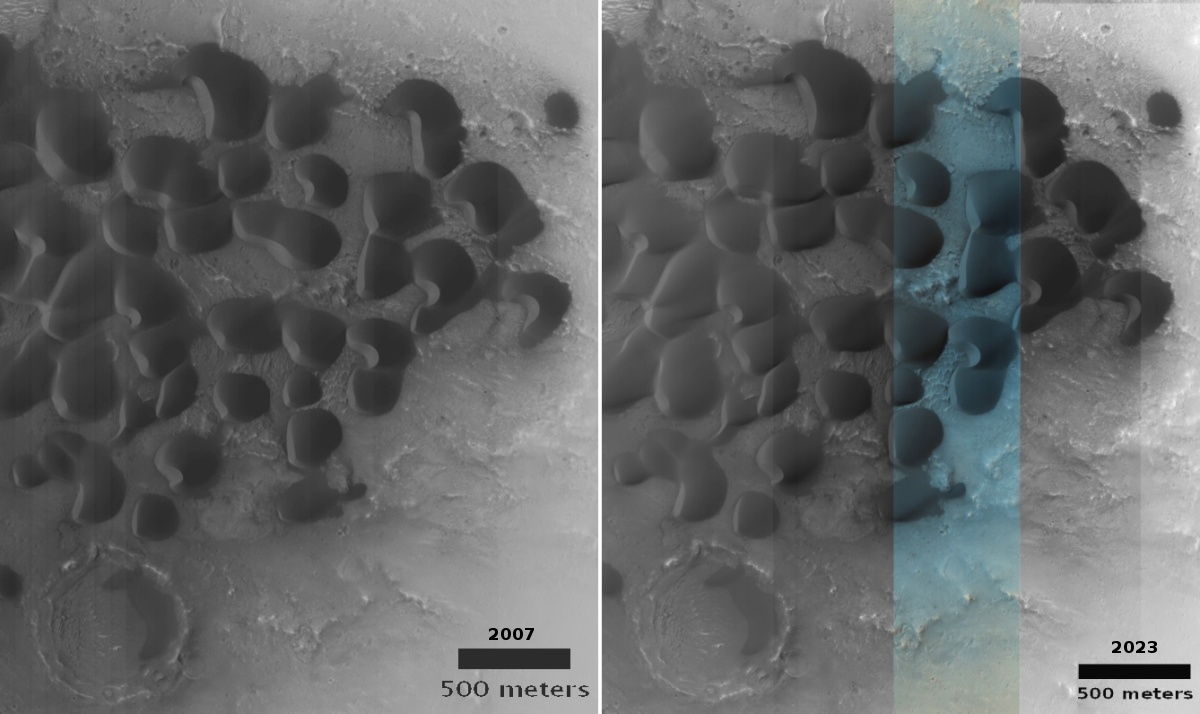
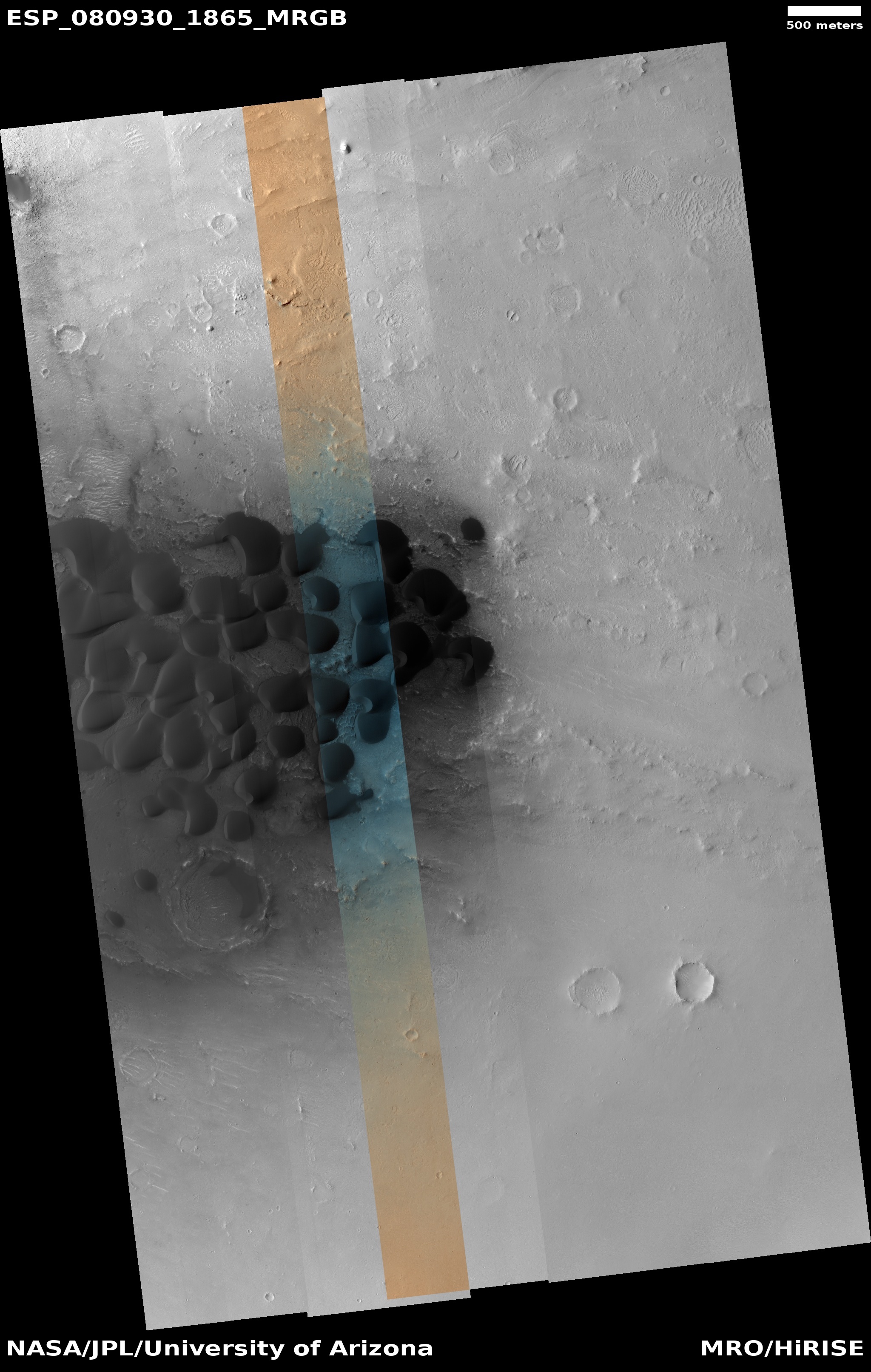
Cool image time! The two pictures above, both rotated, cropped, reduced, and enhanced to match and to post here, were taken by the high resolution camera on Mars Reconnaissance Orbiter (MRO) sixteen years apart. The first, on the left, was taken on February 23, 2007, while the second, on the right, was taken on November 1, 2023.

What drew me to both images was the label for the second: “Dune Change in Arabia Region Crater.” To find out if this image had revealed any changes in the dunes I went back and found the earliest MRO picture of this location, and sized and enhanced the dunes in both to match.

Do you see any changes? I don’t. However, that really means nothing. These are not the highest resolution versions that MRO obtains, and a very careful comparison of those best images might detect more subtle changes than our eyes can perceive in the versions above. Also, there might be brightness changes that require careful software analysis.

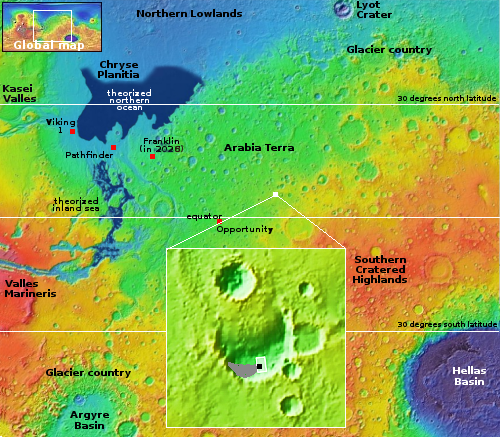
The white dot on the overview map to the right marks the location, in Arabia Terra, the largest transition region on Mars between the northern lowland plains and the southern cratered highlands. The inset shows the half filled crater in which these dunes sit. The grayed area on the floor of the crater marks the entire dune field, extending eastward to the crater rim from this one spot, indicated by the black dot.

It is likely that the dust is blown into this crater and gets trapped there. Whether the dunes move or change is not clear, though if they do the changes are small, even after almost two decades. Instead, the two pictures suggest these dunes have hardened into a form of sandstone, that can be eroded over time by the wind, but only very very slowly.

3 comments

Shoddy Harvard — home of plagiarism and bigotry — loses another big donor

Harvard: where you get can get a shoddy education centered on hate and bigotry
Harvard: where you can spend a lot of money
getting a shoddy education teaching hate and bigotry

One of Harvard’s biggest donors, Ken Griffin, has announced that he is pausing all further donations to the university due to its now obviously shoddy educational standards combined with its advocacy of racial quotas under its Diversity, Equity, and Inclusion program.

Griffin announced his decision to stop donating to Harvard during a keynote talk at a conference hosted by the Managed Funds Association in Miami. Griffin, however, left open the possibility that the University could win back his support. โ€œIโ€™d like that to change and I have made that clear to members of the corporate board,โ€ he said. โ€œBut until Harvard makes it very clear that theyโ€™re going to resume their role as educating young American men and women to be leaders, to be problem solvers, to take on difficult issues, Iโ€™m not interested in supporting the institution.โ€

He added that Harvard students were โ€œwhiny snowflakesโ€ caught in a misguided ideology of oppressor and oppressed during his remarks.

Griffin also stated that his companies will hire no students who signed a group letter that expressed support for Hamas’ rape, torture, and massacre of more than 1,400 Israelis on October 7, 2023.

Griffin has donated more than half a billion to Harvard in recent years, including a $300 million donation to Harvardโ€™s Faculty of Arts and Sciences last year.

He is also not the first billionaire to announce a boycott of Harvard. In November Bill Ackman, a billionaire hedge fund manager and Harvard alumni, released a long letter condemning the university’s former president Claudine Gay for allowing anti-Semitism to fester at the school. Like Griffin, he is apparently withholding further donations while refusing to hire students. Ackman has since repeatedly harangued Harvard in public for its refusal to take any serious reform actions.

Then in December billionaire Leonard Blavatnik stopped his own donations, also because he was appalled by the uinversity’s willingness to allow anti-Semitism to run rampant on campus.

These three men combined had previously donated almost a billion dollars total to the university. One would think their boycott would carry profound weight, and force some immediate changes at Harvard.

Don’t bet on it. » Read more

11 comments

Scientists: No obvious ice in the permanently-shadowed interior of Shackleton Crater

Shadowcam-LRO mosaic
Click for original image.

Using the low-light image produced by the American Shadowcam instrument on South Korea’s lunar orbiter Danuri, scientists now belief that there are no thick obvious deposits of water ice in in the permanently-shadowed interior of Shackleton Crater at the Moon’s south pole.

The image to the right combines pictures taken by Lunar Reconnaissance Orbiter (LRO) of the region around Shackleton with pictures produced by Shadowcam of its permanently-shadowed interior. From their paper’s conclusion:

The trailing (right) side of Shackleton’s interior is warmer owing to the secondary illumination asymmetry and floor topography. Illumination at the floor of Shackleton is patchy and possibly indicates a similar patchy (50 m scale) temperature distribution, which could mean a spatially irregular concentration of cold-trapped volatiles at the subsurface or mixed with regolith.

According to our Shackleton crater interior mapping from ShadowCam images, there is no observed evidence of thick ice deposits or surface ice that could be easily recognized by any relative brightness features observed in multiple illumination geometries. However, this analysis did not include the estimation of reflectance, nor did it involve reviewing all of the images of Shackleton in this preliminary study. Our hypothesis, in the context of water frost detections in Shackleton, is that if ice or frost is present in Shackleton’s interior, then the concentrations are either below the threshold that results in an observable signature in ShadowCam images, or might be mixed with the regolith at the detected areas. At other places where surface temperatures are below 110K, water frost could be hidden in subsurface layers.

The paper’s main purpose was to identify the dim lighting sources within the crater, all of which come from light bouncing off other surfaces. In the process the scientists obtained a better understanding of the surface itself.

2 comments
1 173 174 175 176 177 191