
May 21, 2025 Zimmerman/Batchelor podcast
Embedded below the fold in two parts.
To listen to all of John Batchelor’s podcasts, go here.
» Read more
Embedded below the fold in two parts.
To listen to all of John Batchelor’s podcasts, go here.
» Read more
An evening pause: Performed live 1979.
Hat tip Judd Clark.
Courtesy of BtB’s stringer Jay. This post is also an open thread. I welcome my readers to post any comments or additional links relating to any space issues, even if unrelated to the links below.
The second point is actually more important. It signals the shift among European governments away from the failed government model, something that the French parliament is apparently not yet able to comprehend.

Click for original image.
Cool image time! The picture to the right, cropped, reduced, and sharpened to post here, was taken on April 1, 2025, by the high resolution camera on Mars Reconnaissance Orbiter (MRO).
The scientists label this as a “Layered Butte.” Seems like a good description. From top to bottom there appear to at a minimum about a dozen terraces, each of which represents a specific geological era on Mars.
I post this mostly because I think it shows us another example of the alien beauty of the Martian landscape. The scientific question of course is what do these layers represent. In a general sense, they indicate that over a long time period one by one these layers were laid down, and then over a likely equally long time period the top layers were worn away, one by one. The mesa is just a random spot where that erosion process was not complete, leaving behind this terraced 400-foot-high tower.
» Read more
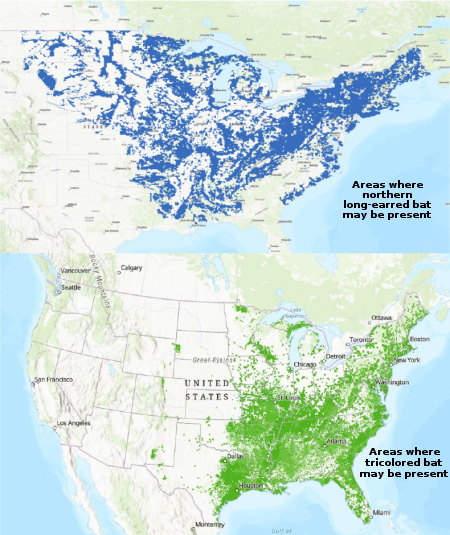
The blue and green areas are now subject to
Fish & Wildlife regulation if you intend to cut
down any trees
Apparently in a bid to give itself more power over every proposed building project in the United States, the Fish & Wildlife Service in October 2024 (just before the election) wildly expanded its regulatory rules for protecting endangered bats.
According to the new rules, Fish & Wildlife now considers the removal of any trees at such projects to be a risk to the endangered species, because those trees “may” have been used as roosts and would therefore threaten the species ability to survive if removed.
No matter that there may be thousands of other trees nearby, including many acres of forest. If you are building anything that involves cutting down any trees, you will be subjected to Fish & Wildlife supervision that could block construction. And the area this new rule covers includes almost the entire eastern and northern parts of the United States, as shown on the maps to the right, taken from the new regulation guidelines [pdf].
Long time reader Jack O’Leary informed me of this new power grab. He also sent me information about one particular project in Massachusetts involving the installation of a well and pump station in a forested area southeast of Boston, far from any bat hibernacula. The only impact this project might have on any bats is the removal of some trees, though the project is located in a forested area with hundreds of acres of trees all around (as shown clearly on the satellite view on Google maps).
Yet Fish & Wildlife makes it clear in its letter [pdf] to the project that its “Endangered Species Act requirements are not complete.” Fish & Wildlife admits that the project will pose no direct threat to the endangered bats, but the very act of cutting down a few trees “may affect” the bats, so therefore government regulatory supervision is required.
» Read more
The South African government appears to be offering Starlink some concessions in order to get it approved in that country, but it also appears that Elon Musk is not interested in the deal, because it would still require the company to impose racial quotas on hiring and ownership that he not only considers immoral, but are illegal by U.S. law.
In an interview at the Qatar Economic Forum in Doha, Musk did not confirm whether a deal had been made with South Africa, as suggested in the reports. However, he maintains that Starlink’s failure to secure a license is attributed to his not being black.
“First of all, you should be questioning why there are racist laws in South Africa; that’s the problem. That’s the issue you should be attacking. The whole idea with Nelson Mandela, he was a great man, was that all races should be on equal footing in South Africa, that’s the right thing to do, not to replace one set of racist laws with another set of racist laws.”
“I was born in South Africa but can’t get a licence to operate in Starlink because I’m not black,” Musk said.
The first link notes that South Africa requires a 30% ownership by “historically disadvantaged groups, primarily Black South Africans,” a racist quota that Musk is likely to reject whole-heartedly.
China yesterday placed six satellites into orbit, its solid-fueled Kinetica-1 rocket lifting off from the Jiuquan spaceport in northwest China.
China claims this was a commercial launch, taking place from the launch facility at Jiuquan dedicated to commercial launches, but the rocket was built by CAS Space, a division of the Chinese Academy of Sciences. It is also solid-fueled, which means it is likely derived from missile technology, something that the Chinese government will supervise quite closely.
No word on where the rocket’s lower stages crashed inside China.
The leaders in the 2025 launch race:
60 SpaceX
30 China
6 Rocket Lab
5 Russia
SpaceX still leads the rest of the world in successful launches, 60 to 48.

Click for original image.
Though there is much uncertainty in their data, astronomers now believe they have discovered an exoplanet orbiting a binary system of two brown dwarfs, but doing so tilted 90 degrees to the ecliptic of the orbits of those brown dwarfs.
The graphic to the right illustrates the theorized system, with the orbits of the brown dwarfs indicated in blue and the exoplanet’s orbit in orange. While sixteen exoplanets have been found orbiting outside a binary pair of stars, this is the first doing so at such an inclination.
The detection has great uncertainty however.
The candidate planet cannot be detected the way most exoplanets – planets around other stars – are found today: the “transit” method, a kind of mini-eclipse, a tiny dip in starlight when the planet crosses the face of its star.
Instead they used the next most prolific method, “radial velocity” measurements. Orbiting planets cause their stars to rock back and forth ever so slightly, as the planets’ gravity pulls the stars one way and another; that pull causes subtle, but measurable, shifts in the star’s light spectrum. Add one more twist to the detection in this case: the push-me-pull-you effect of the planet on the two brown dwarfs’ orbit around each other. The path of the brown dwarf pair’s 21-day mutual orbit is being subtly altered in a way that can only be explained, the study’s authors conclude, by a polar-orbiting planet.
The radial velocity method however requires the scientists to make a number of assumptions, and provides limited information that can result in a misinterpretation of the data. It is for this reason this exoplanet is described as a “candidate planet.” Its theorized existence must be confirmed by other measurements before it is considered real.
I think this was posted as a quick link back in early May, when the scientists first announced their work, but can’t find it now.
China’s state-run press yesterday announced the discovery of a new microbe on its Tiangong-3 space station that appears designed to survive in the harsh environment of space.
In May 2023, the Shenzhou-15 crew collected surface microbial samples using sterile wipes, preserving them at low temperatures in orbit. Subsequent ground analysis revealed the novel Niallia tiangongensis species, confirmed through multidisciplinary methods including morphological analysis, genome sequencing, phylogenetic studies and metabolic profiling, the CMSA said.
…Niallia tiangongensis demonstrates exceptional stress resistance, maintaining cellular redox balance and ensuring robust growth in extreme conditions by regulating bacillithiol (BSH) biosynthesis to counteract space-induced oxidative stress, according to the CMSA. It exhibits distinctive capabilities in biofilm formation and radiation damage repair, making it a highly adaptable “all-rounder” for space environments.
More information here. This new microbe has characteristics both different and similar to microbes found on ISS. Its discovery is also not that unique, a it appears such unusual and new biology has been found in other space-related environments, such as the clean rooms on Earth used to build spacecraft. For example, dozens were found in clean room for the Phoenix Mars lander in the early 2000s.
SpaceX tonight successfully placed another 23 Starlink satellites into orbit (including 13 with cell-to-satellite capabilities), its Falcon 9 rocket lifting off from Cape Canaveral in Florida.
The first stage completed its first flight, landing on a drone ship in the Atlantic. This was the third new booster SpaceX has launched since February. In previous years the company would about this number per year. This new crop so early this year suggests it is finding some of its older boosters might need retirement and its fleet therefore needs replenishment.
More likely the company is anticipating the planned major increases in its launch rate in both Florida and Vandenberg, and is increasing that fleet to meet the demand.
The leaders in the 2025 launch race:
60 SpaceX
29 China
6 Rocket Lab
5 Russia
SpaceX now leads the rest of the world in successful launches, 60 to 47.
An evening pause: A bit of tragic history.
Hat tip Wayne DeVette.
Courtesy of BtB’s stringer Jay. This post is also an open thread. I welcome my readers to post any comments or additional links relating to any space issues, even if unrelated to the links below.