What satellite did the Varda capsule fly past during its return last week?
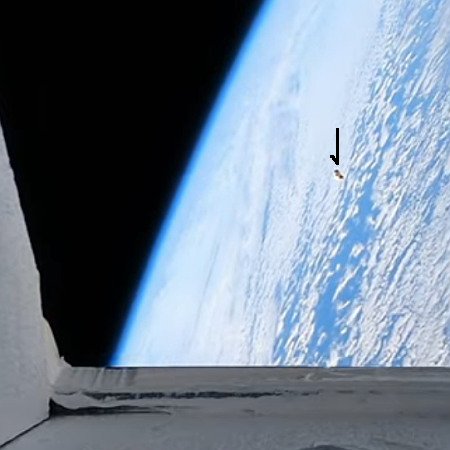
Other satellite passing under Varda's capsule
Click for video cued to this point.

Regular reader Rex Ridenoure emailed me today to note that there appears to be another satellite relatively nearby and visible in the video posted in yesterday’s quick links, taken from inside Varda’s capsule during its return to Earth.

The image to the right is a screen capture taken at 7:56 of the video. At that point the object is visible from 7:50 to 8:01 to the west and below. You can clearly see it moving from left to right (east to west). The two solar panels can also be discerned on either side of the satellite’s main body.

It later reappears for only two seconds in the lower right of the view window at 9:18, then is visible again at 10:30 to 10:33, now beginning to pass below but considerably to the north (?).

If anyone has the resources to identify this satellite, as well as its exact distance during this close approach, please comment below. It raises an interesting question on whether its existence was considered when the re-entry time was decided.

6 comments

May 16, 2025 Quick space links

Courtesy of BtB’s stringer Jay. This post is also an open thread. I welcome my readers to post any comments or additional links relating to any space issues, even if unrelated to the links below.

1 comment

Astronomers detect evidence of numerous protoplanetary disks in three molecular clouds near the galactic center

Using the ground-based ALMA telescope in Chile, astronomers have detected evidence of the existence of numerous protoplanetary disks in three molecular clouds near the galactic center.

The findings suggest that over three hundred such systems may already be forming within just these three CMZ clouds [Central Molecular Zone]. โ€œIt is exciting that we are detecting possible candidates for protoplanetary disks in the Galactic Centre. The conditions there are very different from our neighbourhood, and this may give us a chance to study planet formation in this extreme environment,โ€ said Professor Peter Schilke at the University of Cologne.

You can read the paper here.

These results once again suggest that the formation of stars, solar systems, and planets is more ubiquitous than ever expected, that they can all form in very extreme and hostile environments, of which the center of the Milky Way is one of the most hostile.

And if planets can form here, they can likely form everywhere else. This increases the likelihood of many planets throughout the galaxy capable of supporting the development of life.

0 comments

FAA issues revised launch window and flight restrictions for future Starship test flights

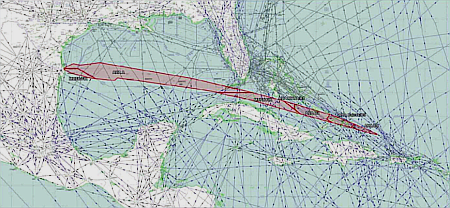
Flight path for Starship's ninth test flight

Due to the breakup of Starship over the Atlantic during its last two test flights, the FAA today issued [pdf] revised launch window and flight plan restrictions for future flights, in an attempt to placate somewhat the concerns of the United Kingdom.

The map to the right, taken from the FAA assessment, shows in red the area where air traffic is impacted by the next Starship/Superheavy launch, now tentatively planned for next week. Note how the path threads a line avoiding almost all land masses, thus limiting the worst impact to just the Bahamas, the Turks & Caicos Islands. Though the launch will effect 175 flights and require one airport on these islands to close during the launch window, to minimize the impact the FAA has required that the launch window be scheduled outside peak travel periods.

At the same time, the FAA after discussions with the governments on these islands has approved this flight plan, noting that “no significant impacts would occur” due to the ninth flight.

The agency has not yet actually issued the launch license, but it will almost certainly do so in time for SpaceX’s planned launch date. Since the advent of the Trump administration the FAA has no longer been slow walking these approvals in order to retype the results of SpaceX’s investigation. Instead, as soon as SpaceX states it has satisfactorily completed its investigation, the FAA has accepted that declaration and issued a launch license. Expect the same this time as well.

2 comments

Kazakhstan denies rumors that Russia plans to abandon Baikonur

In response to reports in its local press that Russia was going to pull out of the Baikonur spaceport in the next three years, two decades before its lease expires in 2050, the Kazakhstan government yesterday issued a denial.

Local media in Kazakhstan have reported that Russia could exit the lease between 2026 and 2028 as it pulls back from international space cooperation, including a planned withdrawal from the International Space Station (ISS) as early as 2028.

โ€œThe question of early termination of the lease, or transfer of the city of Baikonur to the full control of the Kazakh side, is not being considered at this time,โ€ Kazakhstanโ€™s Aerospace Committee told AFP.

There rumors however could have real merit. Once ISS is retired, the Russians will have little reason to use Baikonur. It is almost certain it will not have launched its own replacement station by then, and Baikonur’s high latitude location will make its use with any other station difficult if not impossible. Moreover, the effort to switch to its Angara rocket favors launches from the Vostochny and Plesetsk spaceports, both of which have launchpads built for that rocket.

Finally, Russia has not had the cash to upgrade the launchpads at Baikonur, so much so that it has often been late paying Kazakhstan its annual $115 million rental fee, delays which at one point caused Kazakhstan to seize the launchpad Russia was upgrading for its proposed new Soyuz-5 rocket.

In fact, Russia might not be able to afford Baikonur at all, based on its present finances and the cost of its stupid war in the Ukraine.

We shall not get clarity on this story for at least a year or so, but stay tuned. Nothing is certain.

12 comments

Premature fairing release cancels first launch of Gilmour’s Eris rocket

The Australian rocket startup has canceled any attempt to launch its Eris rocket during its present launch window as a result of the premature fairing release that occurred during the countdown yesterday.

Last night, during final checks, an unexpected issue triggered the rocketโ€™s payload fairing. No fuel was loaded, no one was hurt, and early inspections show no damage to the rocket or pad.

While investigating the cause of this incident, the company will ship and install a replacement fairing from its factory. A new launch date will be announced after these actions are completed. Expect a delay of at least two months, likely more.

2 comments

SpaceX launches 26 Starlink satellites

SpaceX this morning successfully placed another 26 Starlink satellites into orbit, its Falcon 9 rocket lifting off from Vandenberg in California.

The first stage completed its second flight, landing on a drone ship in the Pacific, and doing so only 39 days after its first flight.

The leaders in the 2025 launch race:

59 SpaceX
26 China
5 Rocket Lab
5 Russia

SpaceX now leads the rest of the world in successful launches, 59 to 43.

1 comment

May 15, 2025 Quick space links

Courtesy of BtB’s stringer Jay. This post is also an open thread. I welcome my readers to post any comments or additional links relating to any space issues, even if unrelated to the links below.

6 comments

Curiosity looks uphill at boxwork and future travels

Curiosity's view uphill
Click for original image.

Overview map
Click for interactive map.

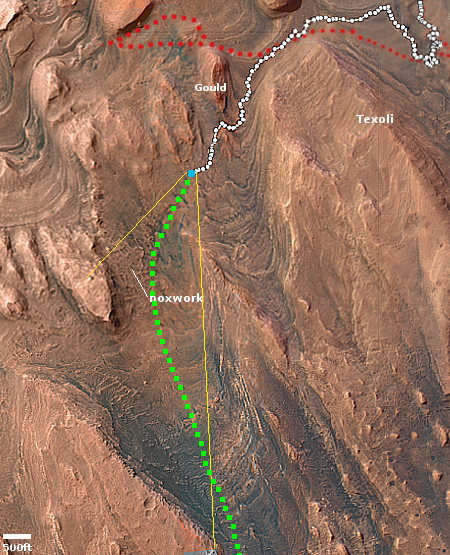
Cool image time! The panorama above, taken on May 14, 2025 by the left navigation camera on the Mars rover Curiosity, takes a look uphill at the canyon that the rover is now entering.

The overview map to the right gives the context. The blue dot marks the rover’s location when the picture was taken, and the yellow lines indicate approximately the view of the panorama above. If you look closely at the ground at the base of the cliff on the right, you can see the boxwork ridges indicated on the overview map.

The red dotted line marks the original planned route of the rover. The science team abandoned that plan several months ago in order to get to the boxwork geology as quickly as possible. It expects to reach that boxwork sometime in the next month or so.

Based on the proposed route posted in September 2023, after the scientists have completed their observations of the boxwork the rover will continue uphill within this canyon, bearing east as it parallels that 100-foot-high cliff seen on the horizon. The green dotted line indicates roughly that future route.

0 comments
1 113 114 115 116 117 182