
The Beatles – Twist And Shout
An evening pause: Performed live, sometime in the early 1960s.
Hat tip Judd Clark.
An evening pause: Performed live, sometime in the early 1960s.
Hat tip Judd Clark.
Courtesy of BtB’s stringer Jay. This post is also an open thread. I welcome my readers to post any comments or additional links relating to any space issues, even if unrelated to the links below.

Click for original image.
Cool image time! The picture to the right, cropped, reduced, and sharpened to post here, was released today by the science team running the Dark Energy Camera on the Blanco 4-meter telescope in Chile.
This winding, shadowy form, accentuated by a densely-packed starry background, is the Circinus West molecular cloud — a region rich in gas and dust and known for its host of newly formed stars. Molecular Clouds, the cradles of star formation, are interstellar clouds that are so dense and cold that atoms within them bond with each other to form molecules. Some, such as Circinus West, are so dense that light cannot pass through, giving them a dark, mottled appearance and earning them the name dark nebulae. The cloud’s flourishing population of young stars has offered astronomers a wealth of insight into the processes driving star formation and molecular cloud evolution.
…Circinus West is known for harboring dozens of young stellar objects — stars that are in their early stages of development. Despite being shrouded in dense gas and dust, these infant stars make themselves known. Zooming in, various clues to their presence can be seen dotted throughout Circinus West’s snaking tendrils.
The cloud is about 2,500 light years away and is estimated to be about 180 light years across. Scientists estimate the mass in the cloud to be about 250,000 times that of the Sun.
No one however would ever even know this cloud existed if it wasn’t back dropped by thick field of stars behind it.
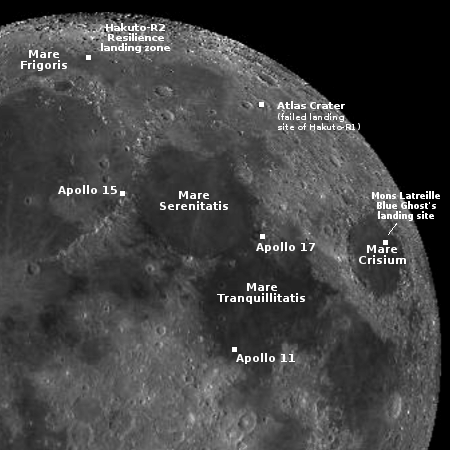
Landing sites for both Firefly’s Blue Ghost and
Ispace’s Resilience
The Japanese startup Ispace today announced that its Resilience lunar lander — launched on a Falcon 9 to the Moon in January — has now completed all the orbital maneuvers required to send it on a path to enter lunar orbit in early May.
Ispace engineers performed the final orbit maneuver from the Mission Control Center in Nihonbashi, Tokyo, Japan in accordance with the mission operation plan. In total, the RESILIENCE lunar lander has completed 8 orbit control maneuvers. RESILIENCE is now maintaining a stable attitude in its planned orbit and mission operations specialists are now preparing for the Mission 2 milestone Success 7, “Entering Lunar Orbit.” The RESILIENCE lander is expected to enter lunar orbit on May 7, 2025.
The map to the right shows the landing zone, near the top of Moon’s near hemisphere in the region of Figoris Mare. The landing will occur a week or so after orbital insertion, after the company’s engineers have fully assessed the situation.
The rover carries eight commercial payloads, including its own Tenacious mini-rover, as well as a “water electrolyzer” from a Japanese company, a “food production experiment” from another company, and a “deep space radiation probe” from the National Central University of Taiwan.
Resilience’s main purpose however remains to prove the company can build and successfully soft land on the Moon. Its only previous attempt, Hakuto-R1, crashed in Atlas Crater. Despite that failure Ispace has won a contract each from NASA and Japan to launch additional lunar landers, so a success here is critical for the company’s future.
Hat tip BtB’s stringer Jay.
As part of a larger European Space Agency (ESA)) project, Viasat has won an ESA contract to build a communications constellation that will orbit the Moon.
Viasat will be responsible for the design and development of the communication network and will lead the definition of the end-to-end communications services: aiming to provide a communications network for lunar landers, rovers, orbiters, and other technology. Viasat will also be responsible for the communication earth ground infrastructure and communication lunar surface user terminals. Telespazio, as Moonlight program lead, has executed a contract with Viasat for the initial design phase of the communication system. This work will be fully funded by the European Space Agency throughout Phase 1.
The UK Space Agency, as one of the major contributors to ESA’s Moonlight program, selected Viasat to lead the UK ecosystem to deliver the communications capability. Moonlight services will be deployed in phases, targeting initial capability at the end of 2028 with full operations aimed by 2030.
It does seem that there are a lot of competing communications/navigation constellations under development, from China, Europe, and the U.S. It also appears that there is far less coordination between them then there should be.
Hat tip BtB’s stringer Jay.
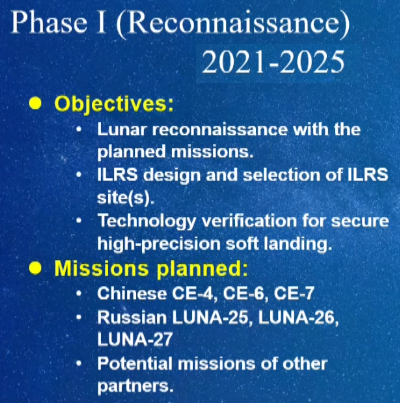
The original phase I plan of Chinese-Russian lunar
base plan, from June 2021.
The new colonial movement: In several different reports today in China’s state-run press — timed to coincide with the launch of three astronauts to Tiangong-3 — Chinese officials confirmed that it has moved up the planned launch dates for both its first lunar rover as well as its Mars sample return mission, and it is also expanding its offers to the international community to partner on those missions.
At the same time it let slip the fact that it will not be establishing its lunar base on the Moon in 2030, as previously claimed. Moreover, note how this so-called accelerated schedule of lunar missions is actually behind the announced timetable outlined by China and Russia in 2021, as shown on the right. None will fly by this year, as promised.
As for the news today, first China announced that its Tianwen-3 Mars sample return mission will launch in 2028.
» Read more

Proposed spaceports in Malaysia
According to an report out of Malaysia yesterday, the Malaysian state of Pahang has initiated a one year study to build a spaceport off its eastern coast near the town of Nensasi, working in partnership with China.
“On April 15, PKNP [Pahang State Development Corporation] signed a letter of intent with China Great Wall Industry Corporation (CGWIC) and Lestari Angkasa Sdn Bhd to establish a strategic collaboration in the space technology sector. “Next month, PKNP and Lestari Angkasa will visit Wenchang Space City in Hainan, China, to hold further discussions on the Pahang International Spaceport project,” he said during the Pahang state assembly session today.
This is the second Malaysian state to propose its own spaceport. In January the eastern state of Sabah began its own study, working in partnership with the Ukraine.
The partnership with China is worrisome for the U.S., as it is very likely that China will arrange use of that spaceport for its own purposes. It will also use its presence there to access and steal any technology brought by other western companies or nations should they launch there as well.
China today successfully launched a new crew of three astronauts for a six-month mission on its Tiangog-3 space station, its Long March 2F rocket lifting off from its Jiuquan spaceport in northwest China.
The crew’s Shenzhou capsule will dock autonomously with the station later today. This was China’s fifteenth manned mission and ninth to the station, which it has now occupied continuously for more than three and a half years.
The rocket’s core stage and four strap-on boosters crashed somewhere inside China. No word on where or whether they crashed near any habitable areas.
The leaders in the 2025 launch race:
46 SpaceX
21 China
5 Rocket Lab
5 Russia
SpaceX now leads the rest of the world in successful launches, 46 to 36.
An evening pause: Hat tip Cotour.
Courtesy of BtB’s stringer Jay. This post is also an open thread. I welcome my readers to post any comments or additional links relating to any space issues, even if unrelated to the links below.
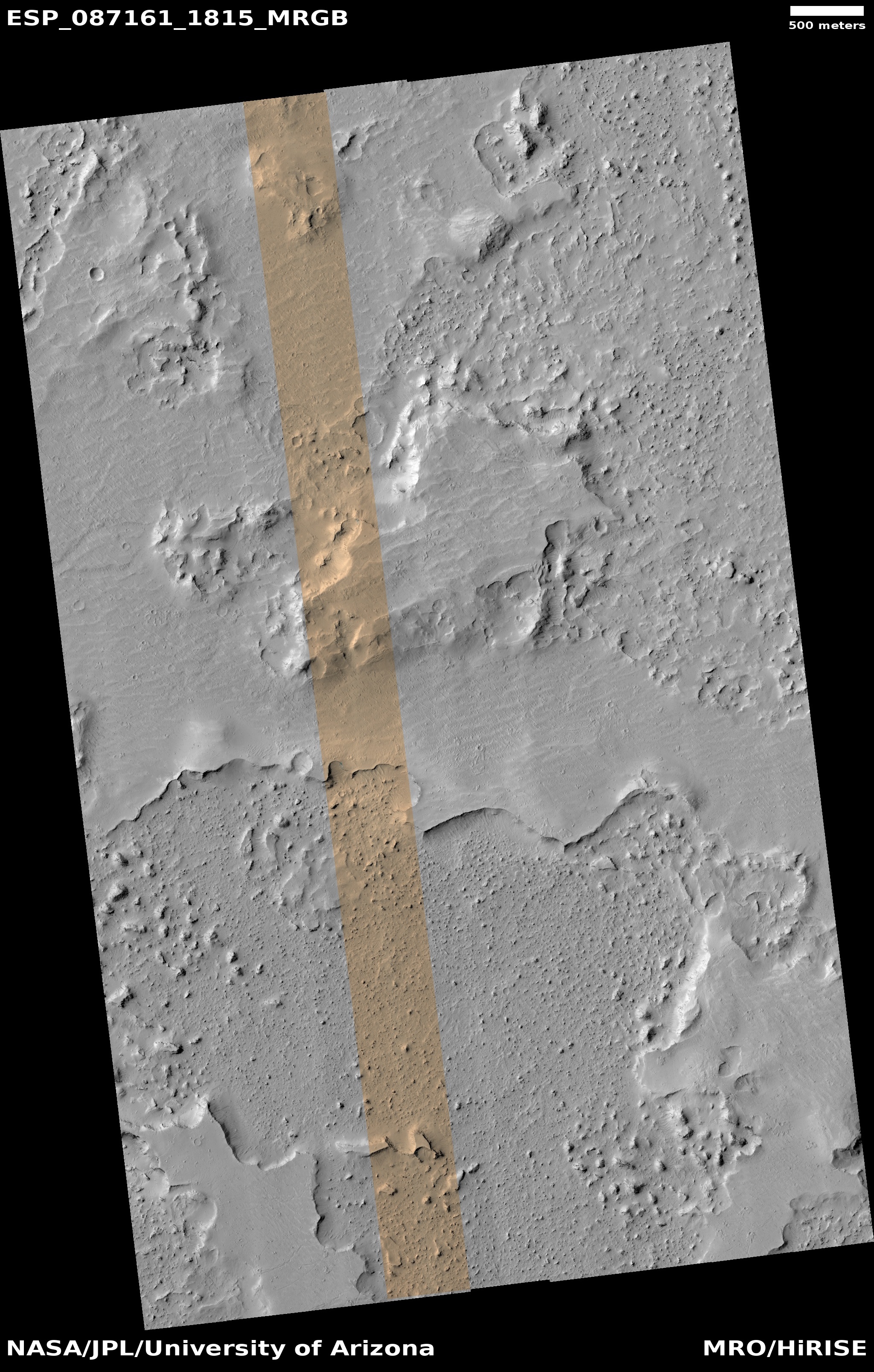
Click for original image.
Cool image time! The picture to the right, cropped, reduced, and sharpened to post here, was taken on February 28, 2025 by the high resolution camera on Mars Reconnaissance Orbiter (MRO).
The scientists label this picture “enigmatic terrain.” And there are certainly mysteries here. For example, why are there scattered tiny knobs across the surface in the low areas, but not on the higher areas? Also, what caused that top layer to get stripped in places? Was it erosion from wind? Or did some other process cause that layer to vanish in these spots?
Note too that this landscape has few craters. Whatever happened here occurred recently enough that it was able to cover over the impact history from the early solar system that peppered the planets with craters as the planets formed. Though impacts continue even to this day, the impact rate is far less, which allows younger terrain like this to remain largely crater free.
The location provides us some answers, but it still leaves much of this geology a puzzlement.
» Read more
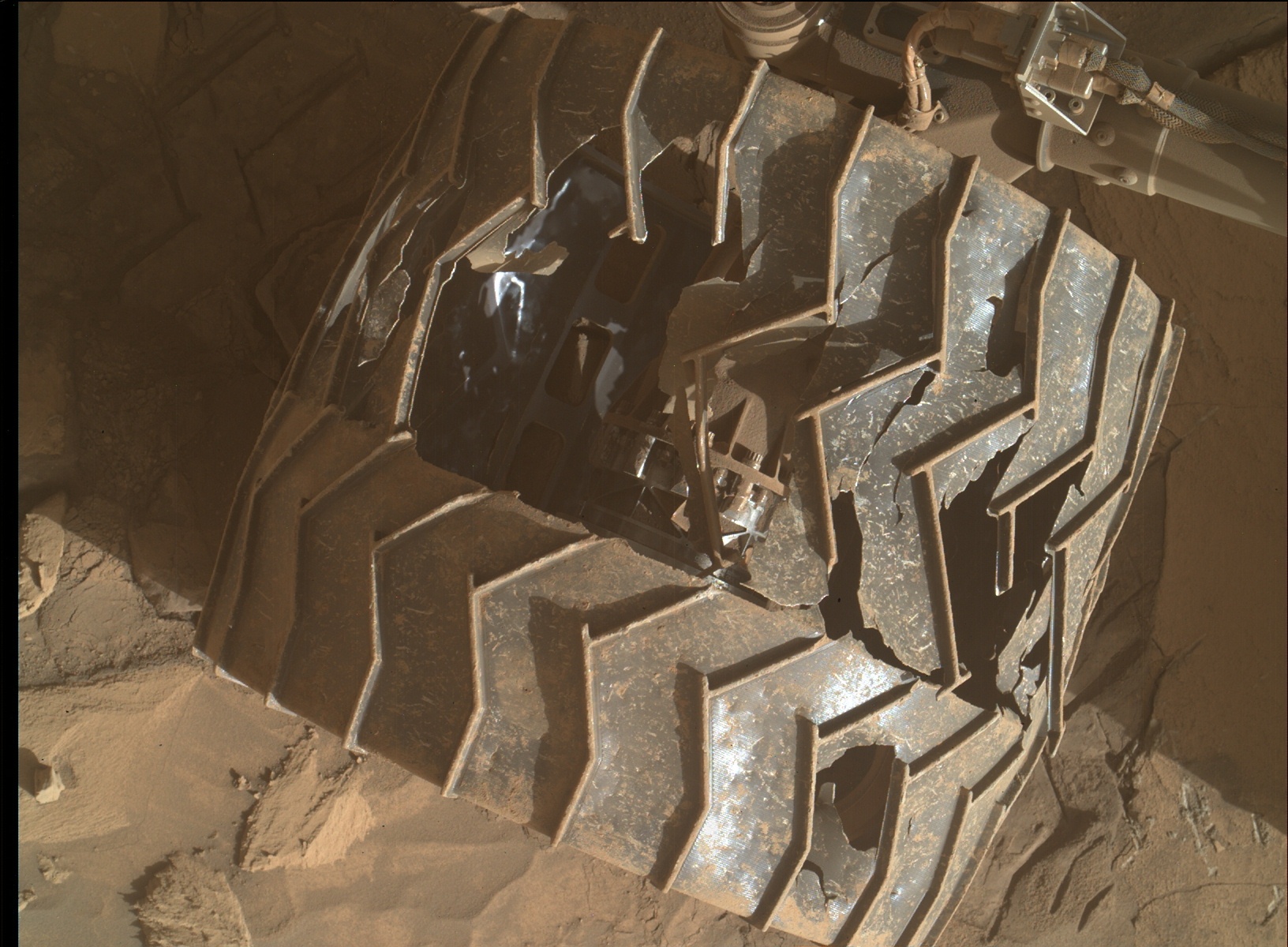
Click for the Sol 4518 original image.
In a set of new pictures taken of Curiosity’s wheels yesterday it appears that the damage to those wheels has increased significantly in the past year, with the most damaged wheel (which based on contradictory science team reports is either the middle left or middle right wheel), having more had more sections broken to the point where this wheel might even fail in the near future.
The pictures to the right show these changes. The treads, called grousers, have been numbered to make the comparisons easier. The bottom two pictures were taken in September 2024, and look at this wheel with the damage on the side to show how a whole section of the wheel had at that time collapsed to form a depression.
The top two pictures show the increase in the damage in this section between February 2024 and yesterday. Note especially the changes in growlers 4, 5, and 6. Not only have large sections broken off in the wheel’s central section, it appears that the wheel’s outside section is beginning to separate from that central section.
The increased damage in the past year illustrated starkly the roughness of the terrain that the rover is traversing. Moreover, there is no sign that roughness is going to ease anytime in the near future. This increased damage thus explains partly why the science team changed the rover’s route to get to the nearby boxwork geology as fast as possible. That unique geology is likely to provide some important scientific information unobtainable elsewhere, and it seems worthwhile to get to it before this particular wheel fails.
There is one silver lining to this cloud. This particular wheel is a middle wheel, which means it is less critical to maintaining the rover’s stability as it travels as well as sits. The photographs of the other wheels taken today do not show as much change. Even if this wheel fails, the rover will still have five working wheels, including the most essential four corner wheels.