China and SpaceX complete launches

Both China and SpaceX completed launches yesterday. First, China placed what its state-run press called “a data relay” satellite into orbit, its Long March 3B rocket lifting off from its Xichang spaceport in southwest China.

No word on where there rocket’s lower stages and four strap-on boosters crashed inside China. All use very toxic hypergolic fuels.

Next SpaceX launched 23 more Starlink satellites, including 13 configured for cell-to-satellite service, its Falcon 9 rocket lifting off from Cape Canaveral in Florida. The first stage completed its 20th flight, landing on a drone ship in the Atlantic.

The leaders in the 2025 launch race:

48 SpaceX
22 China
5 Rocket Lab
5 Russia

SpaceX now leads the rest of the world in successful launches, 48 to 37, with three more launches scheduled for later today. China will use its Long March 5B, its largest rocket, to launch a set of communications satellites, SpaceX will launch another set of Starlink satellites, and ULA will make its second attempt to launch Amazon’s first set of Kuiper internet satellites, the first launch scrubbed due to weather.


0 comments

Axiom replaces its CEO

In a move that apparently promotes one of its most productive managers, space station startup Axiom has now picked Tejpaul Bhatia, its chief financial officer for the past four years, to take over as the company’s CEO.

The choice seems sound, considering what Bhatia has done already for the company.

Ghaffarian cited Bhatia’s work as chief revenue officer at Axiom as a key reason to make him CEO. Axiom noted in a statement that Bhatia secured more than $1 billion in contracts since joining Axiom, including overseeing the company’s series of private astronaut missions to the International Space Station.

…Bhatia came to Axiom from Google, where he was involved in its cloud computing business. He earlier founded and led several startups and worked on ESPN’s video streaming business.

Considering other rumors that suggest the company has been experiencing cash flow issues, this pick might be aimed at alleviating those issues.

0 comments

April 25, 2025 Quick space links

Courtesy of BtB’s stringer Jay. This post is also an open thread. I welcome my readers to post any comments or additional links relating to any space issues, even if unrelated to the links below.

17 comments

Axiom signs deal with medical company to do diabetes monitor research on its next manned mission to ISS

Axiom today announced it has signed a deal with the medical company Burjeel Holdings to fly and test a glucose monitor during its May 2025 AX-4 manned mission to ISS.

The Ax-4 mission will utilize Continuous Glucose Monitors (CGMs), which have become the standard for glucose monitoring in individuals with diabetes. These devices will be tested to ensure their accuracy in microgravity, providing real-time data that will ultimately support the health of astronauts with insulin-dependent diabetes.The comprehensive preflight, inflight, and post flight protocols will employ various testing methods to validate these technologies. The Ax-4 mission also plans to look at insulin exposure in microgravity to assess the potency and stability of the drug product upon its return to Earth.

Testing the behavior of CGMs and insulin delivery technologies in microgravity and with circadian rhythm disruption is expected to advance the understanding of how such innovations can improve diabetes monitoring and care in remote or under served areas on Earth. Experts say this research will lay the groundwork for managing diabetes in isolated locations, such as oil rigs, deserts, or rural regions.

These tests will also make it possible for people who have diabetes to go into space. For Axiom, this will help widen its customer base. For Burjeel it proves its monitors can work in many remote and hostile environments, also widening its customer base.

Hat tip BtB’s stringer Jay, who adds that “This is cool since this is two companies and no NASA/government involvement.”

0 comments

Curiosity’s recent travels as seen from orbit

The view of Curiosity from orbit
Click for original image.

Oveview map
Click for interactive map.

Cool image time! Using Mars Reconnaissance Orbiter (MRO), scientists have captured a very cool image of Curiosity in its recent travels on Mars. That picture is above, reduced and sharpened to post here.

Taken by the HiRISE (High-Resolution Imaging Science Experiment) camera aboard NASA’s Mars Reconnaissance Orbiter, the image shows Curiosity as a dark speck at the front of a long trail of rover tracks. Likely to last for months before being erased by wind, the tracks span about 1,050 feet (320 meters). They represent roughly 11 drives starting on Feb. 2 as Curiosity trucked along at a top speed of 0.1 mph (0.16 kph) from Gediz Vallis channel on the journey to its next science stop: a region with potential boxwork formations, possibly made by groundwater billions of years ago.

The overview map to the right provides some context. Curiosity’s present position is indicated by the blue dot. The yellow lines indicate the approximate section of its past travels photographed by the picture above.

According to the press release at the link, the science team is now estimating the rover will arrive at the boxwork geology in about a month.

0 comments

Your smartphone apps are tracking you

The smart phone: A proven tool for spying

Just one more reason I don’t own a smartphone: Researchers have now found that though there is no evidence that big software companies like Facebook and Google are tracking your smartphone conversations, the data instead shows that the many apps you routinely install on your phone are spying on you quite extensively by periodically taking screenshots of things you look at and sending those images to third parties.

“There were no audio leaks at all – not a single app activated the microphone,” said Christo Wilson, a computer scientist working on the project. “Then we started seeing things we didn’t expect. Apps were automatically taking screenshots of themselves and sending them to third parties. In one case, the app took video of the screen activity and sent that information to a third party.”

Out of over 17,000 Android apps examined, more than 9,000 had potential permissions to take screenshots. And a number of apps were found to actively be doing so, taking screenshots and sending them to third-party sources. “That has the potential to be much worse than having the camera taking pictures of the ceiling or the microphone recording pointless conversations,” said David Choffnes, another computer scientists working on the project. “There is no easy way to close this privacy opening.”

Doing this kind of spying is simply unethical, but it is also now routine in our increasingly unethical culture. What makes it worse is that I expect few will react in any way to this information. People will shrug and continue to install apps casually, accepting the fact that they are now merely a tool that someone else can manipulate.

4 comments

Rocket startup MaiaSpace picks Polish institute to build its rocket’s upper stage engine

The smallsat rocket startup MaiaSpace has selected Poland’s Łukasiewicz Research Network’s Institute of Aviation to develop the engine that will power its Maia rocket’s top stage, used to put satellites into their final orbit.

In a 23 April update, the Łukasiewicz Research Network’s Institute of Aviation (Łukasiewicz–ILOT) announced that it had been selected by MaiaSpace to develop a rocket engine to power Maia’s Colibri kick stage. According to the announcement, the engine will be based on technology developed by Łukasiewicz–ILOT as part of its Green Bipropellant Apogee Rocket Engine (GRACE) initiative, a project financed by the European Space Agency under the Future Launchers Preparatory Programme.

Each new engine will be capable of producing 420 newtons of thrust, with a cluster of these engines powering the Colibri kick stage. However, the update did not specify how many engines would make up the cluster

MaiaSpace had previously indicated it was building its own Colibri kick stage engine. It appears that it has now decided to hire Lukasiewicz to do it instead.

The significance here is not this specific decision, but how it involves two different European commercial entities with no managerial input from the European Space Agency or any government agency. It really does appear that Europe’s aerospace industry has completely freed itself from the dictates of those government apparachiks.

MaiaSpace hopes to complete the first launch of Maia in 2026.

3 comments

Trump cuts apparently shutting down NASA’s climate office in New York

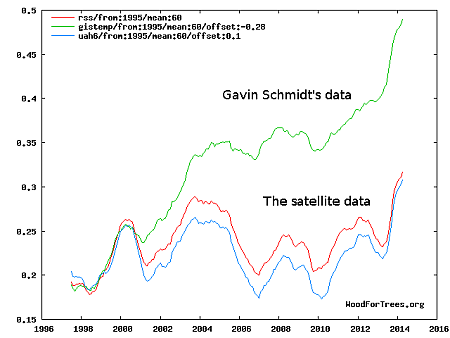
Schmidt's data tampering, as documented in 2017
Schmidt’s data tampering, as documented in 2016.

As part of the Trump administration’s aggressive effort to trim the federal budget as well as shift the research focus at the federal government’s many science agencies, on April 24, 2025 it revealed that it has canceled the building lease for the Goddard Institute for Space Studies (GISS) in New York that has existed since 1961 and in 2016 and 2017 was found to be tampering with past climate data with no explanation, lowering past temperature numbers while raising more recent ones in order to make the data fit the as-yet unproven theory that human activity is causing global warming.

Those “adjustments” have never been justified in any way. Nor has Gavin Schmidt, the man who heads GISS, ever done anything to correct them. Moreover, when his office was accused of this tampering in 2016 he not only refused to fix or justify the changes, he responded by claiming “planetary warming does not care about the election.” In the years since it has been his office that annually declares each year “the hottest on record,” using these tampered numbers to do so and demonstrating that he has been acting not as a real researcher but as a political operative of the global warming crowd.

Though the office lease is being canceled, GISS has not been shut down, as of now.

While NASA is terminating the lease on the GISS offices, it is not closing the institute itself. Lystrup said in the email that it will help employees move “to remote work agreements in the short-term as the agency seeks a new, permanent space for the team.”

I suspect this statement is merely designed by Trump officials to dampen the screams of opposition against its actions. It is very likely GISS is going away, and most of its employees will have to find new jobs.

The hope is that new scientists can be hired to review these tampered numbers and get them fixed so that climate research in the future can proceed with reliable data.

8 comments
1 123 124 125 126 127 182