Rocket startup Astra wins $44 million development contract to build its Rocket-4

Having shut down its smaller Rocket-3 rocket operations and then almost going bankrupt, the startup Astra is apparently coming back from the dead, having won a $44 million military development contract to build its larger Rocket-4 rocket.

Chris Kemp, Astra’s chief executive, said in an interview the company intends to leverage its contract with the Defense Innovation Unit to demonstrate point-to-point delivery of about 1,300 pounds of cargo using Rocket 4. The military for years has expressed interest in using rockets for rapid deployment of critical supplies to remote locations, complementing traditional transportation methods.

The company now claims it will do the first test launch of Rocket-4 in 2026.

When the company’s stock valuation dropped so much in 2022 and was on the verge of shutting down, Kemp and a team of investors purchased that stock and took the company private. Since then it has mostly focused on building attitude thrusters for satellites. Whether this new contract is enough to get this new rocket off the ground remains a big unknown.

1 comment

Transiting exoplanet appears to be losing matter with each transit

Astronomers using the TESS space telescope have discovered an exoplanet about 140 light years away that appears to have a tail of trailing material that is gaining mass with each transit as the planet slowly disintegrates.

The typical signal of an orbiting exoplanet looks like a brief dip in a light curve, which repeats regularly, indicating that a compact body such as a planet is briefly passing in front of, and temporarily blocking, the light from its host star.

This typical pattern was unlike what Hon and his colleagues detected from the host star BD+05 4868 A, located in the constellation of Pegasus. Though a transit appeared every 30.5 hours, the brightness took much longer to return to normal, suggesting a long trailing structure still blocking starlight. Even more intriguing, the depth of the dip changed with each orbit, suggesting that whatever was passing in front of the star wasn’t always the same shape or blocking the same amount of light.

You can read the peer-reviewed paper here [pdf]. Their calculations estimate the planet will disintegrate entirely in about two million years.

Because of the nature of these transits, the relative nearness of the star system, and the existence of this tail of material, this exoplanet is an excellent candidate for studying the planet’s structure and make-up. The scientists advocate further studies using a range of telescopes, including Webb and Hubble.

3 comments

April 22, 2025 Quick space links

Courtesy of BtB’s stringer Jay. This post is also an open thread. I welcome my readers to post any comments or additional links relating to any space issues, even if unrelated to the links below.

Both Jay and I have found it to be a relatively slow news day in space.

1 comment

Trump cuts to NOAA include major shake-up on how it gathers weather data

According to the budget data that was leaked anonymous last week, the Trump administration is proposing a major restructuring of NOAA’s satellite operations, shifting from building geosynchronous weather/climate satellites in partnership with NASA to focusing on buying weather data from commercial smallsats.

The plan would initially reduce NOAA’s program by two-thirds.

The document suggests NOAA’s National Environmental Satellite, Data and Information Service (NESDIS) “immediately cancel all major instrument and spacecraft contracts on the GeoXO program,” saying the projected costs are “unstainable, lack support of Congress, and are out of step with international peers.”

GeoXO is a $19.6 billion program that includes six satellites and ground infrastructure to significantly enhance NOAA’s ability to monitor weather, map lightning, and track ocean and atmospheric conditions over decades. To maintain observations from geostationary orbit at the conclusion of the Geostationary Operational Environmental Satellite (GOES)-R Series, the White House memo calls on NOAA to “immediately institute a major overhaul to lower lifecycle costs by 50 percent” with annual costs below $500 million, while remaining on schedule to launch the first satellite in 2032.

Rather than expanding the geostationary constellation to include satellites over the East, West and Central United States, the proposal includes only East and West satellites like the GOES-R Series. OMB also recommends an immediate end to NOAA relying on NASA to help it acquire weather satellites.

Maybe the most controversial recommendation calls for NOAA to focus on gathering daily weather data while ending its monitoring of long term ocean and atmospheric climate trends.

The shift from NOAA-built satellites to purchasing weather data from commercially launched and built satellites makes great sense, and is the most likely part of this plan to get implemented. Similarly, ending NOAA’s reliance on NASA will help streamline the fat from both agencies.

Whether the Trump administration can force an end to NOAA’s climate gathering operations is less clear. The politics suggest this will be difficult. The realities however suggest that a major house-cleaning in this area is in order, as there is ample evidence that the scientists running this work have been playing games with the data, manipulating it in order to support their theories of human-caused global warming.

9 comments

Africa opens the office building in Egypt of its African Space Agency

Going where no bureaucrat has gone before! Ceremonies on April 20, 2025 in Cairo inaugurated the opening of the headquarters in Egypt of the African Space Agency.

Badr Abdelatty, Egypt’s Minister of Foreign Affairs and Immigration, participated in the official inauguration. The ceremony was attended by several high-ranking officials and dignitaries, including Dr. Ayman Ashour, Minister of Higher Education and Scientific Research; Dr. Sherif Sedky, CEO of the Egyptian Space Agency; Moses Vilakati, African Union Commissioner for Agriculture, Rural Development, Blue Economy, and Environmental Sustainability; and Dr. Tidiane Ouattara, Chair of the African Space Agency Council. Also in attendance were heads and representatives of African and international space agencies, along with ambassadors from African nations and partner countries of the African Union.

…Minister Abdelatty underlined that the African Space Agency will act as a platform to deepen cooperation among African nations in the peaceful uses of space, promote knowledge exchange, and build technical capacities. Additionally, it will work to unify African positions in international forums, especially within the United Nations system. He also stressed the importance of collaboration with academic institutions, research centers, and global space agencies, which will help establish a robust African presence in space science and technology.

While these officials also claimed the agency will foster cooperation across Africa’s space industries and governments, the quote reveals its main focus, acting as a jobs program for the political hacks who have done favors for the various leaders of African countries. This is not to say it won’t help encourage some space development (it will), but we must recognize that this agency has little to do with fostering private enterprise.

2 comments

First images from Lucy’s fly-by of asteroid Donaldjohanson

Asteroid Donaldjohanson
Closest view of asteroid DonaldJohanson.
Click for movie.

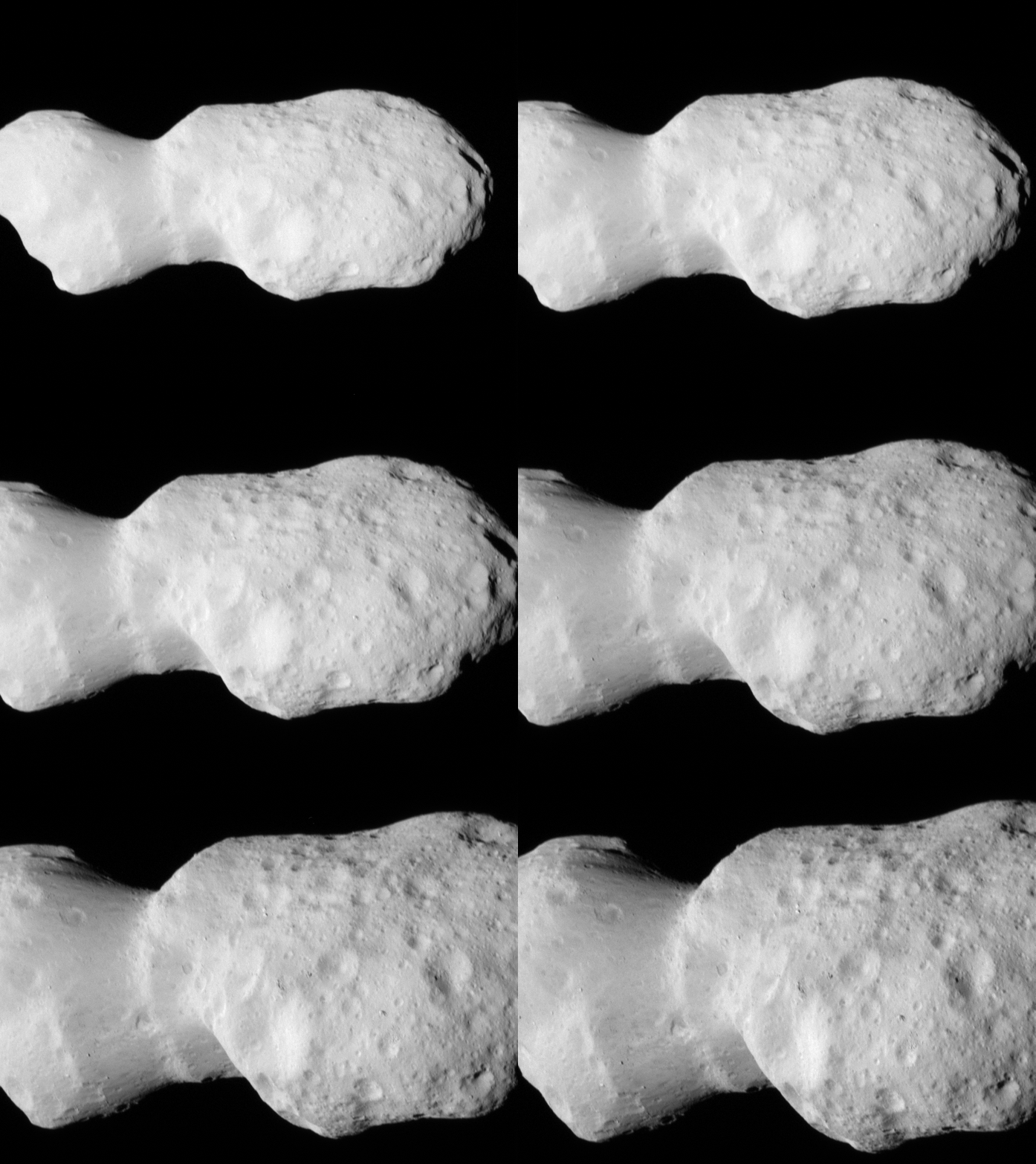
The science team for the asteroid probe Lucy today released the pictures taken by the spacecraft as it approached the asteroid Donaldjohanson on April 20, 2025, compiled into a short movie.

The asteroid was previously observed to have large brightness variations over a 10-day period, so some of Lucy team members’ expectations were confirmed when the first images showed what appeared to be an elongated contact binary (an object formed when two smaller bodies collide). However, the team was surprised by the odd shape of the narrow neck connecting the two lobes, which looks like two nested ice cream cones.

…From a preliminary analysis of the first available images collected by the spacecraft’s L’LORRI imager, the asteroid appears to be larger than originally estimated, about 5 miles (8 km) long and 2 miles (3.5 km) wide at the widest point. In this first set of high-resolution images returned from the spacecraft, the full asteroid is not visible as the asteroid is larger than the imager’s field of view. It will take up to a week for the team to downlink the remainder of the encounter data from the spacecraft; this dataset will give a more complete picture of the asteroid’s overall shape.

Lucy is now on its way to the orbit of Jupiter, where it will get close-up views of five different Trojan asteroids in 2027, followed by a later visit to another group of Trojans in 2033.

2 comments

SpaceX launches three payloads

SpaceX yesterday successfully launched three different payloads on its third “Bandwagon” launch, its Falcon 9 rocket lifting off from Cape Canaveral.

The first stage completed its third flight, landing back at Cape Canaveral. The fairings completed their second and fifteenth flights respectively.

The rocket’s primary payload was a commercial satellite for a South Korean company. Next was a commercial weather smallsat from the startup Tomorrow.

The third payload was from the European company Atmos, and was intended to test its deployable heat shield designed to protect payloads returning from orbit. According to the company, preliminary data says the deployment and return went as planned.

The leaders in the 2025 launch race:

46 SpaceX
20 China (with a launch scheduled for this morning)
5 Rocket Lab
5 Russia

SpaceX now leads the rest of the world in successful launches, 46 to 35.

7 comments

April 21, 2025 Quick space links

Courtesy of BtB’s stringer Jay. This post is also an open thread. I welcome my readers to post any comments or additional links relating to any space issues, even if unrelated to the links below.

5 comments

Martian ridges that imitate rivers

Martian ridges that imitate rivers
Click for original image.

Cool image time! The picture to the right, cropped, reduced, and sharpened to post here, was taken on February 26, 2025 by the high resolution camera on Mars Reconnaissance Orbiter (MRO).

The scientists describe these features as “dendritic relief features,” an apt description of the thousands of miles of river-like meandering ridges that orbital images have discovered in the past decade scattered across Mars, as noted in 2016:

The inverted channels are similar to those found elsewhere on Mars and Earth. They are made of sand and gravel deposited by a river and when the river becomes dry, the channels are left upstanding as the surrounding material erodes. On Earth, inverted channels often occur in dry, desert environments like Oman, Egypt, or Utah, where erosion rates are low – in most other environments, the channels are worn away before they can become inverted.

The most dramatic example of these Martian ridge rivers are the fernlike ridges in Antoniadi Crater. The ridges to the right however are almost as striking.
» Read more

2 comments

Rocket Lab gets two big military contracts, from the Space Force and the UK

Due to its success in quickly redesigning the first stage of its Electron rocket into a hypersonic test vehicle dubbed HASTE, Rocket Lab has now won two very large hypersonic test program contracts from both the American Space Force as well as the United Kingdom.

Rocket Lab has been selected by the U.S. Air Force to participate within its Enterprise-Wide Agile Acquisition Contract (EWAAC), a $46 billion indefinite delivery-indefinite quantity (IDIQ) contract designed for the rapid acquisition of innovative technologies, engineering services, and technical solutions that develops the Air Force’s new capabilities. The program has a contracting period through to 2031 and is designed to be broad in scope, flexible in funding, and agile for maximum use to enable the Air Force to quickly procure services and technologies across various domains.

Further, Rocket Lab has also been selected by the United Kingdom’s Ministry of Defence (UK MOD) for its Hypersonic Technologies & Capability Development Framework (HTCDF), a ~$1.3 billion (£1 billion) framework to rapidly develop advanced hypersonic capabilities for the United Kingdom. As a newly-selected supplier to the HTCDF, Rocket Lab is now eligible to bid to provide services, technologies, and testing capabilities that support the UK’s development of sovereign hypersonic technology.

In both cases Rocket Lab will bid for test contracts using HASTE.

These deals indicate that Rocket Lab has essentially grabbed the business that Stratolaunch had been vying for with its giant Roc airplane and Talon test drop vehicles. Stratolaunch might get some contracts, but it appears the bulk of the work will instead go to Rocket Lab. It also appears that Stratolaunch has also been beaten to this business by the startup Varda, which has also won an Air Force contract for hypersonic testing using its orbital capsules during their return to Earth.

0 comments
1 125 126 127 128 129 182