March 6, 2025 Quick space links

Courtesy of BtB’s stringer Jay. This post is also an open thread. I welcome my readers to post any comments or additional links relating to any space issues, even if unrelated to the links below.

1 comment

Athena sits at an unknown angle on the Moon, hampering operations

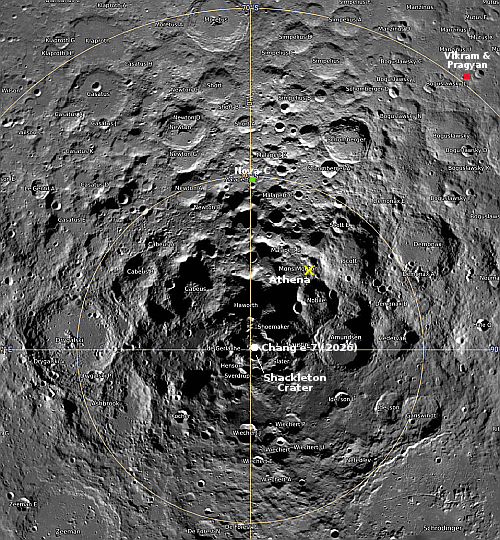
Athena's landing site 100 miles from the Moon's south pole
Yellow cross indicates Athena’s targeted landing site

According to the CEO of Intuitive Machines, Athena is sitting an an unknown angle on the Moon, impacting the possibility of all surface science operations.

The tilt is hampering their ability to use the high gain antenna which they need use to download most of their data. They do not know the angle, or the cause of this issue. It could simply be that the ground slope is too severe. It is also possible the spacecraft, which has a relatively high center of gravity, fell over on its side because of that slope. Moreover, they do not know at the moment exactly where the spacecraft landed, though they know it landed on Mons Mouton as planned. They need to download pictures from the spacecraft, as well as from Lunar Reconnaissance Orbiter (LRO) in orbit to determine precisely the location and the situation.

It is also unclear what payloads will be impacted by this situation. It could be that most if all could be utilized, but that question cannot be answered until they learn more. I suspect both the mini-rover and the Grace hopper will be affected the most, as the tilt might make it impossible to deploy either.

For Intuitive Machines this situation is very unfortunate. It has sent two unmanned lunar landers, and both have had issues at landing, though it must be emphasized that the issue on today’s second landing might have nothing to do with the company’s engineering at all.

3 comments

Is a supermassive black hole is hidden in the Large Magellanic Cloud?

Based on the motions of a number of runaway stars on the edge of the Milky Way that are moving so fast they will leave the galaxy, astronomers believe that many were accelerated not by the galaxy’s own central supermassive black hole but a previously undetected supermassive black hole at the center of the Large Magellanic Cloud, one of the Milky Ways nearby dwarf galaxies.

To make this discovery, researchers traced the paths with ultra-fine precision of 21 stars on the outskirts of the Milky Way. These stars are traveling so fast that they will escape the gravitational clutches of the Milky Way or any nearby galaxy. Astronomers refer to these as “hypervelocity” stars.

Similar to how forensic experts recreate the origin of a bullet based on its trajectory, researchers determined where these hypervelocity stars come from. They found that about half are linked to the supermassive black hole at the center of the Milky Way. However, the other half originated from somewhere else: a previously-unknown giant black hole in the Large Magellanic Cloud (LMC).

You can read the paper here [pdf]. This result was made possible by the very precise location and velocity data of over a billion stars measured by Europe’s Gaia satellite.

Based on the available data, the scientists estimate (with great uncertainty) the mass of this supermassive black hole, which the scientists have dubbed LMC* (pronounced “LMC star”), to be about 600,000 times the mass of the Sun, quite big but significantly less than the mass of the Milky Way’s central black hole, Sagittarius A* (pronounced “A-star”), which is estimated to be about 4.3 million times the mass of the Sun.

The mystery to solve now is why this super massive black hole is so quiet. It has literally emitted no obvious energy in any wavelength in the past seven decades, since ground- and space-based telescopes went into operation capable of detecting such emissions. Even the relatively inactive supermassive black hole at the Milky Way’s center, Sagittarius A* (pronounced “A-star”) emits distinct radio energy that the first radio telescopes were able to detect almost immediately.

2 comments

Intuitive Machines’ Athena lander touches down softly; engineers are assessing spacecraft condition

Though Intuitive Machines’ Athena lander has apparently softly landed near the south pole of the Moon, there remains uncertainty about the spacecraft’s status. Engineers have contact with Athena, and are apparently shutting down the landing equipment in order to make Athena safe for surface operations.

Unlike the previous landing, the spacecraft is upright and responding fully as expected. It appears the main issue is the position of Athena relative to the horizon. This is important as it determines the best antenna’s to use to upload and download data to and from Earth.

A full update will be provided at a press conference scheduled for 4 pm (Eastern) today. I have embedded the live stream of that conference below.
» Read more

6 comments

Scientists discover the oldest known crater on Earth

Though erosion has made it visibly unnoticeable now, scientists have discovered geological features 3.5 billion years old in northwestern Australia that suggest the location is the oldest impact crater known on Earth.

The crater was discovered by geologists at Curtin University and the Geological Survey of Western Australia in the Pilbara region of northwestern Australia. While itโ€™s hard to see directly as a classic crater shape, due to its age, the team found it through other evidence โ€“ namely โ€œshatter cones,โ€ geological features that form only when exposed to extreme pressures, like meteorite impacts or underground nuclear explosions.

The newly discovered crater is estimated to be at least 100 km (62 miles) wide, which suggests the original object that crashed into Earth was traveling at more than 36,000 km/h (22,000 mph), and would have caused destruction on a global scale. The impact appears to have occurred 3.47 billion years ago. โ€œBefore our discovery, the oldest impact crater was 2.2 billion years old, so this is by far the oldest known crater ever found on Earth,โ€ said Professor Tim Johnson, co-lead author of the study.

You can read the published paper here. There are many assumptions and uncertainty in this conclusion, but it is likely correct.

The impact likely occurred during a time period scientists call the Late Heavy Bombardment, when the planets in the solar system were beginning to accrete out of the thick disk of dust and rocks that surrounded the Sun. On Earth most of the evidence of this bombardment is gone, destroyed by erosion and plate technoics. We only know about it from the craters on the Moon, Mercury, and Mars, where erosion has left those impacts mostly untouched.

1 comment

Ariane-6 successfully launches for the second time

The European Space Agency’s (ESA) commercial arm, Arianespace, today successfully launched from French Guiana its new Ariane-6 rocket for the second time, this time placing its first commercial payload, a military Earth imaging satellite, into orbit.

As of posting the satellite has not yet been deployed by the upper stage, as several additional engine burns are required over then hour or so to place it in the right orbit. As there were some issues with this upper stage on the rocket’s first launch, the successful completion of these burns is critical for the rocket’s future. So far the first major burn has been completed as planned. UPDATE: The payload has been successfully deployed in the proper orbit.

This was Europe’s first launch in 2025, so there is no change in leader board for the 2025 launch race:

26 SpaceX
9 China
3 Russia
2 Rocket Lab

0 comments

India’s space agency ISRO begins construction of second spaceport

India's spaceports
India’s spaceports

After several years getting the real estate as well as the necessary regulatory approvals, India’s space agency, Indian Space Research Organization (ISRO), has now begun construction of it second spaceport, dubbed Kulasekaranpattinam, near the southern tip of India.

The map to the right shows the location. The Sriharikota spaceport has been used by the agency for decades. The Agnikul site was used once by one of India’s rocket startups for a suborbital launch, but it is unclear if it will be upgraded to a full launch site in the future.

Kulasekarapattinam was one of the areas recommended for the launchpad even before the rocket launchpad was set up in Sriharikota due to its strategic geographical location near the equator. It is located on the east coast and there is no land to the south of it, allowing for direct southward launches over the Indian Ocean. This will minimize fuel consumption and maximize payload capacity for small satellite launch vehicles (SSLVs), particularly beneficial for cost-effective commercial satellite launches.

The site also avoids the need for complex “dogleg” manoeuvres around Sri Lanka. The manoeuvre involves a sharp turn or bend in a launch trajectory to avoid collisions or falling debris into populated areas, which would require additional fuel.

As part of the breaking ground ceremonies, ISRO scientists also completed a small suborbital rocket launch from this new site, reaching an altitude of 46 miles before falling back into the Indian Ocean.

0 comments

Future now very dim for Lunar Trailblazer

Though engineers are continuing attempts to re-establish contact with the orbiter Lunar Trailblazer as it flies outward after launch, the situation is becoming increasingly grim.

Based on telemetry before the loss of signal last week and ground-based radar data collected March 2, the team believes the spacecraft is spinning slowly in a low-power state. They will continue to monitor for signals should the spacecraft orientation change to where the solar panels receive more sunlight, increasing their output to support higher-power operations and communication.

The problem is that, without communications, the spacecraft was not able to do several mid-course corrections that would have sent it on the right path to the Moon. Though it might still be possible to get it to the Moon, communications must be re-established soon to do so.

0 comments

Europa Clipper completes Mars fly-by

Data from Europa Clipper has now confirmed that its March 1, 2025 Mars fly-by was successful, putting it on the right trajectory to do a fly-by of Earth in December 2026.

When Europa Clipper launched, navigators deliberately aimed a little away from Mars to avoid any possibility of a launch error turning into a Mars impact. Since then, theyโ€™ve performed three deep-space trajectory correction maneuvers to line up for the encounter. Europa Clipper whizzed by Mars at 17:57 UT, only 2 km away from the target height of 884 km. A final maneuver, planned for March 17th, will correct any residual trajectory error.

Only two instruments were activated, mostly as tests to see if they were operating properly. Though the data has not yet been downloaded back to Earth, engineers say that it appears all worked as expected.

If the Earth fly-by in 2026 is successful, Europa Clipper will rendezvous with Jupiter in April 2030, entering an orbit that will fly past Europa numerous times.

0 comments

Blue Ghost lunar surface operations proceeding as planned

According to a Firefly update today, all of Blue Ghost’s planned lunar surface operations are working as planned.

Eight out of 10 NASA payloads, including LPV, EDS, NGLR, RAC, RadPC, LuGRE, LISTER, and SCALPSS, have already met their mission objectives with more to come. Lunar PlanetVac for example successfully collected, transferred, and sorted lunar soil from the Moon using pressurized nitrogen gas.

I have embedded below the video posted at the link of Lunar PlanetVac deploying and then blowing that gas to capture surface soil.
» Read more

0 comments

Engineers turn off one more instrument on each Voyager spacecraft

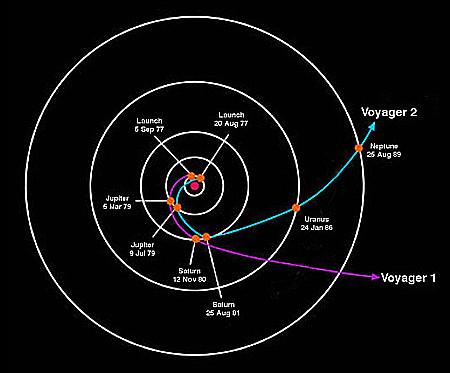
The Voyager missions
The routes the Voyager spacecraft have
taken since launch. Not to scale.

Due to continuing reductions in the power generated by their nuclear energy sources (after a half century of operation) engineers have now turned off one more science instrument on each Voyager spacecraft in order to extend the spacecrafts’ life as long as possible.

Mission engineers at NASAโ€™s Jet Propulsion Laboratory in Southern California turned off the cosmic ray subsystem experiment aboard Voyager 1 on Feb. 25 and will shut off Voyager 2โ€™s low-energy charged particle instrument on March 24. Three science instruments will continue to operate on each spacecraft. The moves are part of an ongoing effort to manage the gradually diminishing power supply of the twin probes.

Even with this action, the future lifespan of both spacecraft is very limited. It is expected the savings in power will allow both to last about a year longer, well into 2026. In order to keep the Voyagers operating as long as into the 2030s mission engineers are now working up a timeline for shutting down the remaining instruments in a step-by-step manner. In that long run the goal won’t be science gathering but engineering. Can humans keep a spacecraft operating for more than a half century at distances billions of miles away?

5 comments
1 147 148 149 150 151 182