Falcon 9 first stage lost after landing yesterday

According to an update on SpaceX’s website, the first stage of the Falcon 9 that launched 21 Starlink satellites (not 23 as initially reported) yesterday was lost shortly after landing.

The first stage booster returned to Earth and landed on the Just Read the Instructions droneship, which was stationed in the Atlantic Ocean ~250 nautical miles off the coast of Florida. Following the successful landing, an off-nominal fire in the aft end of the rocket damaged one of the booster’s landing legs which resulted in it tipping over.

This is only the second time in years that a first stage has been lost in this manner. After the previous occurrence last year during the Biden administration, the FAA grounded all SpaceX launches for several days, an action that indicated clearly an effort to harass the company for political reasons. I will be very surprised if this happens again, with Trump now in office.
1 comment

Ispace targets June 6, 2025 for the Moon landing its Resilience commercial lander

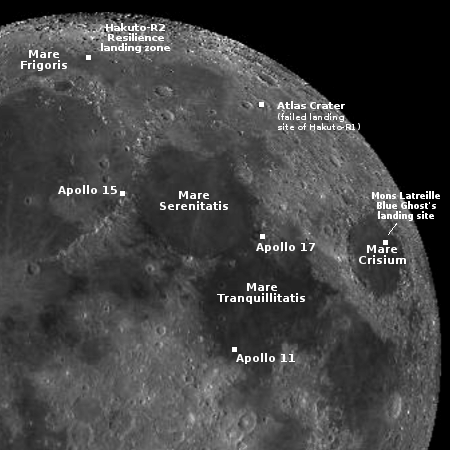
Map of lunar landing sites
Landing sites for both Firefly’s Blue Ghost and
Ispace’s Resilience

The Japanese startup Ispace announced today that its Resilience commercial lunar lander will attempt its touch down inside the Mare Frigoris region on the Moon on June 6, 2025, as shown on the map to the right.

Should conditions change, there are three alternative landing sites that are being considered with different landing dates and times for each. A decision about landing will be made in advance, but the window for landing is open from June 6 through June 8, 2025.

The company also reports that the spacecraft is healthy and operating exactly as expected.

Though Resilience was launched on the same Falcon 9 rocket that launched Firefly’s Blue Ghost lunar lander, it has taken a longer route to the Moon, which is why its landing will take place three months later.

0 comments

Starship/Superheavy test launch scrubbed

Though the countdown got down to T-40 seconds, the eighth orbital test launch of SpaceX’s Starship/Superheavy was scrubbed today due to a number of issues that popped up relating to both spacecraft.

At the moment we do not know exactly what those issues were, and will likely never get detailed explanations. Nor do we know when the next launch attempt will occur, though SpaceX has additional scheduled opportunities over the next week.

3 comments

Falklands government approves changes that will allow SpaceX to provide Starlink service

After a small negotiating kerfuffle, the executive committee of the Falklands government has now approved a major licensing fee change that will allow SpaceX to offer its Starlink service to island residences.

The Executive Committee (ExCo) of the Falkland Islands Government has officially approved a considerable reduction in the VSAT licence fee โ€“ it is โ€œmindedโ€ to slash it from ยฃ5,400 to just ยฃ180 but it will stay at ยฃ5,400 until final agreement in ExCo in early May. This decision paves the way for Starlink to begin providing services in the Falkland Islands, creating a game-changing step towards modernising the Islandsโ€™ telecommunications.

It appears that getting this approval required a major grassroots effort, as the government had initially been reluctant to change anything, despite the fact that numerous people were already using Starlink terminals illegally because there were no other options for good internet access, especially because the government’s deal with OneWeb had produced no results.

0 comments

March 3, 2025 Quick space links

Courtesy of BtB’s stringer Jay. This post is also an open thread. I welcome my readers to post any comments or additional links relating to any space issues, even if unrelated to the links below.

7 comments

Sunspot update: Sunspot activity remains high but stable

The uncertainty of science Time for my monthly update on our Sun’s sunspot cycle, based on NOAA’s monthly graph of the sunspot activity on the Earth-facing hemisphere of the Sun, but annotated by me with additional information.

The graph below shows that the number of sunspots in February continued the trend during this solar maximum of being significantly higher than the consensus prediction by a panel of NOAA solar scientists, as indicated by the red curve. At the same time, the count in February was well below the high point during the summer of 2024. Instead, though it went up slightly in February it remains at about the same level we have seen since September.
» Read more

1 comment

Watch the 8th orbital test flight of SpaceX’s Starship/Superheavy rocket

The eighth orbital test flight of SpaceX’s Starship/Superheavy rocket is scheduled to occur today, with a 60-minute launch window opening at 5:30 pm (Central). I have embedded below the Space Affairs live stream feed, as SpaceX’s X feed won’t be active until about 40 minutes before launch.

This flight has the same essential flight plan as the seventh flight, mainly because the prototype Starship on that previous flight was lost before it could achieve any of its goals. After Superheavy separates and attempts a chopstick landing at Boca Chica, Starship will go into a low orbit that will bring it down over the Indian Ocean. During the coast phase it will attempt to deploy four dummy Starlink satellites to test its deployment equipment, as well as do a Raptor-2 engine restart to demonstrate this works in order to prepare for a full orbit flight on a future test flight, possibly as soon as the next test flight.

Starship will also be testing a new configuration of thermal protection during its return, including leaving some places on its hull with no protection to see how those locations fare.

To paraphrase Elon Musk, prepare for excitment.

» Read more

2 comments

A galaxy surrounded by clusters of hot massive stars

A galaxy surrounded by hot massive stars
Click for original image.

Cool image time! The picture to the right, reduced and sharpened to post here, was taken by the Hubble Space Telescope of the galaxy NGC 5042, located about 48 million light years away. The picture combines data from all of Hubble’s available wavelengths from the ultraviolet to the infrared. From the caption:

Perhaps NGC 5042โ€™s most striking feature is its collection of brilliant pink gas clouds that are studded throughout its spiral arms. These flashy clouds are called H II (pronounced โ€œH-twoโ€) regions, and they get their distinctive colour from hydrogen atoms that have been ionised by ultraviolet light. If you look closely at this image, youโ€™ll see that many of these reddish clouds are associated with clumps of blue stars, often appearing to form a shell around the stars.

H II regions arise in expansive clouds of hydrogen gas, and only hot and massive stars [indicated by blue] produce enough high-energy light to create an H II region. Because the stars capable of creating H II regions only live for a few million years โ€” just a blink of an eye in galactic terms โ€” this image represents a fleeting snapshot of life in this galaxy.

The image also includes one star (distinguished by its four diffraction spikes) and a few background galaxies in yellow, the most obvious found in the upper and lower right.

0 comments

Russia and SpaceX complete launches

Two more launches today. First, Russia launched a Glonass GPS-type satellite, its Soyuz-2 rocket lifting off from its Plesetsk spaceport in northern Russia. The rocket’s core stage, four strap-on boosters and upper stage all landed in planned zones within Russia. Whether they crashed near homes is unknown.

Next SpaceX launched another 23 Starlink satellites, its Falcon 9 rocket lifting off from Cape Canaveral in Florida. The first stage completed its fifth flight, landing on a drone ship in the Atlantic.

Note that though some launch sites indicate China also did a launch this weekend of the solid-fueled Kuaizhou-1A rocket built by the pseudo-company Expace, a translation of this French site indicates the launch was a failure.

The leaders in the 2025 launch race:

26 SpaceX
9 China
3 Russia
2 Rocket Lab

1 comment

Astroforge’s Odin spacecraft tumbling and probably be lost

According to a video update by the company’s founder, Matt Gialich, Astroforge’s Odin spacecraft is slowly tumbling, and is likely going to be lost.

Gialich noted that they still have one more possibility to save the spacecraft, but “hope is fading.”

The goal had been to make the first fly-by of an asteroid by a private company, getting data on the M-type asteroid 2022 OB5, thought to be made up largely of nickel-iron which would make it extremely valuable.

4 comments

Blue Ghost successfully completes a soft landing

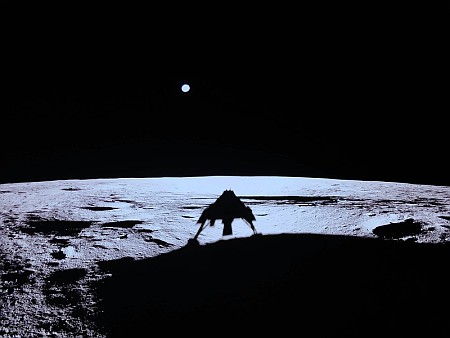
Blue Ghost's shadow on the Moon, with the Earth in the background
Blue Ghost’s shadow on the Moon,
with the Earth in the background.

Firefly tonight became the second private commercial company to land a spacecraft softly on the Moon, its Blue Ghost successfully touching down within Mare Crisium on the northwest quadrant of the visible near side.

At this moment we do not have details about the spacecraft’s condition. Nonetheless NASA bigwigs have come out of hiding to celebrate (if the landing failed they would have likely quietly disappeared). Lots of blather about “important scientific research” but the most important data from this mission is the engineering.

I think the viewers would much rather stay with mission control to hear details about Blue Ghost’s condition. One big unknown is that, of the four landing leg pads, one did not register contact with the ground, though this appears to simply be a failure of the sensor. Just after landing one engineer in mission controler announced the spacecraft was stable, but more information would be of more useful than listening to upper managers from NASA puff themselves. (It is also getting tiresome that the announcers seem incapable of asking anything but “How do you feel?”, one of the most useless questions a journalist can ever ask.)

The first photos are expected shortly. I will update when available.

24 comments
1 149 150 151 152 153 182