Space Force’s X-37B completes seventh flight, lasting 434 days

With landing on March 7, 2025 at Vandenberg in California, of one of the Space Force’s two X-37B reusable mini-shuttles, the military completed the seventh total flight, this one lasting over 434 days.

The mission achieved a number of important milestones. First, it was the first launched on SpaceX’s Falcon Heavy rocket. Previously launches had used both ULA’s Atlas-5 as well as SpaceX’s Falcon 9.

Second, the spacecraft successfully demonstrated its ability to use aerobraking to adjust its orbit.

The Space Force also claimed other classified experiments on board “tested space domain awareness technology experiments that aim to improve the United States Space Force’s knowledge of the space environment.” That’s however all they told us.

Because the Space Force has stopped telling us which of the two X-37B’s is flying on each launch, it is not clear the Space Force even has a fleet of two any longer. It could be one has been retired.

1 comment

Ballinator – History & Lore of 32nd of an Inch Bolts

An evening pause: Some engineering history for the weekend. I know the title makes this sound boring, but it is worth watching, because it illustrates the incredible complexity of some of what we think are the simplest tools. I wonder if the engineers in the space business are thinking about these issues.

Hat tip Mike Nelson.

10 comments

March 7, 2025 Quick space links

Courtesy of BtB’s stringer Jay. This post is also an open thread. I welcome my readers to post any comments or additional links relating to any space issues, even if unrelated to the links below.

  • NASA and the press team up to lobby against possible significant cuts to the agency’s science budget
    I have been following NASA science work for decades, and though much of it is extremely worthwhile, much of it is also fat that could be trimmed, most especially centers and programs that have been shown to fudge climate numbers to fit the theory of human-caused global warming (I’m most specifically looking at the Goddard Institute for Space Studies in New York). These should be shut down as fast as possible.
16 comments

Intuitive Machines confirms Athena fell over at landing; ends mission

Athena on its side on the Moon

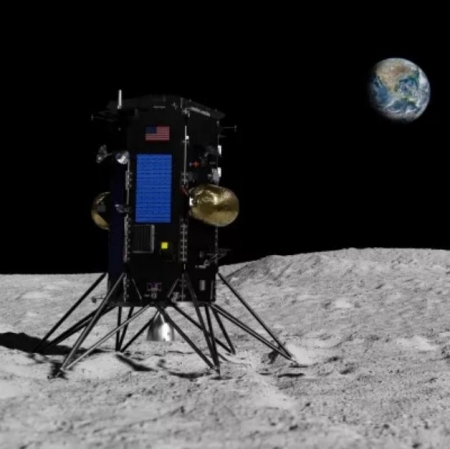
Artist rendering of lander on Moon

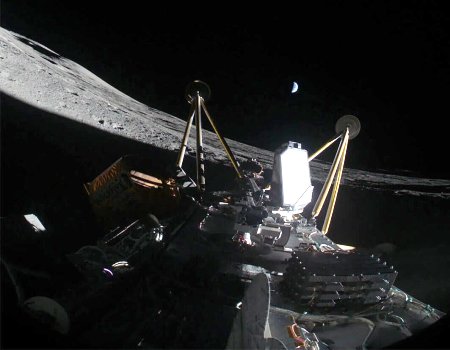
Intuitive Machines today officially ended its Athena lunar lander mission after it released a picture taken from the top of the lander showing clearly that it had fallen over on its side after landing.

That picture, cropped, reduced, and brightened to post here, is to the right. You can clearly see two of the landing legs in the air, with the horizon in the background.

“With the direction of the sun, the orientation of the solar panels, and extreme cold temperatures in the crater, Intuitive Machines does not expect Athena to recharge,” the company stated. “The mission has concluded and teams are continuing to assess the data collected throughout the mission.”

This is the second Intuitive Machines lunar lander to tip over. More and more it does appear that the tall design of this lander is fundamentally flawed. The artist rendering to the right illustrates this. Most unmanned lunar landers are much wider than they are tall. Intuitive Machines’ Nova design has the lander’s height matching the spread of its legs. It creates a center of gravity high enough that the lander will tip over too easily if conditions are not perfect.

The company denies this, saying the center of gravity is much lower than this graphic makes it appear, but the proof is in the pudding. Their design has tried to land on the Moon twice, and both times the lander tipped over.

It is not clear what the company can do to fix this. Expanding its diameter to lower its height is a major redesign. It also might make the lander too wide to fit inside most rocket fairings. A better solution might be to redesign the legs, making their spread wider, and even increasing their number.

Fortunately, NASA’s shift to capitalism in space has produced a number of different companies building lunar landers. Firefly’s Blue Ghost is clearly a success. In June Ispace will make its second attempt to soft land its private lander design on the Moon. And Astrobotic has a contract to try again after it had a fuel line leak after launch last year that prevented it from even attempting a landing.

And of course, Intuitive Machines is still in the game. It has a contract for one more landing mission, plus a mission to put two data relay satellites in lunar orbit.

16 comments

India’s Vikram lunar lander: Data suggests there could be more water impregnated in more places on the Moon

According to scientists analyzing the data sent back from India’s Vikram lunar lander, it appears that water could be impregnated in the upper lunar soil in more places than previously predicted.

You can read their paper here [pdf]. One instrument on the lander measured the temperature of the soil down about four inches, and found the temperature to be 25 degrees Celsius warmer than expected. That location was on a sunward-facing slope, so it was expected to be warmer but not by that amount. From the paper’s abstract:

This demonstrates that local topography at metre scales can alter temperature at high latitudes, unlike equatorial regions. Numerical model calculations using ChaSTE measurements, suggest that larger poleward facing slopes(>14°) at high latitudes can harbour water-ice, making them promising and technically less challenging sites for future lunar exploration and habitation.

In other words, slopes that get much less sunlight near the poles but are not permanently shadowed could still be cold enough only a few inches below the surface to harbor water molecules.

Sounds good, but I am beginning to sense a bit of blarney in these stories, over-pushing the possible existence of water to encourage more government space funding. It might be true that there is more water molecules in more places than predicted, but rarely do these reports say how much, which I expect will be very very little, in the parts per billion range. Nor do these stories ever consider the processing necessary to extract that water. Based on other data obtained from the Shadowcam instrument on South Korea’s Danuri lunar orbiter, it increasingly seems to me that any water found in polar regions of the Moon could be very slight, or even if in large amounts much more difficult to access than anyone ever mentions.

4 comments

Once again the leftist propaganda press takes out its knives to stab SpaceX and Musk

Superheavy captured safely by the chopsticks, for the third time in four attempts
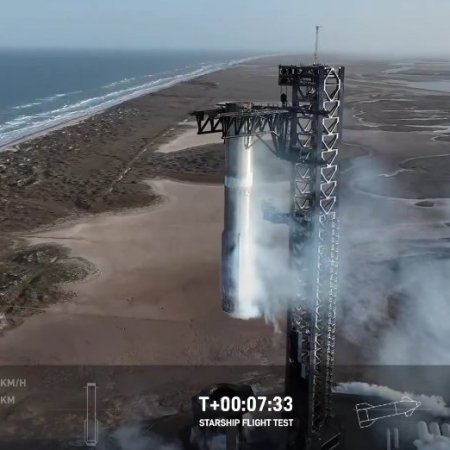
Superheavy captured safely yesterday by the chopsticks,
for the third time in four attempts

As should be expected, the destruction of Starship yesterday just before it made orbit on its eighth test flight was immediately used by partisan leftist media outlets to play “Let’s beat up on SpaceX and Elon Musk because he’s a friend of Trump!”

All these outlets decided to emphasize the falling debris and disruption to air traffic, but in doing so they all spun the story in a very dishonest way. First, both SpaceX and the FAA had been prepared for this possibility, and had used well-established procedures — in league with all other involved nations — to respond to the launch failure. The air space was cleared for only about fifteen minutes, as only this Florida Today article noted. Take-off delays at affected airports ranged from minutes to almost an hour, but hardly much different that normal delays seen every day.

Most important, no one was hurt, no planes were damaged, and there were no negative consequences. If anything, yesterday’s Starship flight illustrated the competence shown by SpaceX as it runs a very ambitious and radical development program of the most powerful rocket ever built. For example, why so little mention of the successful catch of Superheavy, something SpaceX has been able to do three times in the first four test flights? That achievement is truly mind-blowing.

The obviousness of these attacks is truly getting tedious. Moreover, why the hostility to one of the most spectacular efforts by an American company? Shouldn’t the American news outlets above be enthused by this effort? Have they become so hateful of their own country in all things, they want it to fail, always?

Sadly, I think we know the answer to that last question. The leftist indoctrination effort that now dominates almost all of America’s universities has produced a generation that does hate America, because they literally know nothing of its history except the distorted lies put forth by these Marxist colleges. They would rather destroy success than have America succeed.

It is both tragic and shameful, and a perfect example of someone cutting off their own nose to spite their face.

17 comments

French official lauds Ariane 6 launch; demands Europe have its own launch capability

Philippe Baptiste, France’s Minister for Higher Education and Research, yesterday loudly touted the second successful launch of Ariane 6 rocket, even though it occurred years late and costs far more than any other rocket on the market today.

Baptiste did so even as he insisted the Europe must continue to have its own launch capability so that it need not depend on rockets from other countries.

Europe must have sovereignty in space and “not yield to the temptation of preferring SpaceX or another competitor that may seem trendier, more reliable, or cheaper,” Baptiste [said]. “This first commercial launch of Ariane 6 is not just a technical and one-off success. It marks a new milestone, essential in the choice of European space independence and sovereignty. In the labyrinth of the global space race, Ariane 6 is the guiding thread of our strategic autonomy for the years to come.

“We must also collectively advance, as Europeans, on the governance of Europe’s space ambitions. We must ask ourselves all the questions, without taboos. For Europe in space, I am convinced that the European Union must fully assume its role as the political leader in this matter. The challenges are immense, no one knows this better than we do.”

Note Baptiste’s focus on having the European Union (EU) run things, with a focus on Ariane-6, despite its high cost. He was previously head of France’s space agency CNES, which for years has used the EU and the European Space Agency’s (ESA) partners help pay for France’s space program by requiring that all rocket launches be run by ESA’s commercial division, Arianespace.

That situation is now changing, with other ESA nations (Germany, Italy, Spain, and the United Kingdom) all breaking free from Arianespace and instead encouraging the development of competing private rocket startups independent of ESA or Arianespace. Moreover, these ESA partners have aggressive reduced Arianespace’s areas of control. It no longer runs the French Guiana spaceport. Its management of the Vega-C rocket has been transferred back to the Italian company Avio, which builds it. All it now has is Ariane-6, which has limited value because it is so expensive.

So while Baptiste desire for European autonomy matches the efforts of these European countries, his apparent desire to keep all control within the continent’s centralized government authority has been rejected. Europe has a chance to compete, but only because it is freeing its rocket startups from government control.

6 comments

Webb captures infrared view of a baby binary star system and its bi-polar jets

A baby binary in formation
Click for original image.

Cool image time! The infrared false-color picture to the right, reduced and sharpened to post here, was released today by the science team of the Webb Space Telescope. It shows the bi-polar jets spewing out from a newly formed binary of two very young stars as their interact during their formation process.

The two protostars responsible for this scene are at the center of the hourglass shape, in an opaque horizontal disk of cold gas and dust that fits within a single pixel. Much farther out, above and below the flattened disk where dust is thinner, the bright light from the stars shines through the gas and dust, forming large semi-transparent orange cones.

It’s equally important to notice where the stars’ light is blocked — look for the exceptionally dark, wide V-shapes offset by 90 degrees from the orange cones. These areas may look like there is no material, but it’s actually where the surrounding dust is the densest, and little starlight penetrates it. If you look carefully at these areas, Webb’s sensitive NIRCam (Near-Infrared Camera) has picked up distant stars as muted orange pinpoints behind this dust. Where the view is free of obscuring dust, stars shine brightly in white and blue.

To put it more simply, the accretion disk for the binary system lies at right angles to the much larger jets. The rotation of that disk as well as the stars causes those jets to flow up and down from the poles, with the existence of two stars producing the complex patterns in those jets.

As this image was focused mostly on studying the upper jet, it does not show the entire lower jet, which extends beyond the lower border.

0 comments

SpaceX’s eighth orbital test flight of Starship/Superheavy ends like the seventh flight

Starship just before loss of signal

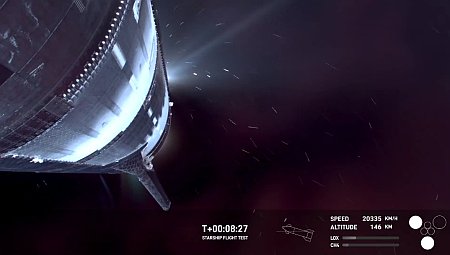
Today’s eighth orbital test flight of SpaceX’s Starship/Superheavy giant rocket has turned out to be almost identical to the seventh flight, with Superheavy completing its mission with a perfect chopstick catch at the launch tower in Boca Chica and Starship failing just before engine shutdown that would have put it into its orbit.

The screen capture to the right shows that moment. Note that graphic on the far lower right. It indicates that only two of the outside engines are firing, in an asymmetrical configuration. As a result Starship began tumbling, as shown by the fact that the Earth is not visible in the background. Shortly thereafter contact was lost, and I expect the flight termination system took over to destroy the ship. Expect videos from the Caribbean of it burning up overhead in the next day or so.

Superheavy however completed the third ever capture by the launch tower chopsticks. Musk has indicated that the company is pushing to reuse a Superheavy booster as soon as possible. The lose of Starship and the fact that two Superheavy engines shut down prematurely during the boost-back burn after stage separation likely delays that reuse at least one or two test flights. First, this Superheavy had issues, that might be solvable but they nonetheless exist.

More important, the loss of Starship just before its orbital coast once again means SpaceX was unable to do any of its orbital and return test program. It will not make sense to risk the next Starship flight with a used Superheavy when testing Starship has now been delayed twice.

Nor does it matter much. It will take many more launches before this rocket is reliably reusable. The first priority now is to make it more reliable on its first launches. Expect SpaceX to target the next test flight for sometime in mid- to-late April.

29 comments
1 146 147 148 149 150 182