
February 28, 2025 Zimmerman/Batchelor podcast
Embedded below the fold in two parts.
To listen to all of John Batchelor’s podcasts, go here.
» Read more
Embedded below the fold in two parts.
To listen to all of John Batchelor’s podcasts, go here.
» Read more
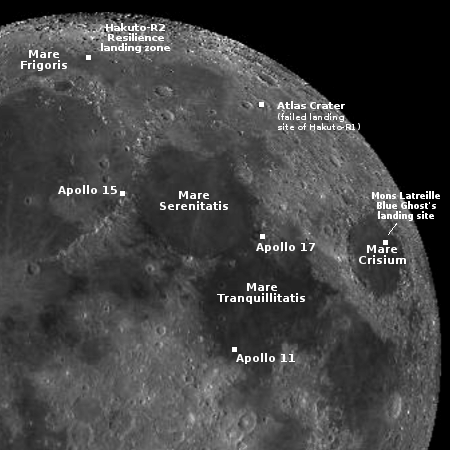
Landing sites for both Firefly’s Blue Ghost and
Ispace’s Resilience
I have embedded below the live stream from Firefly of tonight’s landing attempt on the Moon of its Blue Ghost lander. The stream goes live at 1:30 am (Central), with the landing targeting 2:45 am (Central).
The map to the right shows the location, in Mare Crisium. For context the map also shows the landing sites for several Apollo missions, as well as the location where Ispace’s first lander, Hakuto-R1, crashed, inside Atlas Crater. Also shown is the landing site of Ispace’s second lander, Resilience, in the north in Mare Frigoris.
Overall Blue Ghost’s nominal mission is engineering, to prove the lander can get to the Moon, touch down softly, and operate on the surface. If all goes well it will operate for about a week plus, during the lunar day. Whether it can survive the 14-day-long lunar night won’t be known until the Sun rises there and ground engineers can see if they can re-establish contact.
I have embedded the video update below, which was posted late yesterday. We should expect further updates today. At the moment engineers are having trouble communicating with Odin, and there indications that it is having a power problem as well.
» Read more
The FAA yesterday announced that it has given SpaceX the launch license for its 8th orbital test launch of Starship/Superheavy, presently scheduled for March 3, 2025 at 5:30 PM (Central).
“After completing the required and comprehensive safety review, the FAA determined the SpaceX Starship vehicle can return to flight operations while the investigation into the Jan. 16 Starship Flight 7 mishap remains open,” the FAA’s emailed statement reads. [emphasis mine]
The highlighted phrase reveals much. There is a new boss in Washington now who will not tolerate unnecessary red tape that stymies private enterprise unnecessarily. SpaceX is the only entity qualified to investigate the loss of Starship in the seventh flight, and it has completed its investigation. All the FAA can really do in its own “investigation” is retype SpaceX’s conclusion. It might have some clean-up work of its own relating to clearing the air space after Starship was destroyed, but even there SpaceX’s conclusion note that the plan worked out before launch between the company and the FAA worked perfectly.
Under Biden the FAA would have made SpaceX wait while that retyping took place, likely assigned to someone who can only hunt and peck at an old manual typewriter. No more.
An evening pause: Performed live in Italy on September 11, 2001, at the very day the World Trade Center came down.
Hat tip Rex Ridenoure.
Courtesy of BtB’s stringer Jay. This post is also an open thread. I welcome my readers to post any comments or additional links relating to any space issues, even if unrelated to the links below.

Click for original image.
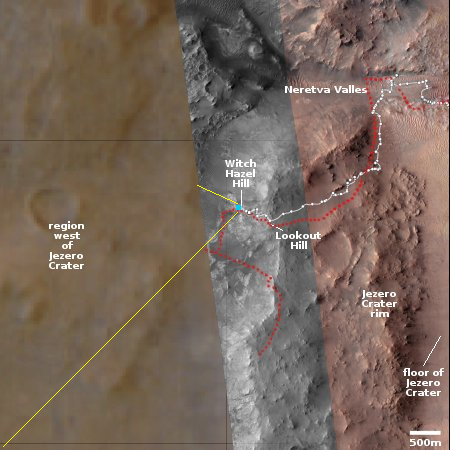
Click for interactive map.
Cool image time! The panorama above, rotated, cropped, and enhanced to post here, was taken today by the left navigation camera on the Mars rover Perseverance. It gives us the first really good high elevation view of the mountainous terrain to the west of Jezero Crater
The overview map to the right provides the context. The blue dot marks the rover’s present position, with the white dotted line its past travels and the red dotted line its future planned route. The yellow lines are my approximate guess as to the area covered by the panorama above.
Neither the rover team nor the team running Mars Reconnaissance Orbiter (MRO) that provides the high resolution images of this region have as yet updated the interactive map to show this western region in high resolution. My guess as to why is that the planned route is not yet heading that way (as indicated by the red dotted line). When Perseverance has finished its exploration of the outer slopes of the rim of Jezero Crater and heads west, this fuzzy area on this map will likely be replaced with high resolution data, similar to the rest of the map.
Nonetheless, if you look close, you can distinguish several geological features seen in the panorama, such as the large crater to the right and the ridge line to the left. Beyond are mountain chains and valleys, as well as many additional craters. This is truly a barren and alien place, though it has enormous potential for eventually becoming a friendlier environment.
All that is required is for humans to live there, with the natural desire to make it so.
In a series of statements in the last few days Elon Musk has claimed that the $2.4 billion upgrade of the FAA’s air traffic system by Verizon is failing, and further suggested, in a proposal fraught with conflict-of-interest issues, that SpaceX take over the contract instead.
The CNN article that I link to above is surprisingly well written. It describes the situation fairly, and includes no slanderous asides on Musk or SpaceX, as I have found typical of almost every other article written by the propaganda press about this particular subject (or any about Musk).
If Musk says Verizon’s upgrade is failing, I would tend to believe him. That Verizon has barely begun work installing the upgrades, two years after winning the contract, reinforces his accusations. SpaceX has already provided the FAA at no cost three Starlink terminals for testing, and if it does get the job we can be sure the upgrade would be installed far quicker than this.
The conflict-of-interest issue however remains. I am not sure how, or even if, Musk or SpaceX can get around it.
The European startup Polaris Spaceplanes, which has been doing tests of an aerospike engine for use in its proposed Aurora orbital re-usable spaceplane, has now won a contract from the German military to develop “a fully reusable hypersonic research vehicle”.
The contract describes the vehicle as a hypersonic testbed and experimental platform for defence-related applications, as well as scientific and institutional research. A secondary role of the vehicle will be to serve as a small satellite launch system when equipped with an expendable upper stage.
While not directly named in the update, this contract will likely kick off the development of AURORA. The contract’s initial scope is limited to the design of the vehicle. However, POLARIS revealed that the contract also includes provisions for follow-on initiatives to manufacture and flight-test the full-size vehicle.
The company has also done a series of test flights using smaller engineering test vehicles. It appears these tests convinced the German military to issue the company this contract.
This contract award also underlines Germany’s enthusiastic embrace of capitalism in space. It not only encouraged the establishment of the most rocket startups ahead of any other European nation, it is now taking action to encourage other aerospace startups as well.
SpaceX has rescheduled the 8th Starship/Superheavy orbital test flight from today to March 3, 2025, with the launch window opening at 5:30 pm (Central).
The company gave no reason for the delay, but it also indicated that the FAA has still not closed out the investigation of the Starship failure on the last test in January, nor issued the launch license.
That SpaceX is pushing for this quick launch date suggests it either expects the FAA to issue the permit momentarily, or it is purposely highlighting continuing delay tactics and is applying pressure on the agency. Unlike the Biden administration, which was very hostile to Musk and SpaceX and worked to harass it with lawfare, Trump will not take kindly to such tactics. By making such tactics patently obvious Musk and SpaceX will force Trump to step in.
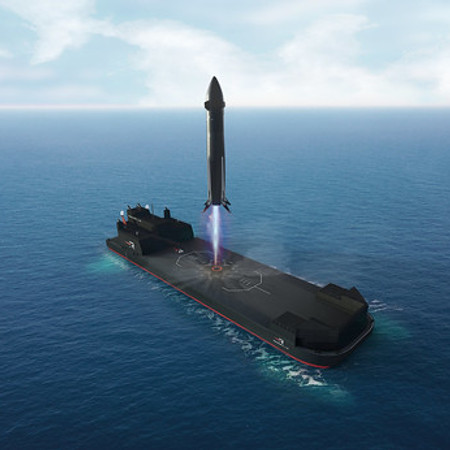
Graphic showing the barge after modification
with Neutron landing
Rocket Lab today unveiled a modified barge that it will use as a drone ship for ocean landings of the first stage of its new Neutron rocket.
‘Return On Investment’ is a 400 ft (122 m) modified barge that will be customized to enable landings at sea for its reusable Neutron rocket. Modifications will include autonomous ground support equipment to capture and secure the landed Neutron, blast shielding to protect equipment during Neutron landings, and station-keeping thrusters for precise positioning. The Company has acquired the barge and construction of ‘Return On Investment’ will take place throughout 2025, with expectations of being ready to enter service in 2026.
The name appears to be a dig against the stock market analyst who gave the company a negative report a few days ago, predicting Neutron won’t launch for the first time in 2025 — as Rocket Lab continues to predict — but in 2026.
At the same time, not having the landing platform ready until 2026 means that the first few launches will have to attempt a return to land or that first launch is delayed to 2026.
Meanwhile, Rocket Lab’s just released quarterly report appears to defy that negative assessment as well.
Rocket Lab founder and CEO, Sir Peter Beck, said: “2024 was a record-setting year for Rocket Lab, with our highest annual revenue ever posted of $436.2 million and a record Q4 2024 revenue of $132.4 million – a 382% increase compared to Q4 2021, our first full quarter following our debut on the Nasdaq as a publicly-traded company. Top achievements across launch and space systems include a record number of 16 launches for Electron in 2024 (a 60% increase in launch cadence compared to 2023) and more than $450 million in newly-secured launch and space systems contracts.”
More and more it appears to me that this stock market analyst was simply attempting to lower the stock price so as to garner profits when the price rebounded back to its proper value.
The startup Varda yesterday successfully returned its second capsule from orbit, with the capsule re-entering the atmosphere and touching down in Australia after spending six weeks in space.
The W-2 capsule carried a spectrometer built by the Air Force Research Laboratory (AFRL) and employed a heatshield developed in collaboration with NASA’s Ames Research Center in California’s Silicon Valley. The capsule also carried internal research that will expand Varda’s pharmaceutical processing capacity and capability.
The capsule landed at the Koomibba Test Range, operated by the spaceport startup Southern Range and located on the southern coast of Australia. Varda had arranged this landing location after it had absurd regulatory delays getting permission to land its first capsule at the Air Force test range in Utah.