Ispace’s Resilience lunar lander completes lunar flyby in preparation for entering lunar orbit

The Resilience lunar lander, built by the Japanese startup Ispace and launched in January on the same Falcon 9 rocket as Firefly’s Blue Ghost lunar lander, has now completed its closest flyby of the Moon as it prepares to enter lunar orbit sometimes in early May.

The spacecraft is actually still in Earth orbit, but with a apogee that is almost 700,000 miles out, or almost three times the distance of the Moon’s orbit. Once Ispace’s engineers have gotten a precise track of this orbit they will then determine the exact parameters of the engine burn in May that will place Resilience in lunar orbit.

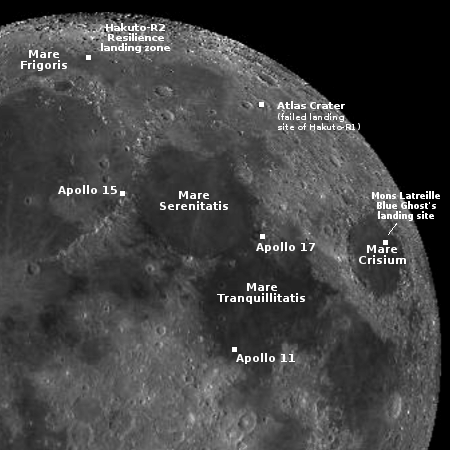
This is Ispace’s second attempt to place a lander on the Moon. The first, Hakuto-R1, came close, but crashed in Atlas Crater (see the map in my previous post) when, at an altitude of several kilometers, its software thought it was only a few feet above the surface and shut the engines off.

Most of the instruments on Resilience are either symbolic or engineering experiments to observe the lander’s operations. It is however carrying a small rover, dubbed Tenacious, which will attempt to travel on the surface.

6 comments

Blue Ghost enters lunar orbit, targets March 2, 2025 for landing

Map of lunar landing sites
Landing sites for both Firefly’s Blue Ghost and
Ispace’s Resilience

Blue Ghost on February 13, 2025 successfully completed a long four-minute engine burn to complete its transfer from Earth to lunar orbit, with a target date for the actual landing on March 2, 2025.

Now that the lander is in lunar trajectory, over the next 16 days, additional maneuvers will take the lander from an elliptical orbit to a circular orbit around the Moon. Blue Ghost Mission 1 is targeted to land Sunday, March 2, at 3:45 a.m. EST.

NASA has also announced the live stream coverage during landing:

Live coverage of the landing, jointly hosted by NASA and Firefly, will air on NASA+ starting at 2:30 a.m. EST, approximately 75 minutes before touchdown on the Moon’s surface. Learn how to watch NASA content through a variety of platforms, including social media. The broadcast will also stream on Firefly’s YouTube channel. Coverage will include live streaming and blog updates as the descent milestones occur.

I will embed the Firefly live stream when it becomes available.

2 comments

Texas commission rejects anti-SpaceX calls to deny company its Starship deluge water permit

The Texas Commission on Environmental Quality this week strongly and finally dismissed the repeated demands by various fringe activist groups to shut down SpaceX’s launch operations at Boca Chica and the use of the deluge system designed to protect the launchpad and the Superheavy booster.

The Texas Commission on Environmental Quality on Thursday denied requests from a dozen area residents and several groups to reconsider the commercial space company’s permit to dump as much as 358,000 gallons of water into wetlands during tests and launches of its Starship rocket from its Starbase east of Brownsville.

Commission Chair Brooke Paup introduced the item as “quite a big deal,” then quickly moved to deny additional hearings on the subject and issue the permit. She said concerns raised by individuals and groups including Save RGV, the South Texas Environmental Justice Network and the Carrizo/Comecrudo Nation of Texas failed to identify “new factual information or an error that would alter the executive director’s decision.

“The hearing requesters did not show that their ability to practice their religion or engage in recreational activities will be affected in a manner different than the general public,” Paup said.

The commission admitted in its ruling that there had been numerous technical errors by both the commission and SpaceX when it initially approved the permit, but none of those errors were significant.

It appears this particular effort by a very tiny minority of leftist anti-Musk activists has finally been shut down. We can only hope that these groups will now fade away, not because they want to give up but because their funding could be gone. I suspect their money came from somewhere within the fraudulent grant programs at EPA and other federal agencies that DOGE has now identified and shut down.

15 comments

Starlink Falcon 9 launch sets new reuse record for first stage

Last night SpaceX successfully launched 21 new Starlink satellites, its Falcon 9 rocket lifting off from Cape Canaveral in Florida.

The first stage completed its 26th flight, a new record for the Falcon 9 boosters. That number also exceeded the number of flights the space shuttle Endeavour completed in nineteen years from 1992 to 2011. This SpaceX booster however needed less than three and a half years to do it. Next shuttle record to beat is Columbia’s, which flew 28 times.

The 2025 launch race:

20 SpaceX
7 China
1 Blue Origin
1 India
1 Japan
1 Russia
1 Rocket Lab

0 comments

Watching a Falcon 9 liftoff from an airplane passenger seat

An evening pause: I think this launch was in December 2022, from Cape Canaveral. Makes a great start for the weekend.

Hat tip Greg the Geologist.

0 comments

A rose in space

A rose in space
Click for original image.

Cool image time! Using the Gemini South telescope in Chile, astronomers have taken a very beautiful picture, cropped, reduced, and sharpened to post here, of a nebula dubbed LH 88 that surrounds a star cluster and is located 160,000 light years away in the Large Magellanic Cloud.

The bright stars seen in the image are widely separated, but their motions through space are similar, indicating that they have a common origin. The layered nebulous structures in LH 88 are the remnants of stars that have already died. The delicate leaves of the rose were formed by both the shockwaves from supernovae and the stellar winds of the O and B stars.

The intense radiation of these super giant O and B stars — that burn fast and explode as supernova after only a few million years of life — not only shapes the nebula, it lights the nebula’s different atoms and molecules in different colors, with red/orange representing hydrogen and blue oxygen. The white areas indicate a mixture of both.

1 comment

Astronomers demand more regulations to prevent industry from ruining the Moon’s “environment”

According to two articles yesterday in the British press (here and here), both quoting extensively one astronomer, if strong regulation and control (given to them of course) isn’t imposed immediately, the space tourism of billionaires is going to ruin the Moon’s pristine environment, which on its far side is especially perfect for radio astronomy. From the first link:

“There’s a rush of companies and states who might want to get in on the act on the moon,” said [astronomer Martin Elvis, who added that there were also other concerns. “There’s a desire there from the billionaire class, ‘Oh I would love to spend a week on the moon’. And you don’t need many billionaires to start adding up. If they go without coordination, then it’s a mess. We could well lose these unique opportunities to do science on a scale that we couldn’t possibly imagine.”

One of the most exciting possibilities is the use of the far side of the moon for radio astronomy. As all signals from the Earth are blocked, telescopes would, Elvis said, have the sensitivity to see into the so called “dark age” of the universe, after the big bang but before stars had formed.

Elvis is based at Harvard and also co-chairs a working group at the International Astronomical Union (IAU) that wants astronomers to be given full legal control of the Moon, preventing anyone from building anything without their permission so they can instead build their telescopes there instead.

The problem is that the astronomical community has so far shown little interest in building telescopes in space. It has instead focused on building giant Earth-based telescopes while trying to get governments to restrict the launch of satellite constellations that might interfere with those telescopes. Now it wishes to restrict lunar development as well.

Elvis however admits “It’s a sort of first come, first served situation, which encourages people to rush in and do things without thinking too hard.” Let me translate: Everyone else is beating us to the Moon because we haven’t been interested in going, so now that we might be interested we want governments to shut down our competition.

It is long past time for astronomers and the IAU to stop trying to use government to squelch everyone else and get in the game. Initiate the building of telescopes both in space and the Moon. Not only are these better places to build telescopes than on Earth, it will give astronomers some credibility when they ask others to give them their own space.

10 comments

Blue Origin’s CEO lays off 10% of Blue Origin’s workforce to reduce “bureaucracy”

Dave Limp, Blue Origin’s CEO since late in 2023, announced yesterday that the company is laying off 10% of its workforce to in order to reduce the company’s overhead and make it more efficiently run.

From his company-wide email:

We grew and hired incredibly fast in the last few years, and with that growth came more bureaucracy and less focus than we needed. It also became clear that the makeup of our organization must change to ensure our roles are best aligned with executing these priorities. Sadly, this resulted in eliminating some positions in engineering, R&D, and program/project management and thinning out our layers of management.

I think Limp has finally gotten a full handle on the company after a year and a half in charge, and has now begun reshaping it from the five years of bloated and failed inactivity that occurred during the reing of the previous CEO, Bob Smith. Smith tried to turn Blue Origin into another old-fashioned big space company like Boeing or Northrop Grumman, big and slow and inefficient. Thus, nothing happened there from 2017 to 2023. Since Limp took over Blue Origin has begun to function more like SpaceX, and thus has begun to move. These layoff are probably Limp’s first main effort to clean house.

2 comments

The movement to ban smartphones in schools widens

The smart phone: Bad for kids
The smart phone: Proven very bad for kids

According to a detailed Washington Examiner story earlier this week, the campaign to ban smartphones in schools is expanding rapidly, with widespread bi-partisan support, backed up by studies and school reports that consistently show significant improvements in student behavior and learning when smart phones are banned.

Eight states have banned cellphone use in schools, with Florida being the first to do so when Gov. Ron DeSantis (R-FL) signed a bill into law in 2023. The legislation in the Sunshine State allows teachers to ban cellphone use during classroom instruction and authorizes them to hold a student’s phone if it becomes a distraction.

Florida was followed by Indiana, Louisiana, Virginia, California, Minnesota, South Carolina, and Ohio in passing similar bans that have either been enacted or will be in the coming year. Each of the states that have passed bans has taken different approaches to implementing the policy.

Fifteen other states have proposed a ban, and an additional eight states are either doing test bans in selected regions or have issued recommendations endorsing bans. That makes for a total if 32 states out of 50 that are working to keep smart phones away from kids when they are in school.

The best aspect of this is the generally bi-partisan nature of the movement. While most of the initial action occurred in red states controlled by conservative politicians, blue states like California and Minnesota have also joined in. A Minnesota middle school for example was an early practitioner of the ban in 2023, finding it not only improved classroom participation, but the entire social atmosphere in the school improved. In California meanwhile Democrat Governor Gavin Newsom signed a law restricting smartphone that takes effect in July 2026. Even Washington, D.C. is debating legislation to institute a school ban.

The sooner the better. Kids don’t need smart phones. All they really need is a dumb phone to call their parents in case of an emergency. And when they are in school this is even less necessary. Spending their time staring at a screen is the worst way to learn to live with other humans, a learning experience that is probably their number one class assignment.

7 comments

Pits formed from sublimating underground ice on Mars?

Pits formed from sublimating underground ice
Click for original image.

Cool image time! The picture to the right, cropped, reduced, and sharpened to post here, was taken on October 31, 2024 by the high resolution camera on Mars Reconnaissance Orbiter (MRO).

The science team labels this “Impact Ejecta with Marginal Pits,” though even on the full image I am not sure what the impact ejecta is. The pits themselves appear to have formed when near-surface ice sublimated away during the summer months. The location is at 59 degrees north latitude, deep within the Martian northern lowland plains. Since orbital data suggests much of those plains at this latitude has an ice table of some thickness near the surface, it is very reasonable to assume these pits formed when summer sunlight heated that ice, turning it to gas which eventually pushed out to form the pits.

But what about the impact ejecta? Where is it? And where is the crater from that impact?
» Read more

2 comments
1 158 159 160 161 162 182