February 18, 2025 Quick space links

Courtesy of BtB’s stringer Jay. This post is also an open thread. I welcome my readers to post any comments or additional links relating to any space issues, even if unrelated to the links below.

  • By today NASA’s workforce will shrink by 10%
    The layoffs are as per Trump’s order to lay off all new provisional employees, plus the 750 or so who accepted the buy offer. The article is another example of the media wailing over a staffing reduction that private companies do all the time, usually to the benefit of the company.
  • South Africa rejects Starlink
    Actually, Starlink had already rejected South Africa, partly because of its racist policies confiscating land from whites, and partly because the government there was demanding an exorbitant share of Starlink’s profits.
4 comments

Blue Ghost lowers its lunar orbit while shooting a movie of the Moon

The company Firefly announced that its lunar lander Blue Ghost successfully completed 3:18 minute engine burn that tightened its orbit around the Moon.

This maneuver moved the lander from a high elliptical orbit to a much lower elliptical orbit around the Moon. Shortly after the burn, Blue Ghost captured incredible footage of the Moon’s far side, about 120 km above the surface.

I have embedded the movie below. Quite spectacular indeed. The spacecraft is still on target for a March 2, 2025 landing attempt.
» Read more

3 comments

Another “What the heck?” image on Mars, this time a mystery on both small and large scales

What the heck?
Click for the original image.

Cool image time! The picture to the right, rotated, cropped, reduced, and sharpened to post here, was taken on October 21, 2024 by the high resolution camera on Mars Reconnaissance Orbiter (MRO). Labeled simply as a “terrain sample,” it was likely taken not as part of any specific research project but to fill a gap in the schedule in order to maintain the camera’s proper temperature.

In this case however the camera team picked this spot probably to satisfy their own curiosity. This same location was photographed by MRO back in July 2022, and they were likely wondering if the streaks coming off these dark spots had changed at all in the subsequent years.

As far as I can tell, there has been no significant change, though the highest resolution versions of these images might show more.

The geology in the picture itself is very puzzling. At first glance the dark streaks appear to have been caused by wind blowing the dust from the dark spots. At second glance this doesn’t work, as large dark areas do not appear to be linked to those dark spots.

What is going on here?
» Read more

3 comments

ISRO’s head touts private construction of PSLV rocket

In comments published in the Times of India today, the head of India’s space agency ISRO, V Narayanan, enthusiastically touted the fact that a private consortium is presently manufacturing its first PSLV rocket under a five-rocket contract.

Isro chairman V Narayanan revealed this in an exclusive interview to TOI and said the launch, scheduled for the third quarter of this year, will mark a milestone as the first PSLV manufactured by the private sector under a contract for five rockets. The vehicle is in “advanced stages of realisation” with Isro providing technical guidance to the industrial partners.

Sounds good, eh? Actually, this instead appears to be an attempt by ISRO to thwart the Modi government’s desire to transfer ownership of ISRO’s rockets, starting with the long established PSLV rocket, from ISRO to the private sector. This five-rocket deal, first signed in 2022, doesn’t transfer anything. All it does is have private companies build the rocket, something that ISRO has had private companies do for decades. The one difference is that ISRO is no longer listed as the prime contractor, and appears to be somewhat less involved in management.

Well, it is at least a start. Getting government bureaucracies to give up power can sometimes be a struggle that lasts years, unless you are Donald Trump arriving for a second term disgusted with that same struggle during his first term.

The launch, targeting the third quarter of this year, will place a collection of tecnology test payloads into orbit.

0 comments

SpaceX engineers given task to review FAA air traffic operations

On February 16, 2025 the new head of the Department of Transportation revealed that he had invited SpaceX to review its air traffic control operations in Virginia and make recommendations.

Tomorrow, members of @elonmusk’s SpaceX team will be visiting the Air Traffic Control System Command Center in VA to get a firsthand look at the current system, learn what air traffic controllers like and dislike about their current tools, and envision how we can make a new, better, modern and safer system.

Because I know the media (and Hillary Clinton) will claim Elon’s team is getting special access, let me make clear that the @FAANews regularly gives tours of the command center to both media and companies.

Many propaganda news reports immediately did exactly what Duffy predicted, quickly finding people to attack both Musk and Duffy for this action and giving them a bull horn for those attacks:

That prompted criticism from some aviation professionals. “SpaceX put people in danger yesterday and their for-profit corporation should reimburse every other for-profit corporation that had to divert, change course or delay because of their operations in the national airspace system,” wrote Steve Jangelis, aviation safety chair for the Air Line Pilots Association, in a social media post after the incident.

Like many in the propaganda press, this article made a big deal about the debris that fell in the Caribbean during the January Starship/Superheavy test flight when Starship broke up soon after stage separation. It however buried this fact to the very end of the article:

In the case if January’s launch, Diez said SpaceX coordinated “debris response areas” with ATO [the FAA’s Air Traffic Organization] beforehand, as it had done on past flights, but this was the first time the areas were activated. “It was only a matter of minutes from when it was activated to when airspace began to be cleared,” she said, sufficient given the time it would take for debris to fall into the airspace. The airspace was cleared in about 15 minutes, she added.

Those debris response areas are developed in coordination with the FAA’s Office of Commercial Space Transportation, or AST, said Katie Cranor, acting deputy director of AST’s office of operational safety, on the same panel. After the mishap, she said “only certain sections of the debris response areas were activated to allow traffic to still move freely.”

To put it more bluntly, SpaceX did the proper due diligence before launch — anticipating the possibility of such a failure — and worked well with the FAA to prepare for it. These facts have been conveniently left out of all the reports on that January launch, and we should at least give kudos to this article for finally mentioning it, albeit reluctantly.

Nonetheless, the insane hostile reaction to this invitation for help by the Transportation Department illustrates once again the stupidity of the left. In every case they attack blindly and without any thought at all, hoping such attacks will win them support and hurt their opponents. Instead, it simply makes them look petty and stupid, and is likely convincing their moderate supporters to rethink that support.

4 comments

February 17, 2025 Quick space links

Courtesy of BtB’s stringer Jay. This post is also an open thread. I welcome my readers to post any comments or additional links relating to any space issues, even if unrelated to the links below.

3 comments

With CBS helping him, under no condition should Trump settle his $10 billion lawsuit against the network

Lying lefist propaganda, through and through

Don’t settle! In the fall Donald Trump filed a $10 billion lawsuit against CBS News, alleging the network interfered with the election by maliciously editing a 60 Minutes interview with vice president Kamala Harris to hide and improve her incoherent word salad answers, and it did so to aid her just days before the election. In February, when the actual transcripts of the interview were released, proving CBS’s misconduct, Trump expanded the lawsuit to include CBS News’s parent company, Paramount Global, which streamed the program.

Though some might argue the lawsuit rests on weak legal grounds, it seems that Trump’s complaint has some merit, especially since the leftist bias of the older alphabet news outlets (CBS, CNN, NBC, MSNBC, ABC, PBS) has become so obvious in the past decade. These networks no longer even try to report the news fairly or with any accuracy. Instead, they twist every story to either promote the Democratic Party or slander the Republican Party.

That bias has caused these networks a lot of trouble in the courts in recent years, when others have sued them for defamation and slander. » Read more

6 comments

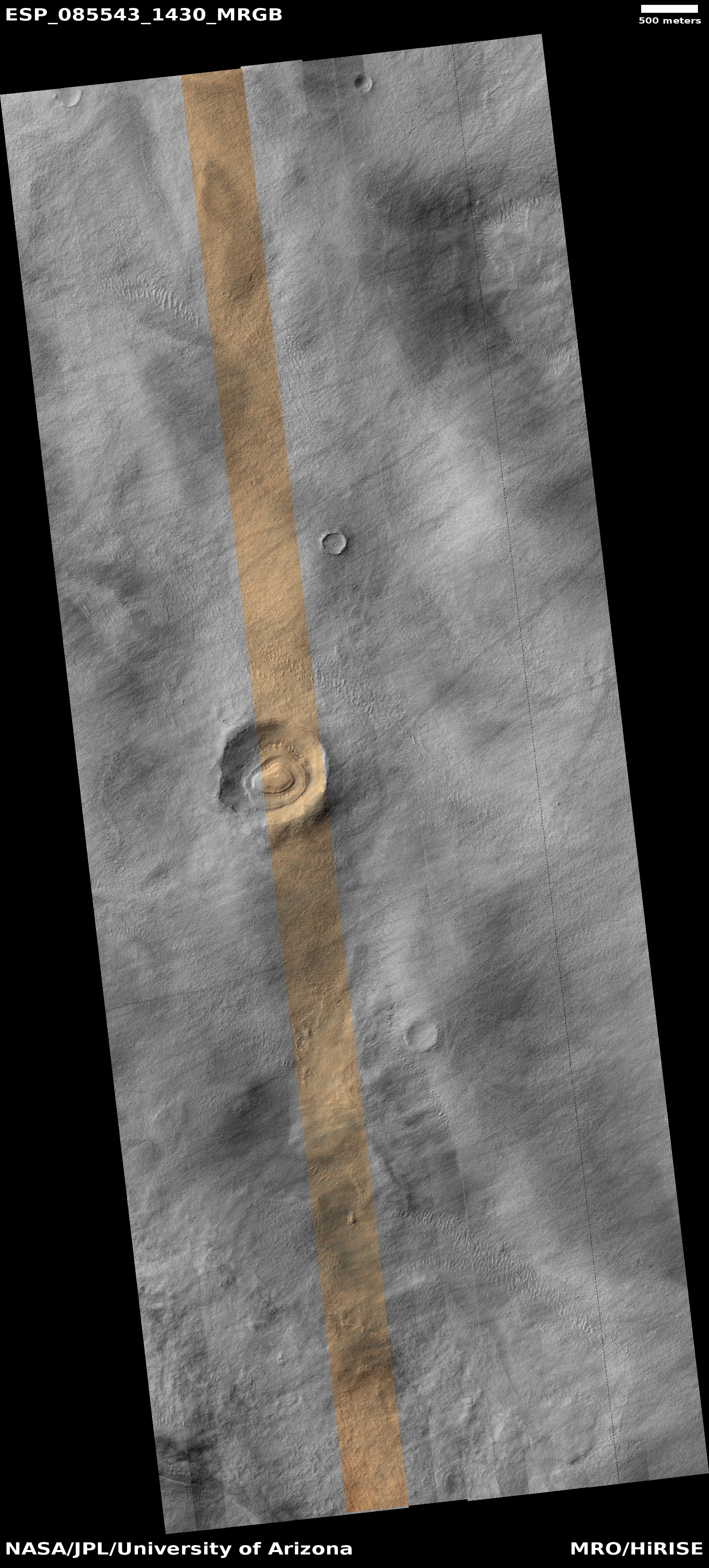
Glacial material even in Mars’ Death Valley

Glacial material even in Mars' Death Valley
Click for original image.

Cool image time! The picture to the right, cropped, reduced, and sharpened to post here, was taken on October 25, 2024 by the high resolution camera on Mars Reconnaissance Orbiter (MRO).

The science team labels this a “layered feature,” which is appropriately vague in order to not prematurely push a conclusion that is not yet proven. Extensive orbital imagery and data however strongly suggests the layers inside this crater are glacial in nature, each layer laid down during Mars’ many thousands of climate cycles as the planet’s rotational tilt swung back and forth from 11 degrees to 60 degrees. According to the most popular theory today, when that tilt was high, the mid-latitudes (where this 3,000-foot-wide unnamed crater is located) were actually colder than the planet’s poles. The water ice at the icecaps would then migrate from the poles to the mid-latitudes, causing the glaciers to grow.

When the tilt was low the process would reverse, with the mid-latitudes now warmer than the poles, causing the glaciers to shrink. The wedding cake nature of these layers is likely because, over time, Mars has steadily lost its total budget of water to space, so with each cycle the glacier could not grow as much.

Though many such glacial-filled craters have been found in the mid-latitudes, reinforcing these theories, the location of this crater is even more interesting.
» Read more

0 comments

British rocket startup Skyrora targets ’26 for its first orbital test flight

According to an article yesterday in the British media, the British rocket startup Skyrora is now hoping to do the first orbital test flight of its XL smallsat rocket in 2026, launching from the Saxavord spaceport in the Shetland Islands.

The company applied for this launch license with the UK’s Civil Aviation Authority (CAA) more than a year ago, but still waits an approval. Previously the company had completed in Iceland several successful suborbital test launches in 2018 and 2020, with a last test in 2022 ending in failure.

The company has been around a long time, with relatively little progress. Whether its schedule is realistic remains unknown, and is more questionable because it is burdened by the CAA’s red tape.

0 comments

ESA astronaut with no right leg cleared by medical board to fly to ISS

An international medical board has now cleared ESA astronaut John McFall to fly on a future long-duration mission to ISS, despite the fact that his right leg had been lost due to a motorcycle accident when he was nineteen and wears a prosthesis.

He is the first person with such a disability to be medically approved to train for missions to the station. “John is today certified as an astronaut who can fly on a long-duration mission on the International Space Station, and I think this is an incredible step ahead in our ambition to broaden the access to society to space,” Daniel Neuenschwander, ESA’s director of human and robotic exploration, said at a briefing to announce the certification.

ESA selected McFall as part of an astronaut class announced in 2022. That selection process included an effort by ESA to pick what it called at the time a “parastronaut” to see if people with some physical disabilities could safely fly to space.

This is actually a great idea. As one Russia astronaut once said to me, “The legs are mostly useless in weightlessness.” Testing to see how McFall does on a six-month mission will tell us whether the weightlessness environment is a good one for people who can’t walk, as has been theorized for decades.

At the moment McFall has not yet been assigned to any scheduled flight. He joins a class of twelve astronauts selected by ESA in 2022. He is also being considered as a possible astronaut on a proposed all-British tourist flight that Axiom is considering flying.

It is unfortunate that the racist Diversity, Equity, and Inclusion policies of the past decade poison this decision. I am certain many will assume McFall’s future flight will be done just for those reasons, and thus will discount it.

7 comments

Starlab space station wins $15 million grant from Texas

the proposed Starlab space station

Among the grants awarded last week by the new Texas Space Commission, the consortium building the Starlab space station received a $15 million grant to build a facility in Texas.

The Systems Integration Lab will include two labs, the main SIL and a Software Verification Facility. The SIL will house flight-like hardware for testing. In this environment, engineers and astronauts can check systems designed for the Starlab space station, catching any potential issues in advance and ensuring efficient and effective operations in space. The SVF will contain a simulated station environment with flight computers and serve as the primary software integration and requirements verification facility.

Starlab is one of four space stations presently being developed. Starlab had already received a $217.5 million design contract from NASA, as part of the agency’s phase one program to eventually develop two private commercial space stations to replace ISS. NASA also awarded similar development contracts, to Axiom for its Axiom station that will initially be docked to ISS, and to the Orbital Reef station proposal, led by a consortium of companies that includes Blue Origin and Sierra Space.

A fourth company, Vast, did not compete for that phase 1 contract. Instead, it has privately funded its first single modular station, Haven-1, which it is now aiming for a spring 2026 launch. All four station projects are competing to win NASA’s much larger phase 2 contract awards, which will only go to two of these four proposals. At present, this is how I rank their chances:

  • Haven-1, being built by Vast, with no NASA funds. The company is moving fast, with Haven-1 to launch and be occupied in 2026 for a 30 day mission. It hopes this actual hardware and manned mission will put it in the lead to win NASA’s phase 2 contract, from which it will build its much larger mult-module Haven-2 station..
  • Axiom, being built by Axiom, has also launched three tourist flights to ISS. There are rumors it is experiencing cash flow issues, but it is also going to do a fourth ISS tourist flight this spring, carrying passengers from India, Hungary, and Poland.
  • Orbital Reef, being built by a consortium led by Blue Origin and Sierra Space. Though Blue Origin has apparently done little, Sierra Space has successfully tested its inflatable modules, including a full scale version, and appears ready to start building the station’s modules for launch.
  • Starlab, being built by a consortium led by Voyager Space, Airbus, and Northrop Grumman.

Of all these projects, Starlab appears to have cut the least amount of hardware, which is why I rank it last. At the same time, this grant from Texas is some positive news. In addition, it has partnered aggressively with the European Space Agency (ESA), and appears to have its support for making the station Europe’s ISS replacement. If so, even if it doesn’t win NASA’s phase 2 award it might instead get ESA to fund it. That Europe’s biggest aerospace company Airbus is now one of its major partners clearly helps.

2 comments
1 157 158 159 160 161 182