Australian rocket startup Gilmour Space appears to have finally gotten its launch license

Australian commercial spaceports
Australia’s commercial spaceports. Click for original map.

According to two news reports (here and here) as well as an update today on the company’s website, the Australian rocket startup Gilmour Space has gotten its last government approval allowing it to finally do the first orbital test launch of its Eris rocket from its private Bowen launch site on the east coast of Australia.

Though the company has not yet announced a launch date, the news reports and previous announcements suggest it will occur in late March. This document [pdf] provides excellent details about the launch, including the range limitations and flight path. No live stream will be provided on this first launch attempt.

I expect more information to be announced either later today or tomorrow. If this is confirmed, it will have been a long time coming. Gilmour first applied for its launch license in April 2022, with the intention of launching that year. Unfortunately, Australia’s Civil Aviation Safety Authority (CASA) appears as slow and as difficult to work with as the United Kingdom’s Civil Aviation Authority. It took CASA almost three years to issue this license (assuming it has been issued). With that kind of red tape, I don’t know how Gilmour is going to become profitable. It certainly can’t wait three years between each launch.

0 comments

The broken edge of Mars’ largest volcanic ash field

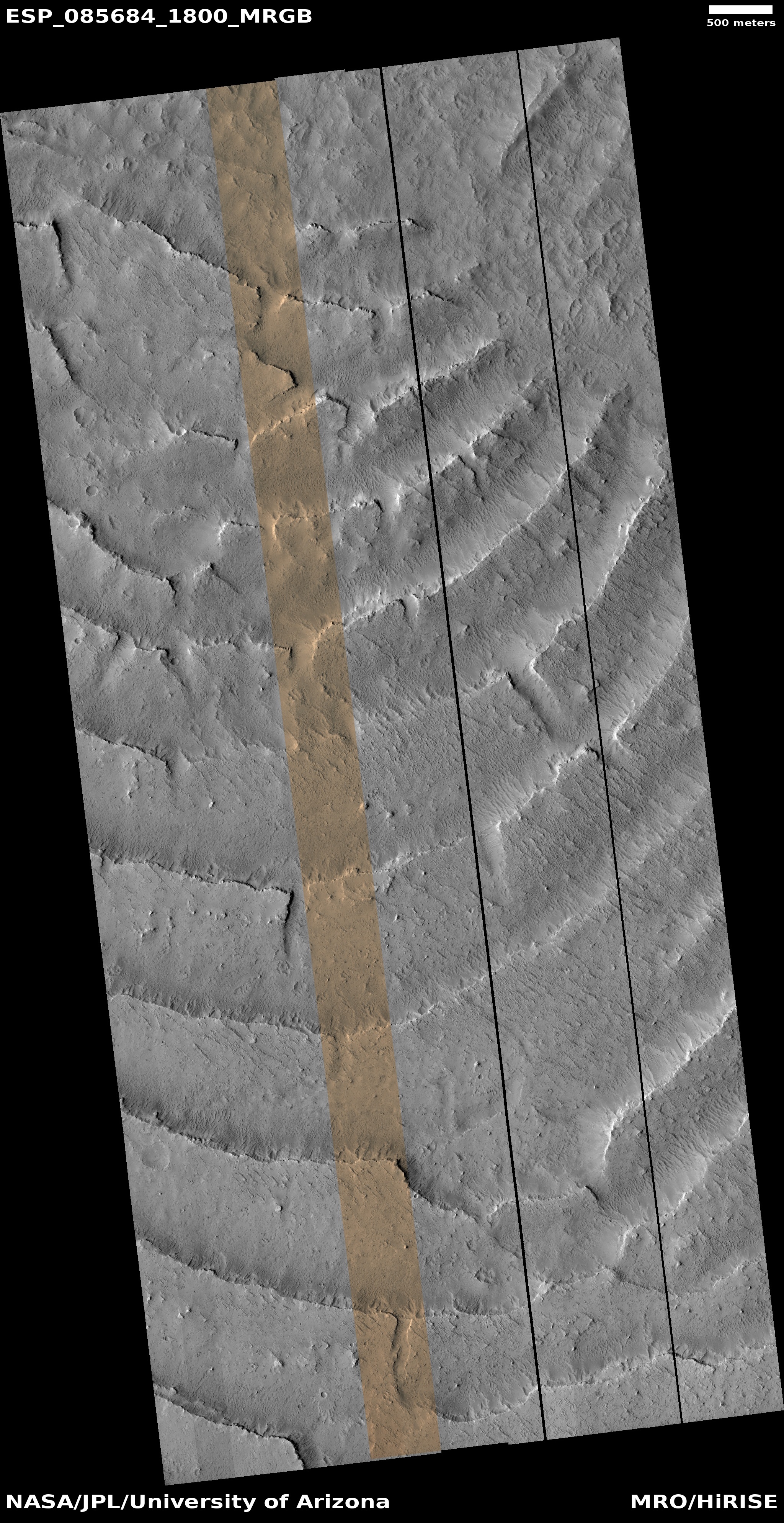
The broken edge of Mars' largest volcanic ash field
Click for original image.

Overview map

Cool image time! The picture above, reduced and rotated to place north to the left, was taken on November 5, 2024 by the high resolution camera on Mars Reconnaissance Orbiter (MRO).

The science team labeled it “Stepped Features in Tartarus Skopulus”. The white dot on the overview map to the right marks the location, right at the equator on the northern edge of the Medusae Fossae Formation, the largest volcanic ash field on Mars, about the size of the subcontinent of India. As I wrote in a post in 2024:

It is believed that most of the planet’s dust comes from this ash field. It is also evident that the ash is a leftover from the time period more than a billion years ago when the giant volcanoes that surround this field were erupting regularly. The eruptions laid down vast flood lava plains that coat the surface for thousands of miles.

The ash either came from the eruptions themselves, or was created as the thin Martian wind eroded those flood lava plains, slowly stripping ash from the top. The ash then gathered within the black-outlined regions on the map.

In that 2024 post the cool image showed another location on the north edge of Medusae. In that case the prevailing wind had carved long parallel ridges as it pulled ash from the field.

Here, the wind appears to play no part, or if it did, it produced a very different terrain. At first glance it appears the stepped terraces formed as the ash field began to slide downhill to the north, spreading to crack along the curved lines. The inset especially suggests this explanation.

A closer look instead suggests these terraces each represent a different layer of ash placed down by a sequence of eruptions. Over time the prevailing winds, which here appear to generally blow to the south, stripped off the top of each layer, creating this stair-step landscape.

I however have no guess as to why the terraces are curved. Regardless, it is all strange, but quite beautiful in its own way.

0 comments

Alaskan spaceport sues insurance company over delayed rocket clean-up claims

The Alaskan spaceport in Kodiak has now sued the insurance company of the rocket startup ABL (now out of the orbital rocket business) because it has not responded to the spaceport’s claims for cleaning up the mess caused by a failed static fire engine test.

According to the spaceport, the cost of the damages and cleanup totals about $3.1 million.

The corporation claims ABL Space Systems was required to carry insurance that covered the spaceport, and had a policy for up to $50 million through the U.S. Aircraft Insurance Group (USAIG) to cover the damages.

But after sending three emails to USAIG asking for a copy of its policy and status on a filed claim, which allegedly existed but was never confirmed by the insurance group, Alaska Aerospace’s lawyer Cook with Birch Horton Bittner & Cherot sent a final follow up email last month on Jan. 8.

Having still not gotten a response, the spaceport has now sued. Delays and suits like this are not unusual in the insurance business, because insurance companies often stall when it comes to paying out large claims.

The failure during the static fire test was the final blow in ABL’s effort to enter the orbital launch market. After one failed launch and this static fire test failure it abandoned the market to instead focus on building missiles for the military.

0 comments

Musk: Biden delayed the return of Starliner’s astronauts “for political reasons”

During a television interview with President Trump, Elon Musk suggested that the reason the two Starliner astronauts have been forced to remain on ISS for months was because of a political decision by the Biden administration last year.

The billionaire SpaceX CEO said his company was “accelerating the return of the astronauts” as per Trump’s instructions. Musk then appeared to take a shot at the Biden administration, saying the move was “postponed kind of to a ridiculous degree,” before the president chimed in saying “they got left in space.”

When Hannity pointed out the astronauts have been on the ISS for almost 300 days instead of the planned 8 days, Trump simply said “Biden,” before Musk claimed they were “left up there for political reasons, which is not good.”

While the decision to return Starliner unmanned certainly had a political component (a desire to avoid a disaster in the final year of Biden’s term), Musk’s claim is greatly exaggerated. Worse, Musk is papering over his own company’s contribution to the delays. Had SpaceX and NASA chosen in December to use an already existing Dragon capsule instead of a brand new capsule to launch the next crew to ISS, the astronauts would be home already. Instead, they decided to get that new capsule ready, requiring an almost two month delay in their return.

When it became obvious last month that even this extra time was insufficient to get the new capsule ready, only then did SpaceX and NASA choose to switch capsules. That switch allowed them to move up the return date by about a week.

In reporting Musk’s words here, our ignorant press has generally left these details out, allowing both Musk and Trump to make it appear as they are saviors for these poor astronauts. This is simply not true. SpaceX is certainly making it possible to bring them home (something Boeing was unable to do), but it also contributed to the delay in doing so.

16 comments

New data from Webb shows the Milky Way’s central supermassive black hole flares multiple times per day

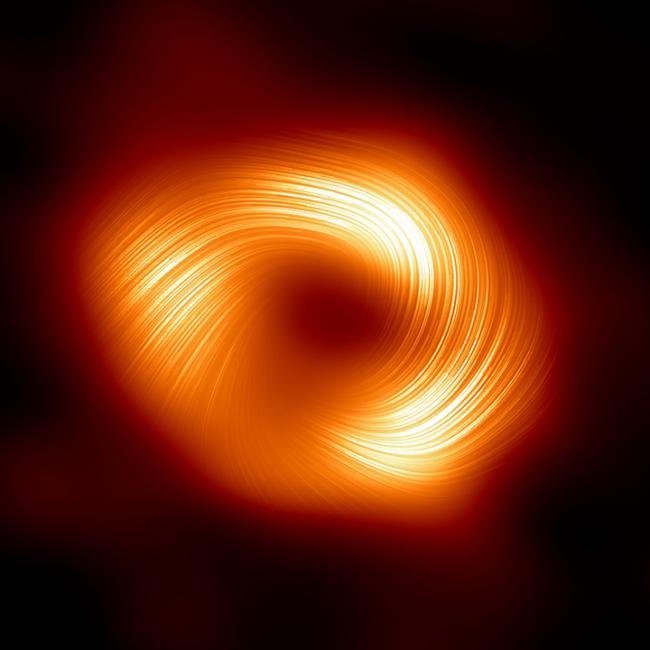
The magnetic field lines surrounding Sagittarius A*
The magnetic field lines surrounding Sagittarius A*,
published in March 2024. Click for original image.

Though past research had shown that the Milky Way’s central supermassive black hole, dubbed Sagittarius A* (pronounced A-star) is generally quiet and inactive, new data from the Webb Space Telescope gathered over a year’s time now shows that it flares multiple times per day.

Throughout the year, the team saw how the black hole’s accretion disk emitted 5 to 6 large flares per day, of varying lengths and brightnesses, plus smaller flares in between. “[Sagittarius A*] is always bubbling with activity and never seems to reach a steady state,” Yusef-Zadeh says. “We observed the black hole multiple times throughout 2023 and 2024, and we noticed changes in every observation. We saw something different each time, which is really remarkable. Nothing ever stayed the same.”

In their paper published in The Astrophysical Journal Letters, the team outlines two possible ideas for the processes driving these flares. The faint flickers may be caused by turbulent fluctuations in the accretion disk, which could compress plasma and trigger a burst of radiation. “It’s similar to how the sun’s magnetic field gathers together, compresses and then erupts a solar flare,” Yusef-Zadeh says. “Of course, the processes are more dramatic because the environment around a black hole is much more energetic and much more extreme.”

The larger and brighter flares, on the other hand, may be caused by two fast-moving magnetic fields colliding and releasing accelerated particles. These magnetic reconnection events also have a solar parallel.

You can read their paper here [pdf]. Though this research shows unexpected activity, that activity is still relatively mild compared to other central supermassive black holes in many other galaxies. Why this difference exists remains an unanswered question.

4 comments

SaveRGV drops lawsuit against SpaceX’s Boca Chica operations

SaveRGV, one of several fringe activist groups that has been using lawfare to try to shut down SpaceX’s Starship/Superheavy operations in Boca Chica, suddenly announced yesterday that it has dropped a lawsuit against the company that claimed the potable water released in the launchpad deluge system during launches polluted the wetlands there.

Save RGV board member Jim Chapman said they dropped the lawsuit because the Texas Commission on Environmental Quality [TCEQ], the state’s environmental agency, granted SpaceX a permit that “moots” their lawsuit. “We think we’re right,” Chapman said in a phone interview. “We just didn’t feel like [the lawsuit] was going to move in a positive direction for us.”

According to the article at the first link above, SaveRGV and its partner fringe groups have filed a different lawsuit against TCEQ, challenging its decision to issue SpaceX that permit.

When TCEQ issued the permit last week, I wondered if the lawfare of these groups would begin to fade away because their funding is now drying up because of the Trump’s DOGE team effort to shut down the laundering of money illegally to such groups by many agencies in the executive branch. SaveRGV’s decision yesterday, only days after TCEQ’s decision, makes me think my theory might have some merit. It could be it no longer has funds to pay its lawyers for multiple lawsuits, and has decided to focus on one for the time being. Only time will tell.

4 comments

ULA & Northrop Grumman complete static fire test of Vulcan strap-on booster

As part of its investigation into the loss of a strap-on booster nozzle during the second launch of ULA’s Vulcan rocket in October 2024, ULA and Northrop Grumman on February 13, 2025 successfully completed a static fire test of another strap-on booster.

The test was also apparently done in order to convince the Space Force to certify Vulcan for military launches. The Pentagon originally required Vulcan to complete two launches before certification, something that second launch achieved despite the loss of the nozzle. It has held off that certification however, insisting on more information into the nozzle loss.

The investigation has scrambled ULA’s planned launch schedule. The company had hoped after the second certification launch to fly two Space Force commercial launches before the end of 2024. Both launches were pushed back into 2025, so much so that ULA has been forced to de-stack a Vulcan rocket so it can instead do an Atlas-5 launch first, carrying the first set of Amazon’s Kuiper satellites.

Whether the results of this static fire test will satisfy the military is at present unknown. No details about the test were revealed, other than the companies were studying the results.

0 comments

SpaceX launches 23 Starlink satellites; landing first stage on drone ship in the Bahamas

SpaceX today successfully placed 23 Starlink satellites in orbit, its Falcon 9 rocket lifting off from Cape Canaveral in Florida.

The rocket’s two fairings completed their 14th and 22nd flight respectively. The first stage completed its 16th flight, landing on a drone ship off the coast of the Bahamas, near Exumas. That landing was the first ever to land in territory of another country. SpaceX negotiated rights to do so from the Bahamas to give it more orbital options launching from Florida.

The 2025 launch race:

21 SpaceX
7 China
1 Blue Origin
1 India
1 Japan
1 Russia
1 Rocket Lab

4 comments
1 156 157 158 159 160 182