The mysteries buried in the Martian south pole ice cap
The mysterious layers in Mars' south pole ice cap
Click for original image.

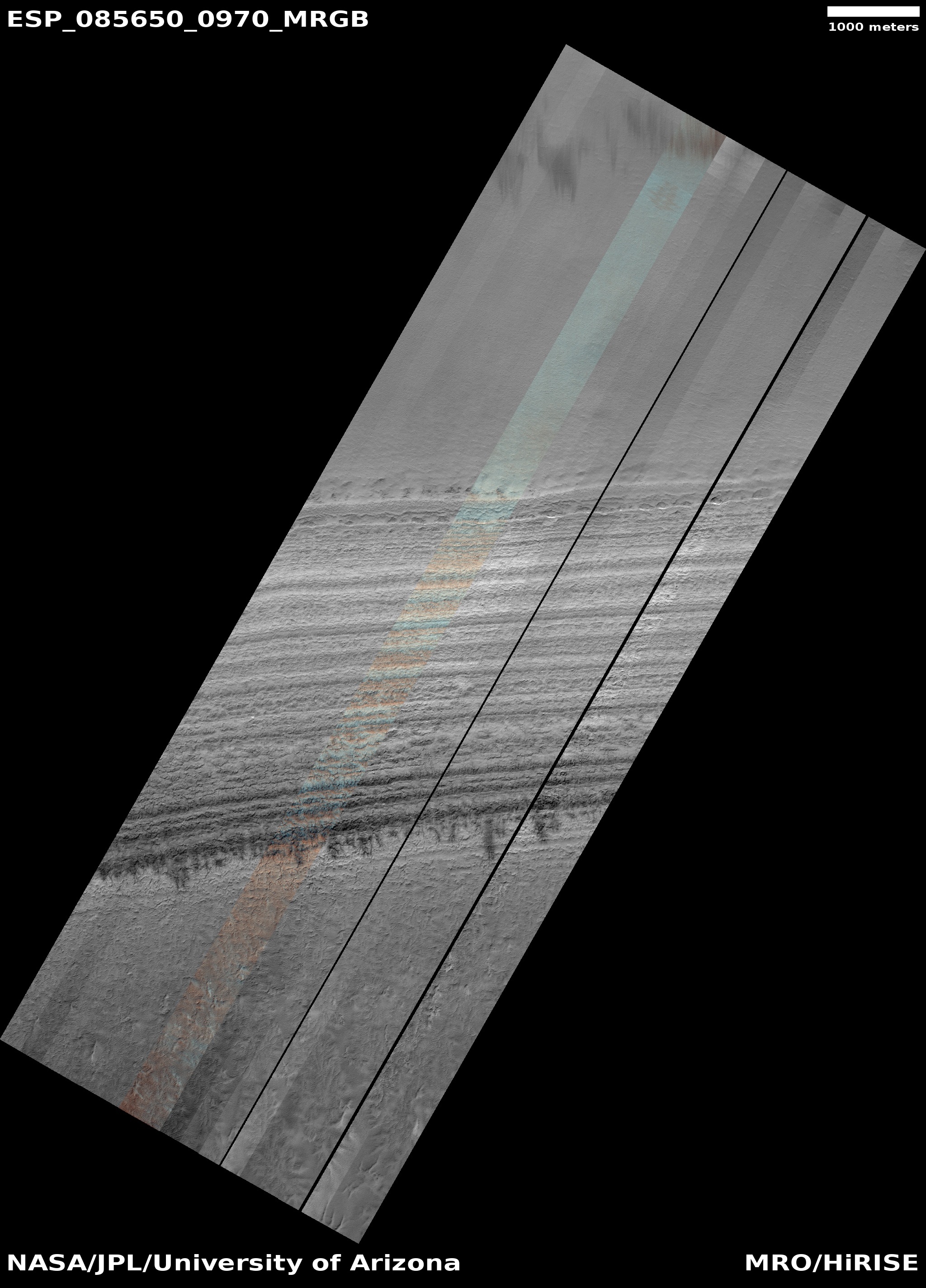
Cool image time! The picture to the right, cropped and color-enhanced to post here, was taken on November 3, 2024 by the high resolution camera on Mars Reconnaissance Orbiter (MRO).

The picture is labeled as a “terrain sample,” which means it was likely taken not as part of any specific research project, but to fill a gap in the camera schedule in order to maintain the camera’s proper temperature. In this case the camera team tries to choose interesting features, though sometimes they can’t due to timing.

In this case they were able to target a nice piece of geology, a layered 2,000 foot cliff on the outer edge of the south pole ice cap. The color strip illustrates the possibilities within those layers. I have significantly enhanced the colors to bring out the differences. The orange suggests dust, the aqua-blue water ice, though these colors could also indicate interesting mineralogies.
» Read more


0 comments

ESA releases three images taken by BepiColombo during its Mercury fly-by yesterday

BepiColombo image from January 8, 2025 fly-by of Mercury
Click for original image. For the annotated version
click here.

The European Space Agency (ESA) today released what it called the three best images taken by the ESA/JAXA joint mission BepiColombo to Mercury in its closest fly-by of the planet yesterday.

The image to the right, cropped, reduced, and sharpened to post here, shows the north polar regions of Mercury. The probe’s solar array is visible to the right.

Flying over the ‘terminator’ – the boundary between day and night – the spacecraft got a unique opportunity to peer directly down into the forever-shadowed craters at planet’s north pole.

The rims of craters Prokofiev, Kandinsky, Tolkien and Gordimer [the four craters in a line at the terminator] cast permanent shadows on their floors. This makes these unlit craters some of the coldest places in the Solar System, despite Mercury being the closest planet to the Sun!

Excitingly, there is existing evidence that these dark craters contain frozen water. Whether there is really water on Mercury is one of the key Mercury mysteries that BepiColombo will investigate once it is in orbit around the planet.

This was BepiColombo’s last slingshot maneuver. It is now set to enter Mercury orbit in late 2026, where it will split into two separate orbiters, one build by ESA and the other by Japan’s space agency JAXA.

0 comments

Correction: SpaceX DOES NOT launch 21 more Starlink satellites

CORRECTION: Reader BobT in the comments below noted that this launch is actually nothing more than a duplicate posting of the launch I counted yesterday. Thus, it doesn’t exist, and I have deleted it from my annual count.

As I note below in thanking BobT for noting the error, “This does illustrate something profound. Their launches are now so routine and frequent that it is possible to not realize you are rewatching one you viewed a day earlier. They all sound the same!”

The 2024 launch race thus remains unchanged:

3 SpaceX
1 China

6 comments

SpaceX is now targeting January 13, 2025 for 7th Starship/Superheavy test launch

In a tweet yesterday, SpaceX announced that it now intends to fly the seventh test orbital launch of Starship/Superheavy no earlier than January 13, 2025, with a launch window opening at 4 pm (Central).

The launch will test numerous new systems. Superheavy will test the reuse of one of the engines used on the fifth flight, brought back successfully when the booster was successfully caught by the tower chopsticks. It will also test improvements to the launch tower as another chopstick catch will be attempted. As for this Starship prototype, which the company calls Version 2, the upgrades and tests are extensive:

  • New avionics
  • Redesigns in the propulsion system
  • The flaps have been shrunk and shifted in position to prevent heat damage
  • The tiled heat shield system has been further upgraded
  • Deployment test of 10 dummy Starlink satellites
  • An in-orbit Raptor-2 engine relight

The last test is critical for future orbital test flights. On this test Starship will follow the same orbital flight path as the previous flights, low enough that the atmosphere will force it down without action over the Indian Ocean. SpaceX needs to prove that Starship’s Raptor-2 engines can reliably be restarted before it can go to full orbits that will require such a relight to accurately bring the spacecraft down at the right place.

1 comment

JPL shuts down due to threat from California fires

In a tweet posted yesterday, the head of JPL announced that all operations have been shut down because of the growing threat from the wildfires that are devastating the Los Angeles region.

JPL is closed except for emergency personnel. No fire damage so far (some wind damage) but it is very close to the lab. Hundreds of JPLers have been evacuated from their homes & many have lost homes.

If these fires should reach the center and do significant damage, a number of on-going space missions will be severely impacted, since those missions, such as the two Mars rovers, are operated from this location.

And this possibility exists, in this new dark age. The Democratic Party governments of Los Angeles and California have done everything they can in the past two decades to block fire prevention, from not managing the brush in the mountains to cutting funding to their fire departments to refusing to supply sufficient water to their fire hydrant system. This last action, which also included destroying dams, eliminating reservoirs, and refusing to replace them, is the most despicable. It appears firefighters throughout Los Angeles have been helpless because the hydrants have been dry. Thus, the fires burn out of control.

If the nearby fire reaches JPL we shall face the possibility that several major on-going space missions could suddenly end.

6 comments

DeSantis: Put NASA headquarters in Florida

At an event yesterday Florida governor Ron DeSantis proposed moving NASA headquarters to Florida, saving the half a billion dollars NASA now wants to spend to build a brand new gold-plated new headquarters building in Washington.

[DeSantis:] “They have this massive building in Washington, D.C., and like nobody goes to it. So why not just shutter it and move everybody down here? I think they’re planning on spending like a half a billion to build a new building up in D.C. that no one will ever go to either. So hopefully with the new administration coming in, they’ll see a great opportunity to just headquarter NASA here on the Space Coast of Florida. I think that’d be very, very fitting.”

The NASA transition team for the Trump administration is already sent out a trial balloon about cutting the size of NASA headquarters considerably. That team has also proposed eliminating NASA centers in California and Maryland and consolidating their work into the Marshall Center in Alabama.

Note the trend: All these moves shifts money from decidedly Democratic states to Republican ones. The announced goal would be to reduce NASA’s overhead, but at the same time the moves would take money and power away from Democrat strongholds.

2 comments

The biggest members of ESA cut their annual contributions to the partnership

In a continuation of the recent trend to go their own way in space, most of the largest partners in the European Space Agency (ESA) have decided to cut back their annual contributions this year to the agency.

The European Space Agency’s 2025 budget has dropped below its 2024 level after Germany, Italy, and the United Kingdom collectively cut their contributions by €430 million.

During his annual press briefing on 9 January, ESA Director General Josef Aschbacher revealed that the ESA budget for 2025 would be €7.68 billion, down from €7.79 billion in 2024. The reduction in the agency’s budget could have been far worse, as all of the ‘big four’ countries, apart from France, significantly reduced their contributions.

Germany, Italy, the United Kingdom, Belgium, and Spain all reduced their contributions. Except for Belgium, all have instead been recently diverting such funds directly either to space startups in their own country (see here and here), or forgoing contributing to large ESA projects and instead buying the services from other private sources (see here).

In general, it appears the bigger nations in Europe have realized that ESA has not been providing them a good deal. It takes their money, but doesn’t deliver competitive goods. Consider the Ariane-6 rocket. Conceived by ESA and ArianeGroup in 2015, it was five years late in launching. Worse, it was conceived as an entirely expendable rocket — even though SpaceX had just proven in ’15 that re-usability was possible — so that it is now too expensive to compete in today’s rocket market.

ESA also requires its projects to distribute contracts among all the partners, which increases costs and slows development.

In the past five years these countries have been increasingly bypassing ESA, especially when it comes to rocketry. Instead of having all European rockets built and managed by ESA’s commercial arm, Arianespace, these nations are switching to the capitalism model, whereby they each purchase launches from independent competing rocket companies.

The ESA budget cuts reflect this continuing trend. No point in giving cash to this moribund bureaucracy when the money can be better spent elsewhere.

2 comments

January 7, 2025 Space Show panel discussion from the show’s advisory council

A few years ago David Livingston invited me to join a small advisory council he runs for The Space Show of people who are all independent experts on the space industry. Yesterday he decided to try a new program idea, whereby he would gather these advisors together for a Zoom session to discuss the state of the space industry at this moment.

You can listen to this discussion here. I highly recommend my listeners do so. The participants were the following, many of whom will be familiar names for those that keep abreast of the space industry:
» Read more

0 comments

Rush – Limelight

An evening pause: Performed live 2012, but this was not before an audience but was simply their sound check performance beforehand to make sure the microphones were all at the right level to mix properly.

Hat tip to Ferris Akel, who adds “by a band that always took soundchecks very seriously.”

2 comments

January 8, 2025 Quick space links

Courtesy of BtB’s stringer Jay. This post is also an open thread. I welcome my readers to post any comments or additional links relating to any space issues, even if unrelated to the links below.

  • China touts its own Mars sample return mission, Tianwen-3, targeting 2028
    The mission has been kept very simple by scaling up what China’s engineers learned in doing its two lunar sample return missions. Or to put it another way, they will almost certainly fly at least two of these missions before NASA even comes close to deciding how it get Perseverance’s samples back.
0 comments

Graceful beauty found within the mid-latitude glaciers of Mars

Overview map

Graceful beauty found within the glacial mid-latitudes of Mars
Click for original image.

Cool image time! The picture to the right, rotated, cropped, reduced, and sharpened to post here, was taken on October 27, 2024 by the high resolution camera on Mars Reconnaissance Orbiter (MRO).

The red dot on the overview map above marks the location, about 35 miles southwest of the rim of 80-mile-wide Moreau Crater. This location is also deep within the 2,000-mile-long northern mid-latitude strip I label glacier country, as almost every high resolution picture from MRO shows glacial features.

This picture is no different, in that it shows the typical lineated parallel grooves seen on the surface of glaciers both on Earth and Mars, and especially found on glaciers flowing within a narrow canyon, as this glacier is. The parallel grooves are caused by the waxing and waning of the glacier. Each layer represents a past period when ice was being deposited on the surface, with the grooves indicates times when that ice was sublimating away. The graceful curves of the grooves is due to the drift of the glacier itself downhill.

This canyon is about seven miles wide at this point, formed from the confluence of two southerly tributaries to the south. The downward grade is to the north, but the low point is not where you would expect, out into the northern lowland plains. Instead, I have marked the low point in the inset with a white dot, inside the canyon itself. It appears this glacier drains into this low spot, but then this debris-covered ice appears to vanish.

It can’t really vanish, but there is a geological mystery here that involves the alien nature of Mars. For some reason the glacier dies at this point, its material sublimating away. Is there a drainage here that sends the ice to the north by underground passages? Your guess is as good as mine.

The lineated nature of this glacial flow however is no mystery in one respect. It is quite beautiful, as seen from space.

0 comments
1 176 177 178 179 180 182