
Cracks on Mars

Cool image time! The picture to the right, cropped, reduced, and sharpened to post here, was taken on September 20, 2025 by the high resolution camera on Mars Reconnaissance Orbiter (MRO).
The camera team describes these features as “ridges,” which in one sense is entirely true. The features are ridges that rise above the surrounding plain. The problem is that they are also cracks, with most showing a distinct central fissure in their middle.
Such double ridged cracks are reminiscent of the surface of dried mud or paint, when it begins to crack and shrink. The surface on each side of a crack pulls away, rising upward slightly as it does so. Is that what we are seeing here, the drying of this surface?
As always, location is critical to understanding the Martian geology.
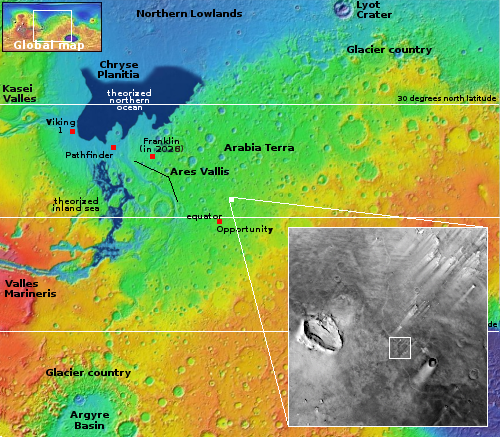
The white dot on the overview map to the right marks the location, about 306 miles northeast of the region that was explored by the rover Opportunity. As this is in the dry Martian tropics, there is no near surface ice, which might explain the drying and shrinking nature of these features.
This hypothesis is further strengthened by other research of several nearby craters (see here, here, and here) which found evidence that there were once active water springs in this region.
The surrounding region however also shows evidence of past volcanic activity, laying down floor lava. The features seen here could also be the result of the drying of that flood lava.
Note in the inset the strange crater to the west of these cracks. I only noticed this in creating that inset, and found it so strange I will feature it tomorrow. It might also explain these cracks.

On Christmas Eve 1968 three Americans became the first humans to visit another world. What they did to celebrate was unexpected and profound, and will be remembered throughout all human history. Genesis: the Story of Apollo 8, Robert Zimmerman's classic history of humanity's first journey to another world, tells that story, and it is now available as both an ebook and an audiobook, both with a foreword by Valerie Anders and a new introduction by Robert Zimmerman.
The print edition can be purchased at Amazon or from any other book seller. If you want an autographed copy the price is $60 for the hardback and $45 for the paperback, plus $8 shipping for each. Go here for purchasing details. The ebook is available everywhere for $5.99 (before discount) at amazon, or direct from my ebook publisher, ebookit. If you buy it from ebookit you don't support the big tech companies and the author gets a bigger cut much sooner.
The audiobook is also available at all these vendors, and is also free with a 30-day trial membership to Audible.
"Not simply about one mission, [Genesis] is also the history of America's quest for the moon... Zimmerman has done a masterful job of tying disparate events together into a solid account of one of America's greatest human triumphs."--San Antonio Express-News