
Private mission to Apophis gets another customer, two student-built landers
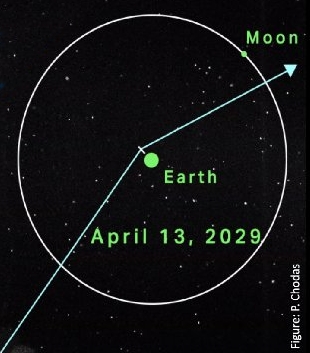
A cartoon (not to scale) showing Apophis’s
path in 2029.
The orbital tug startup Exlabs has signed up a second payload customer to fly on its private ApophisExL mission to rendezvous with the potentially dangerous asteroid Apophis when it makes its April 13, 2029 close fly-by of the Earth.
ExLabs has announced its partnership with Japan’s Chiba Institute of Technology (ChibaTech) and its Planetary Exploration Research Center (PERC) to send university-led payloads to the surface of asteroid Apophis during its rare near-Earth flyby in 2029. ApophisExL is the world’s first commercial deep-space rideshare and is supported by mission design and operations collaboration with NASA’s Jet Propulsion Laboratory (JPL) operated by Caltech.
Under the leadership of planetary scientist and PERC Director, Dr. Tomoko Arai, ChibaTech students and researchers are developing two landing payloads to be deployed on the asteroid’s surface.
An Australian satellite startup, Fleet Space Technologies, had already signed on to fly a mapping instrument on ApophisExL.
Though the press release at the link calls this private mission “a new model,” using private enterprise rather than relying on the government for doing planetary missions, it actually harks back to the way things were done in the U.S. before World War II, when the private sector did most of this pure research. In fact, as late as the 1960s there was at least one company, American Science and Engineering, doing the first X-ray astronomical observations flying suborbital rockets. It later won contracts from NASA and other agencies to help build several later orbiting X-ray telescopes.
Over time the government space agencies became dominant, so that most of this design work was either done by them or by universities, with private companies relegated to the roles of minor subcontractors.
This new model is simply an extension of the capitalism model that is taking over the entire space industry, shifting power and ownership from big, expensive, and inefficient government programs to small, cheap, and economical private missions. Those space agencies can still do missions, but they do it by buying payload space on these private missions.
Below is a list of the missions going to Apophis in 2029:
- Osiris-Apex, already on its way to Apophis after completing its asteroid mission to Bennu.
- Ramses, a European mission scheduled to launch in 2028, which will also deploy these additional probes:
- Farinella, built by a partnership of the Italian Space Agency and Terran Orbital
- Destiny+, built by Japan’s space agency JAXA. It will first fly past Apophis, then head to its prime target, the asteroid Phaethon
- A radar cubesat being built Tyvak
- A cubesat lander being built by Emxys
- AphophisExL, a private mission being built by the startup Exlabs, which will also deploy two smaller landers built as part of a Japanese university student project.
China might also send two cubesats, but it is not clear that mission has been approved. Blue Origin has also said it is contemplating a mission, but no one should take this very seriously, considering this company proposes a lot and accomplishes relatively litte.

On Christmas Eve 1968 three Americans became the first humans to visit another world. What they did to celebrate was unexpected and profound, and will be remembered throughout all human history. Genesis: the Story of Apollo 8, Robert Zimmerman's classic history of humanity's first journey to another world, tells that story, and it is now available as both an ebook and an audiobook, both with a foreword by Valerie Anders and a new introduction by Robert Zimmerman.
The print edition can be purchased at Amazon or from any other book seller. If you want an autographed copy the price is $60 for the hardback and $45 for the paperback, plus $8 shipping for each. Go here for purchasing details. The ebook is available everywhere for $5.99 (before discount) at amazon, or direct from my ebook publisher, ebookit. If you buy it from ebookit you don't support the big tech companies and the author gets a bigger cut much sooner.
The audiobook is also available at all these vendors, and is also free with a 30-day trial membership to Audible.
"Not simply about one mission, [Genesis] is also the history of America's quest for the moon... Zimmerman has done a masterful job of tying disparate events together into a solid account of one of America's greatest human triumphs."--San Antonio Express-News
If we can get Sentinel on the way, we are going to have a number of Minuteman and SRB cores freed up after SLS…I have heard it said that five sets would be left after Artemis V.
It is going to be awhile before probes can be prepositioned, but I think some small outfit could knock out some cubesats to go on a stacked solid like Athena III…not enough to really compete with Falcon and others–just something on stand by that can launch at a drop of the hat.
That could also send something like pellets out of LEO towards any threat from cis-lunar space.
LEO is transparent, but launch something Moonward….it might come back more stealthily.
I can see a time in the not-too-distant future when celestial bodies won’t want to come near the Earth – Moon system: attacked by probes, they will be. “Stay away from that place, man. If you even look like you’re headed their way, you’ll have to put up with a bunch of astral probes.”