
SpaceX files first IPO documents with SEC
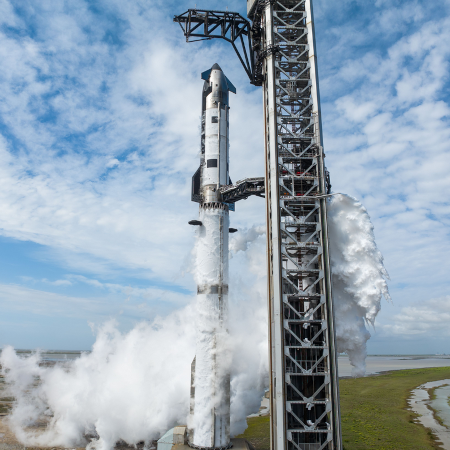
Starship/Superheavy (version 3) on launchpad for launch
later today.
After months of speculation and behind the scenes planning, SpaceX yesterday finally filed the initial public offering (IPO) documents with the Securities and Exchange Commission (SEC) outlining the company’s financial standing, in order to give potential stock purchasers an idea of what they are buying.
The filing shows SpaceX’s Connectivity segment, driven primarily by Starlink, has become the company’s financial engine. The segment generated $11.4 billion in revenue during 2025, along with $4.4 billion in operating income and $7.2 billion in adjusted earnings before interest, taxes, depreciation and amortization. The company said the business benefited from subscriber growth [now 10.3 million], wider enterprise adoption and improved network efficiency, with operating income rising more than 120% year over year.
By contrast, the company’s newly acquired AI segment is consuming cash at a remarkable pace. The AI business generated $3.2 billion in revenue during 2025 but posted an operating loss of $6.4 billion as SpaceX ramped investment in AI applications and compute infrastructure. Capital expenditures tied to the AI segment reached $12.7 billion during the year, far exceeding spending in the Space and Connectivity businesses.
…SpaceX’s Space segment generated $4.1 billion in revenue in 2025 and posted a $657 million operating loss. The company spent more than $3 billion on research and development tied to Starship during the year alone. The filing described Starship as the “key enabler” of SpaceX’s long-term growth strategy, saying the vehicle is designed to dramatically improve payload capacity, reusability and launch frequency while opening entirely new categories of missions.
Capital expenditures in the Space segment totaled $3.8 billion in 2025, reflecting the enormous infrastructure demands tied to developing and scaling the Starship program. On a consolidated basis, SpaceX reported $18.7 billion in revenue during 2025, alongside an operating loss of $2.6 billion and adjusted EBITDA of $6.6 billion. For the first quarter of 2026, the company reported revenue of $4.7 billion and an operating loss of nearly $1.9 billion.
In other words, Starlink and rocket sales are paying for the development of Starship and AI.
It appears the company is targeting an early to mid June date for the actual IPO, which some on Wall Street predict could bring in $75 billion in cash. This will be in addition to the $12 billion SpaceX has already raised in private investment capital as well as the more than $12 billion in revenue it earns each year from its Starlink subscribers. Note also that this Starlink annual revenue is presently about half that of NASA’s annual budget, with no upper limit in sight.
In other words, if all goes as planned, the company will have about $100 billion on hand to develop all its business models, with Starship/Superheavy likely leading the way.
I repeat: SpaceX is America’s space program. NASA is merely a sideshow that will become increasingly irrelevant as SpaceX gears up to full speed. And if things go as I believe they will, SpaceX’s success will act to fuel the rest of the American space industry, making the government even less important.

On Christmas Eve 1968 three Americans became the first humans to visit another world. What they did to celebrate was unexpected and profound, and will be remembered throughout all human history. Genesis: the Story of Apollo 8, Robert Zimmerman's classic history of humanity's first journey to another world, tells that story, and it is now available as both an ebook and an audiobook, both with a foreword by Valerie Anders and a new introduction by Robert Zimmerman.
The print edition can be purchased at Amazon or from any other book seller. If you want an autographed copy the price is $60 for the hardback and $45 for the paperback, plus $8 shipping for each. Go here for purchasing details. The ebook is available everywhere for $5.99 (before discount) at amazon, or direct from my ebook publisher, ebookit. If you buy it from ebookit you don't support the big tech companies and the author gets a bigger cut much sooner.
The audiobook is also available at all these vendors, and is also free with a 30-day trial membership to Audible.
"Not simply about one mission, [Genesis] is also the history of America's quest for the moon... Zimmerman has done a masterful job of tying disparate events together into a solid account of one of America's greatest human triumphs."--San Antonio Express-News
Anyone concerned SpaceX won’t be able to afford to finish Starship development should ask themselves why they think it will cost more than the SLS/Orion combo, given the company’s demonstrated execution on Starship to date, and the financial resources an IPO will give them. For those concerned SpaceX will suck all the air out of the room, I point them to the ongoing success Rocket Lab and Stoke have had raising money in terms of space launch, and their numerous competitors in the satellite space. Success typically breeds imitators, especially when people (correctly) perceive a growing market. By any measure–whether profitability, operational rocket engines, new entrants into the commercial sector, investments into space companies, operational satellites, cost to send people to space, or new possibilities emerging that were not affordable even a decade ago–the space sector is increasingly healthy and vibrant. A much bigger situation than one where the state continues to dominate and develop everything in the name of ‘stability.’
You speak as if SpaceX exists in a vacuum. We saw the damage done by foot-dragging before, and things could get worse again.
Worse, SpaceX is tied to A.I. now
I just want to know more about how that $6.4 billion loss happened in the A.I. business that doesn’t have the same overhead as space launch.
Elon likely lashed AI and space together hoping the former could bail out the latter, when we saw above that space alone is what is profitable.
SLS, Neutron, and Stoke have the advantage of being not-Elon, and emotion often drives investments and other types of support.
I think the Elon-hate is too much (I absolutely loathe Buffett) but it exists….and if I were the head of a NewSpace company with only a few million, I would use that money to buy some politicians to—if not help me outright–then at least hobble Musk….and some wouldn’t even have to be paid to do that.
I’m the country doctor to your Vulcan here….
“For those concerned SpaceX will suck all the air out of the room …”
Agree completely that there are new vibrant players, but still there may indeed be some elderly hypoxia victims. Yeah, talking about you, ULA! How’s that SMART reuse thing coming along?
I am concerned that the IPO will create a ‘need’ among the Congressional Profresives to introduce legislation to ‘protect the historically disadvanteged’ from ‘wealth inequity’, in order to ‘preserve Democracy’.
Here’s the thing–there is now a push for what is called “digital sovereignty” ….only, it isn’t
https://techxplore.com/news/2026-05-online-big-tech.html
It is the polar opposite…just noose tightening really….but that could gain traction here in the US.
That’s why I think SpaceX should have nothing to do with computing….that is a financial failure mode.
Being a South African, he should know than many shark attacks are toward spearfishermen who essentially chum the waters just doing what they do.
JW says: “Elon likely lashed AI and space together hoping the former could bail out the latter, when we saw above that space alone is what is profitable.”
Elon does little on hope and he has an incredible tolerance for risk. Starlink has paid for all Starship development including the launch infrastructure. In a former life, we used to call that bootstrapping and celebrated it.
Note that Jay Valentine still believes that datacenters are an obsolete tech for AI, that a distributed solution knocks a few zeroes off the requirements for massive amounts of new CPU / energy to power AI. Should he be correct, I trust Musk and his team to pivot to whatever else is profitable than almost anyone else on the planet today. Infrastructure that can launch a million datacenter satellites can quickly swing to launching a million humans into the inner solar system if the requirements change a bit.
My guess is that AI is tied to SpaceX due to the million satellite constellation. That connection did surprise me a bit as I thought it would be a better match for the Optimus line of robots out of Tesla and the move toward full self drive for their EVs. Cheers –
Jeff Wright,
AI at present has high capital expenditures because of the need for reliable power, and for enormous compute infrastructure, and in both areas the supply isn’t matching the demand. That means AI companies have to pay a premium for both, or, as SpaceX, Tesla, and Intel are doing, build their own fab. And, as with Meta, look for deals anywhere it can to get the energy it needs, since we weren’t smart enough to unshackle construction years ago.
Space alone is profitable for now. SpaceX is increasingly making deals to sell access to other AI companies, and it’s using AI internally to improve its capabilities. It isn’t a problem if AI takes a while to become profitable–that has been the case in many industries, as people figured out what to do with new inventions. Why do you think SpaceX is raising so much money with an IPO? Starlink alone is enough to fund Starship development; they’ve got much bigger plans, and they’re willing to take big risks. Part of what shows the health of any company (or country) is a willingness to commit to long-term projects with uncertain, but potentially big, rewards.
Bribery is foolish, but if you’ve got only a few million to your name, trying to outspend Musk is a fool’s game. Especially when you could instead develop interoperability with his systems and instead make a profit. I’ve seen you do things like this before–instead of thinking of ways to build off of what others do and compete productively, you view everything as a zero-sum game.
Jeff Wright,
You’re correct that AI doesn’t have the same overhead as space launch – it has more.
Blair Ivey,
The Congressional Progressives can introduce anything they want. Getting it passed or even out of the relevant committees is another matter entirely. And, given that there are likely to be significantly fewer Congressional Progressives after the mid-terms, they will likely be spending more time attempting to repair battle damage than plotting fresh mischief.
Here’s more on the IPO:
tiny.cc/a9u3101
I haven’t heard what its trading symbol is.
BMJ: I understand it will SPCX.
Jeff Wright,
I wouldn’t worry about so-called “digital sovereignty.” This seems to be just one more European pipedream to go with all of the other alleged “sovereign” capabilities it now claims to want – like space launch, manned spaceflight, military defense, LEO broadband Internet and artificial intelligence. Europe is too poor to afford any of that in any substantive way. The two choices it has are to continue using American tech or to abandon modernity. They’ll continue to grumble, but they’ll also take door number one as they always do.
I don’t really understand your antipathy to AI. You seem to react to anything Ai-ish like a vampire encountering a cross. AI is in the early stages of becoming one of the foundational elements of modern civilization just as steam power, rail transport, electricity, personal automobiles, aircraft, limited-access highways, personal electronics, the Internet and satellite-based communications have previously.
Robert Zimmerman,
The numbers from SpaceX’s S-1 filing are interesting, but not surprising. The Space segment of SpaceX’s business last year – exclusively Falcon 9 launches – grossed $4.1 billion, and lost $657 million after capital expenditures of $3.8 billion. That means gross profit for the Space segment was about $3.14 billion or about 76.5%. I’ve been maintaining for more than a decade that SpaceX’s gross profit on Falcon launches is about 75%. Seems I was about right.
Those who’ve been trying to peddle the fiction that all of Musk’s works are smoke and mirrors have been quick to pounce on the fact that SpaceX lost money last year. SpaceX has never booked much net profit in any given year because it just has to pay taxes on that. It has, historically, plowed nearly every penny of gross profit back into additional capital expenditure and R&D spending. That will continue post-IPO. SpaceX’s investors didn’t invest to clip coupons and get dividends, they invested to get share price appreciation. They have gotten a boatload of that and are about to get several boatloads more.
Dick: Yup, these numbers surprised neither you nor I. I’ve been saying now for almost four years that Starlink is paying for the development of Superheavy and Starship. It appears it is also now paying for the develompent of xAI.
This IPO is an expansion of a successful model.
Multiple Falcon 9 launches are providing additional capacity to the existing and profitable Starlink network. Starlink is already an AI data node with some residual data storage capability as part of it’s data transfer capability.
Superheavy and Starship will dramatically expand all of this proven model of it’s business and technology model. The customer base is solid and expanding.
I’m looking forward to the IPO…..
Dick Eagleson:
You may underestimate the desire of Progs to position themselves for 2028 by playing to the anti-billionaire sentiment they’ve spent years fomenting. In the symbolic world of Leftism, legislation need not be passed; only introduced. The California Assembly do this routinely. “See, we *want* to do something, but those Evil Republicans won’t let us!” Progressive plans fail on economics, but Republicans are easier to blame, than reality.
Jeff Wright,
You wrote: “Elon likely lashed AI and space together hoping the former could bail out the latter, when we saw above that space alone is what is profitable.”
Now we know why you dream about projects past and don’t appreciate projects future. You don’t look ahead, you only look behind. There was a time when even space was not profitable for SpaceX. It is now, because they persevered.
“SLS, Neutron, and Stoke have the advantage of being not-Elon, and emotion often drives investments and other types of support.”
Being Elon-free has not improved SLS any.
Blair Ivey,
I don’t get the impression that the left’s screechy anti-billionaire rhetoric is garnering them any real additional support outside of their shrinking base anymore than are their anti-ICE and pro-trans-“women”-in-female-sports fulminations. A number of Blue cities and states are busily chasing all of their formerly-resident billionaires into other jurisdictions. Even as soon as the mid-terms, the ill-effects of this ideological pogrom will hit ordinary people hard enough to render this poker hand a busted flush. 2028 is going to be a bridge entirely too far. The wreckage the progressive left is making of places like Portland, Seattle and NYC will be far too obvious by 2028 to cover up. “Vote for us and your city too can look just like Berlin in 1945!” is not going be a winning campaign proposition.
Dick Eagleson wrote: ” . . . or to abandon modernity. . . .”
Given European history, and demographic shifts, that’s entirely on the table.
” “Vote for us and your city too can look just like Berlin in 1945!””
I live in the vicinity of Portland Oregon. People here live the Socialist Dream, and still vote Democrat. People living in Progressive Pits still reliably vote Democrat. An alarming percentage of the population has been indoctrinated to the point that they won’t consider alternatives, even as their lives become measurably worse year after year. If you are walking past two weeks of garbage to the polls to vote Democrat; there is no help.
Dick Eagleson and Blair Ivey,
You have just described California, where the cities and towns have been burned down for the past decade. California literally burned Paradise to the ground.
Jeff Wright,
As you’re concerned about the AI segment of SpaceX being profitable, they’ll make $15 billion/year from Anthropic alone. You can find this sort of information in their S-1.