
Vast unveils new high powered satellite bus to support the expected boom in satellite construction
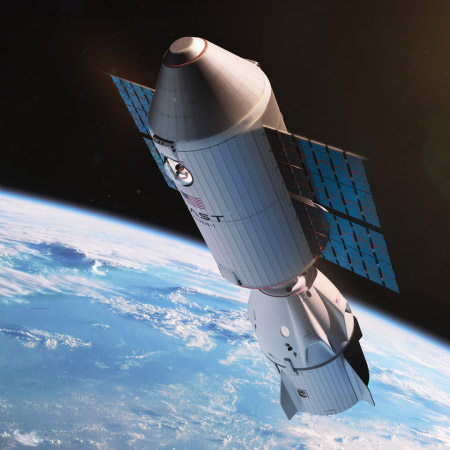
Artist rendering of Vast’s Haven-1 station, with a docked
Dragon capsule. Like Have Demo, it is being built using
company funds with no government support.
The space station startup Vast yesterday unveiled a new product line of high powered satellite buses, dubbed Vast Satellite, designed to support the expected boom in satellite construction.
With the launch of Vast Satellite, Vast is expanding beyond commercial space stations into high-volume spacecraft platforms designed for high-performance orbital missions. The first offering is a 15 kW-class satellite bus designed to support a wide array of power-intensive missions through flexible configurations.
Built around common in-house subsystems—including avionics, power, communications, propulsion, and flight software—Vast Satellite leverages technologies already developed for its Haven-1 space station, and validated through the successful Haven Demo mission in 2025. This shared architecture combined with Vast’s vertically integrated manufacturing model and advanced production capabilities is designed to support faster development timelines, lower costs, and increased mission reliability.
The company says it has already sold four buses to a confidential customer, with an option for 200 more. This sale occurred because Vast has proved itself with its policy of committing its own investment capital in designing, building, and flying demo missions. The Haven Demo was initially launched to test the subsystems to be used on the Haven-1 single module station the company hopes to fly next year on a three-year mission, during which four two-week manned crews will occupy it. That success allowed Vast to now diversify, using what it learned and proved on that demo to sell new products to other customers.
Similarly, its Haven-1 station, built on its own dime with no NASA funds, is intended to prove its capability as a space station provider. If successful, it is certain at that point to attract customers, including NASA.

On Christmas Eve 1968 three Americans became the first humans to visit another world. What they did to celebrate was unexpected and profound, and will be remembered throughout all human history. Genesis: the Story of Apollo 8, Robert Zimmerman's classic history of humanity's first journey to another world, tells that story, and it is now available as both an ebook and an audiobook, both with a foreword by Valerie Anders and a new introduction by Robert Zimmerman.
The print edition can be purchased at Amazon or from any other book seller. If you want an autographed copy the price is $60 for the hardback and $45 for the paperback, plus $8 shipping for each. Go here for purchasing details. The ebook is available everywhere for $5.99 (before discount) at amazon, or direct from my ebook publisher, ebookit. If you buy it from ebookit you don't support the big tech companies and the author gets a bigger cut much sooner.
The audiobook is also available at all these vendors, and is also free with a 30-day trial membership to Audible.
"Not simply about one mission, [Genesis] is also the history of America's quest for the moon... Zimmerman has done a masterful job of tying disparate events together into a solid account of one of America's greatest human triumphs."--San Antonio Express-News
With the satellite market exploding, and the barrier to entry being so much smaller than for manned space stations, this seems sensible. It makes me wonder if Vast will also tackle unmanned stations purely for production, akin to Varda’s efforts but scaled up, down the line.
Each free-flyer developing one product perhaps
A very good move on Vast’s part – aggressively monetizing anything it had to do anyway for other purposes.
Nate P’s suggestion anent unmanned stations also has considerable merit for all of the same reasons. As with this satellite bus initiative, there could well be such discussions already underway with potential clients. The satellite initiative was only announced once an initial contract had been secured. Unmanned stations could be expected to follow a comparable path – announce once the initial agreement’s ink is dry.
Dick Eagleson: This action by Vast is comparable to Rocket Lab’s quick action to adapt the first stage of its Electron rocket to do suborbital hypersonic testing for the military. Take what you have and improvise to fill customers’ needs.
Speaks well of the company, which is why I rate Vast’s future very highly.
Jeff Wright,
Possibly. Depends on what the product is, if the environmental factors (think vibratory, temperature, and similar) overlap, how much customers can afford to pay and Vast can afford to spend, and much more.
Robert Zimmerman,
As do I. Max Haot has been a hustler ever since the Launcher days and has never let any grass grow under his feet. Launcher, like SpaceX, was vertically integrated anent all of the big stuff from the get-go and retained that orientation when Launcher essentially became Vast. I expect great stuff from Vast over the next few years and not just in terms of Commercial LEO. The company has the potential to play a big role in cis-lunar space and on the lunar surface too.
Why did horizonal integration last as long as it did?
Bean counter bias?
Jeff Wright,
Pretty much.
I find this to be good news on several levels.
Vast has found a way to begin revenue service sooner rather than later. They have made a sale of four satellites, or at least of four busses. The quantity of the follow-on option suggests that the customer plans a constellation of satellites.
B. Vast is diversifying into more than just space stations and modules (assuming that they could sell modules to other space station companies, as Sierra Space had planned with its Life module).
Third, they are using their existing hardware, from avionics to stationkeeping and attitude control thrusters to power for their expanded business. They don’t have to develop as much hardware and software for this new product. It also gives their engineering team something to do.
Dalet, it bodes well for the company that they already have business and are already expanding their products. This is similar to Rocket Lab, which has expanded its services far beyond launch services. SpaceX has fewer different services, even after absorbing the AI company and Tesla.
5. As Nate P has suggested in the first comment, above, the satellite manufacturing business could be more lucrative than the space station business. Hopefully Vast will continue with space stations, because their idea for a spinning station has been needed for a long time for the ability to experiment with a variety of G-forces. Nate’s suggestion of unmanned manufacturing space stations sounds like another good idea, giving us production on a large scale. A possible third major source of revenue. Robert has good reason to be optimistic about Vast.
From the article:
When I got into the commercial communication business, I was surprised when the interviewer said that these types of satellites were a commodity. I had expected that various companies had technical advantages, but what my new business was looking for was faster manufacturing from contract signature to launch (availability) and lower costs, because commodities sell to the low-price supplier who has a ready supply. According to the article, Vast will cover these same concerns.
Current satellite buses are designed for closer to 5kW, or so, but Vast is developing a higher-power bus, which is needed for the upcoming orbital datacenter and AI business. Vast has announced that they are an early supplier of satellites for this business, and they clearly hope to get a jump on the competition.
Isn’t it interesting that orbital datacenters were suggested a few years ago but no one seems to have begun developing them until now.
This is a satellite bus, the basic structure that a payload is attached to. This is how modern communication satellites are put together, and the companies I worked for used similar buses for defense satellites, integrating a military payload onto a standard bus. Standardizing the bus allows for reduced development costs, faster manufacture, and more reliability, as all the bugs get worked out early on and the later sales use a very reliable base design.
____________
Jeff Wright asked: “Why did horizonal integration last as long as it did? Bean counter bias?”
There are advantages and disadvantages to each kind of business model. Horizontal integration allows for a lower startup cost, fewer employees, and faster time to market; there is no need to develop the entire product, only a need to develop a product integrated largely from other companies’ components. Vertical integration allows for better control over the availability, cost, and quality of parts.
Horizontal integration is not dead, but we do keep hearing about vertically integrated businesses, which can give the impression that it is the preferred business model.