
The battle of Gettysburg as seen by those who lived it
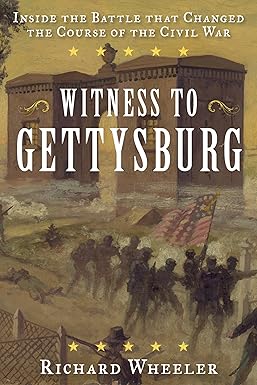
I just finished one of the best histories I have ever read, and want to recommend enthusiastically to my readers. It is called Witness to Gettysburg, and was written by Richard Wheeler. My version was the 1987 edition, but a new edition was published in 2021.
Why was it so good? To understand this we need to look at the nature of the material historians use to construct their work. Some of this source material is more important than others. In the case of Wheeler’s book, he used the best material in the most vivid way possible, and put aside other materials that could have distracted from the story.
In writing my own histories of space exploration in the 20th century, I quickly learned there were two types of sources I needed to depend on. First there are what historians call original or primary sources. These are the testimonies of the actual participants, the individuals who actually did the deed and thus knew better than anyone what really happened. In the case of space, astronauts, their families, and the engineers and managers of NASA at the time made up this group.
Primary sources can also include others who were not actually participants but lived at the time and witnessed the events as they occurred. For example, news articles written by reporters as events unfolded fall into this group. So can the historian himself, if he or she was alive during those events. In the case of my own books, that made me this kind of primary source. I was alive when the space age began, and saw it unfold in real time, with my own eyes.
Any history that does not rely on these original sources, or gives them short shrift, should not be taken seriously.
Next come secondary sources, books and academic articles written after the fact by historians, economists, sociologists, or researchers from any number of academic fields. Such works are of great value for any historian, as they can give you a wider context and alternative interpretations of the long term consequences of what happened. They can also be invaluable for tracking down more original sources.
There is however a danger if you rely too much on these secondary sources. Often academics begin treating their analysis of events as more important than that of the primary sources, even though they weren’t there and only know of the events secondhand. When I got my masters degree in early colonial history in the 1990s I discovered this tendency to be a very big problem in academia. My history teachers wanted me to learn early colonial history from what past historians thought about it. I wanted to learn that history from the people who lived it. My teachers didn’t like that, and constantly challenged my conclusions because I was contradicting those other historians. I countered that I had read the original sources, and discovered those other historians were simply wrong.
In the end, I found I actually knew more about that history than my teachers, as they were seeped in arguing the analysis of their compatriots rather than studying the real data.
Now, back to Wheeler’s book, which focuses entirely on the battle of Gettysburg, from the moment Robert E. Lee began his invasion north to the end of the battle when he was retreating in defeat.
What made this book so good is Wheeler’s approach. To quote him in his introduction:
Witness to Gettysburg attempts something new: a telling of the story, in terms both historical and human, as largely as possible in the words of the participants, both military and civilian, both male and female.
In other words, Wheeler let the people who fought or witnessed the battle to tell the story. As much as possible, he relied on primary sources, while he stayed in the background and only inserted himself in order to clarify the context of each quote, or provide detailed maps to make the topography of the battle more easily understood.
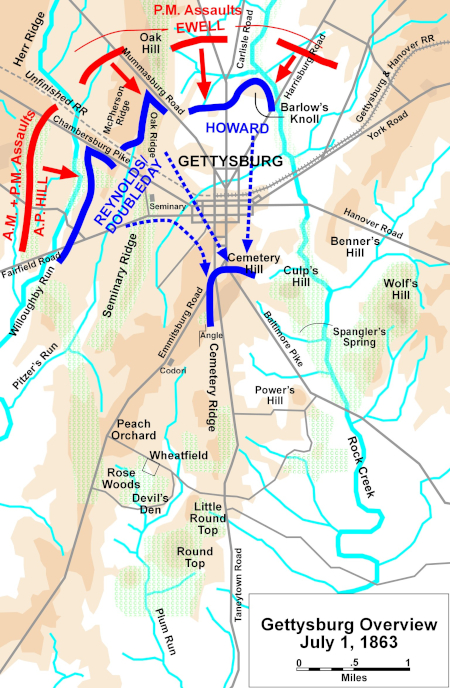
Red indicate Confederate forces, blue the Union
The result is a vivid and very powerful and clear recreation of the battle. Wheeler is aided by the fact that Americans in the mid-1800s were not only very literate, they wrote a lot of letters and memoirs describing these events. In a sense, their writings were the equivalent of our smart phones today. Rather than lifting their camera to record what happened so that others would have multiple videos of the event, they each sat down and wrote their perspective, almost always immediately afterward. The result is that we can see Gettysburg as it unfolded from many points of view, of Union and Confederate soldiers as well as the civilians caught up in these events.
In reading a history of this kind you also get a more personal sense of the time and place. For example, the civilized behavior of both warring sides to civilians and their opponents is quite startling. Lee’s invading army treated the Pennsylvanian civilians it surrounded with diffidence and respect, even allowing them to express openly their opposition to the rebellion. Civilians were not combatants, and were to be treated kindly. And while both armies were unwavering in their desire to win by killing as many soldiers as possible, both treated the wounded and their captured prisoners decently. The wounded for example were all helped by both sides, no matter which army they came from.
In the end however Wheeler’s book makes it clear who the good guys were in this war. Before Lee’s arrival in Gettysburg the town had a small population of free black citizens, treated decently and as equals by the white population. When the Confederates arrived those blacks were rounded up to be taken back to the south as slaves. It didn’t matter they were free Americans. They were black, and the southerns automatically considered them inferior and destined to be slaves forever.
And we learn this from their own words.
It is also clear in reading Witness to Gettysburg how badly General Lee managed the battle. His choices during the engagement were routinely bad. His subordinate General James Longstreet kept trying to tell him his head-on-attack tactic was a mistake, that a flanking move would be more effective, but Lee would not listen. In the end Lee destroyed his army with no gain, and had to flee back to Virginia in defeat.
Once again, it is essential if you want to understand the past to read the perspective the people who lived it. Sadly our modern universities no longer demand this, and so we now have several generations of college-educated students who really only know the past through the cartoon ideologies of their teachers and the academics these teachers admire.
Wheeler’s book is a great way to counter that shallow education, and to get that more humane perspective of our country’s past.

On Christmas Eve 1968 three Americans became the first humans to visit another world. What they did to celebrate was unexpected and profound, and will be remembered throughout all human history. Genesis: the Story of Apollo 8, Robert Zimmerman's classic history of humanity's first journey to another world, tells that story, and it is now available as both an ebook and an audiobook, both with a foreword by Valerie Anders and a new introduction by Robert Zimmerman.
The print edition can be purchased at Amazon or from any other book seller. If you want an autographed copy the price is $60 for the hardback and $45 for the paperback, plus $8 shipping for each. Go here for purchasing details. The ebook is available everywhere for $5.99 (before discount) at amazon, or direct from my ebook publisher, ebookit. If you buy it from ebookit you don't support the big tech companies and the author gets a bigger cut much sooner.
The audiobook is also available at all these vendors, and is also free with a 30-day trial membership to Audible.
"Not simply about one mission, [Genesis] is also the history of America's quest for the moon... Zimmerman has done a masterful job of tying disparate events together into a solid account of one of America's greatest human triumphs."--San Antonio Express-News
“in the end Lee destroyed his army with no gain, and had to flee back to Virginia in defeat.”
As you know, the aftermath of the battle was hugely controversial. The union general, Meade, did a terrible job when he had Lee in his hands. He allowed Lee’s army the time to cross the flooded Potomac River and escape. What ifs are always controversial but if Meade had captured Lee’s Army the war might’ve been shortened by years.
Lincoln was hugely frustrated. He is quoted as saying
“We had them within our grasp. We had only to stretch forth our hands and they were ours. And nothing I could say or do could make the Army move.”
Wikipedia has what seems to be a good article on the battle.
https://en.wikipedia.org/wiki/Retreat_from_Gettysburg
Bob Wilson: That Lincoln quote is exactly why he hired Grant. And it is exactly why Grant’s policy in taking power was to tell Meade his target was Lee’s army. You go where it goes.
Lee’s Lieutenants.
Used the link and bought it.
I found a visit to Gettysburg to be hugely impressive; to walk the ground where so many relatives had fought each other. The battlefields have grown a crop of monuments, and there is a plaque showing the furthest North the South ever got. It’s in the fence line on the other side of a huge open expanse, and it’s just as far as it looks in the movie. Which, doing some research before visiting will enhance the experience, and one could do worse than watch the 1993 film. The 1974 novel ‘The Killer Angels’ is a remarkable novelisation of the Battle.
I suspect one of the reasons for the civility in the Civil War was that many of the officers on both sides had served together prior to the outbreak of hostilities. Each knew the other, they were friends; and in many cases, had gone to the same school at West Point. One-and-done Confederate President Jefferson Davis (D) was a Hudson High grad, and former US Secretary of War. There was also the fact that folks on both sides had the same cultural touchstones. Everyone more-or-less had the same type of societal indoctrination in primary school that is necessary for a civilization. That hasn’t been true for decades in this country. Now, half the Country has no idea what the other half is talking about. Then, there were Americans, and, Democrats. Now, there are Americans, and, well, that part hasn’t changed
You imply that almost everyone in the country was literate at the time of Gettysburg. I suggest that there were many literate people that were quite good at explaining events. Working from other later events, such as army records of WW1, I would suggest that there was a high percentage of illiterates at that time. Somewhat similar to there being a lot of informed people on this site, and an enormous number of uninformed among our friends and relatives.
While it is often said that the winners write the histories, it is more accurate to say that the articulate survivors write them. Reading WW2 accounts from several countries*, it is amazing how much contradiction there is in written eyewitness accounts. Talking to individuals often also revealed lack of accurate knowledge. Such as a bomber crewman bragging about having 50 caliber machine guns while the German fighters only had 30s. Unaware of the 20MM cannon standard on the ME109 and FW190.
*American, Japanese, German, English, Russian, And civilian from occupied areas.
I would suggest that you can be as articulate as you want, but if you want your voice heard, you better win them wars.
“It is also clear in reading Witness to Gettysburg how badly General Lee managed the battle.”
Lee was a very good general (yes, he was); but Wheeler is right: Lee had a bad fortnight in the Gettysburg Campaign. Partly that’s down to health, but mainly, I think his tremendous run of success over the past 12 months led him to the point where he really thought his men could do anything, and concomitantly, that the Army of the Potomac leadership could always be outmaneuvered. At Gettysburg, he found the hard limits of both propositions. He was let down by failures of his subordinates (Stuart, Heth, Hill, Ewell) at various points, but ultimately the loss is on Lee.
I acknowledge that I have only limited knowledge and understanding of perspectives on “Gettysburg,” nor what awareness Lee brought to the greater context. However, from what I claim to understand, I have to conclude that Lee understood, as perhaps only a few in the Confederate military leadership grasped, was the fact that Gettysburg was “it.” If this latest attempt by Lee to defeat the Union and occupy its Capital failed, the war was, ultimately, lost and “over.” The South would no longer remain capable of again equipping and sustaining an Army to “march and fight north into Maryland and Washington.”
Further, it is my opinion that Lee was a superb tactical and strategic commander, and that much of the relentless (now, over 1 1/2 century in length!) attempts to make him out to be a foolhardy dolt, might be termed, LDS. “DS” seems a timeless affliction for which no apparent “remedy” has yet to emerge.
Further still, Lee’s mental state, to what extent I may be correct in guessing at his awareness of the larger context, had likely declined with the tragedy that IS WAR! As the specifics at Gettysburg unfolded, desperation no doubt played a role in his decisions.
Fortunately, for America, the “gooder” guys won, and the “bad” guys had to accept the gooder guys imposition of terms. Fortunately, the “unconditional” surrender of Lee and what remained of his defeated army embodied some laudable conditions.
Same for the Japanese Imperialists and German Socialists when they were “unconditionally” made to surrender.
Obviously, I have no way of knowing, but I hope such lessons are not lost on team Trump, as the pressure builds by the usual suspects for the usual reasons, that so often lead to the usual results.
john hare–
The literacy rate in 1860 was relatively high, depending on location within the USA.
The Land Ordinance of 1785 had previously specified that Section 16 of each newly surveyed Township, would be for the maintenance of public schools.
“120 Years of American Education: A Statistical Portrait”
(Edited by Tom Snyder, National Center for Education Statistics, 1993).
https://nces.ed.gov/naal/lit_history.asp
Blair Ivey–
I want to take a little bit to your account. The monument known as the High Water Mark of the Confederacy really wasn’t the closest the South came to winning in the battle. Actually, the closest they came was on the second day of the battle. Without orders, the Union general Sickles had moved his group almost a half mile forward for the Union line on Cemetery Ridge, into a peach orchard. In no time flat, his troops were facing the entirety of Longstreet’s II Corps, coming at them down the Emmitsburg Road.
As what is now called Sickles’ Salient was being caved in, a group of Alabama troops came around one end. Union general Hancock, who was everywhere on the first two days of the battle. saw the developing catastrophe. If the Alabama troops could make it through the gap, they would split the Union line in two.
Desperate, he looked around and saw a detachment of the 1st Minnesota coming up. He told their commander to charge the group of Alabama troops who were coming at them, who outnumbered them more than 6 to 1. The 1st Minnesota were veterans; thewy had been in 13 battles by this time. They knew what the orders meant. They meant they’d all been sentenced to death. Yet there was no hesitation, The 282 men burst into a charge that hit the Alabama boys in a dry creek bed.
Somehow, they made the Alabama brigade hesitate; the Alabama troops had the numbers to have rolled right over them. General Hancock had needed 5 minutes for other units moving in to seal the gap. The 1st Minnesota boys gave him almost ten.
262 men went charged across that field. 47 came back. The rest were all down or dead.
For my money, the High Water Mark of the Confederacy should be right where the 1st Minnesota’s charge went home.
Hello Chris,
“The monument known as the High Water Mark of the Confederacy really wasn’t the closest the South came to winning in the battle. Actually, the closest they came was on the second day of the battle.”
It seems we owe John Bachelder for the phrase and the monument, and William Faulkner for making it famous. I don’t think Lee had any real chance of decisively defeating Meade’s army after the First Day, but I agree that this seems to be another instance where the first draft of history really does get improved upon by later generations. The counterattack of the First Minnesota certainly seems braver, more desperate than Pickett’s Charge, or even the charge of the 20th Maine; maybe the real problem is that Gettysburg offers us so many desperate, courageous moments that some were bound to get short shrift, even from Civil War devotees. They got a terrific monument, at least.
I liked Sherman.
That guy could move an army. He is credited with burning towns he never set torch to.
His army moved south so fast he out paced his own supply lines. So much so that they just gave up trying to reach his army.
Thank you, I’m looking forward to this book. I’ve spent many days exploring that battlefield over several visits.
I agree with Richard M’s sentiment above that Lee’s string of prior successes emboldened him and he probably thought that his boys could do almost anything, especially with so much on the line. He came north for a reason, and likely understood where the war was ultimately going.
I was a history major at Gettysburg College in the 80s, and a lot of good, in-depth books were being published about the battle and war. It started to become an over saturated market, and a few duds paused my purchasing. It seems the pendulum has swung about and some interesting books are coming off the presses.
Interesting: Related:
Man enslaved by Jefferson Davis shares his story: https://youtu.be/WUTuyVG1nMk?si=bXs18e6vB2y9mFmJ