
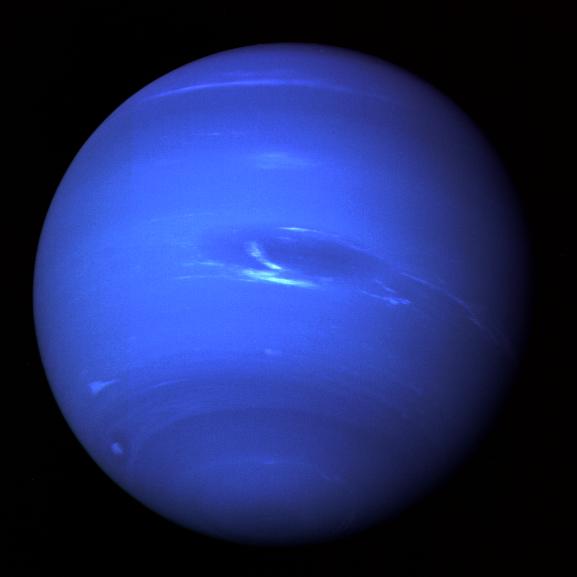
Neptune as seen by Voyager-2 in 1989, four days before closest approach
Click for original image.
Cool image time! In two earlier posts I highlighted the pictures taken by Voyager-2 of Neptune’s two largest moons, Triton and Proteus, when it made its close fly-by of Neptune in 1989. Other than a very distant low resolution picture of 105-mile-wide Nereid, Voyager-2 took no other good images of Neptune’s other known moons.
So today, let’s begin a tour of some of Voyager-2’s imagery of Neptune itself. The picture to the right, reduced slightly to post here, was taken on August 20, 1989 as the spacecraft was beginning its approach to Neptune. It shows the full daylight hemisphere of the gas giant. From the caption:
The images were taken at a range of 4.4 million miles from the planet, 4 days and 20 hours before closest approach. The picture shows the Great Dark Spot and its companion bright smudge; on the west limb the fast moving bright feature called Scooter and the little dark spot are visible. These clouds were seen to persist for as long as Voyager’s cameras could resolve them. North of these, a bright cloud band similar to the south polar streak may be seen.
Next week I will post some of the other good shots taken of Neptune, as well as one or two close-ups of Triton that need highlighting. Sadly, at that point we will have more or less reviewed most of the best data now available of this distant world. Astronomers have used the Hubble Space Telescope in subsequent years to attempt to track its weather patterns, but even Hubble really can’t provide enough resolution to really make that research substantive.
But stay tuned. The Voyager-2 images to come are worth viewing.

On Christmas Eve 1968 three Americans became the first humans to visit another world. What they did to celebrate was unexpected and profound, and will be remembered throughout all human history. Genesis: the Story of Apollo 8, Robert Zimmerman's classic history of humanity's first journey to another world, tells that story, and it is now available as both an ebook and an audiobook, both with a foreword by Valerie Anders and a new introduction by Robert Zimmerman.
The print edition can be purchased at Amazon or from any other book seller. If you want an autographed copy the price is $60 for the hardback and $45 for the paperback, plus $8 shipping for each. Go here for purchasing details. The ebook is available everywhere for $5.99 (before discount) at amazon, or direct from my ebook publisher, ebookit. If you buy it from ebookit you don't support the big tech companies and the author gets a bigger cut much sooner.
The audiobook is also available at all these vendors, and is also free with a 30-day trial membership to Audible.
"Not simply about one mission, [Genesis] is also the history of America's quest for the moon... Zimmerman has done a masterful job of tying disparate events together into a solid account of one of America's greatest human triumphs."--San Antonio Express-News
In a world long ago before mass internet, I watched “Neptune At Night” a live telecast of the flyby. I believe Carl Sagan narrated. Stayed up late on East coast to watch the pictures as they arrived. Exciting. Good Times.