
France buys two manned missions from space station startup Vast
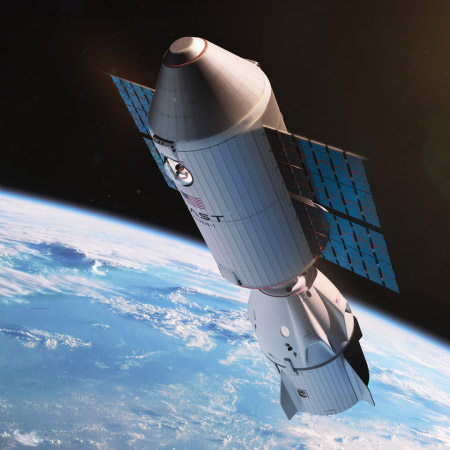
Artist rendering of Haven-1 with docked
Dragon capsule
In a major deal that solidifies its future space station plans, the space station startup Vast yesterday announced that the French government had agreed to fly two Vast manned missions, first to ISS and then to its Haven-1 single module space station scheduled for launch in 2027.
Today at the Choose France Summit, created by the President of the French Republic, Emmanuel Macron, Vast announced its commitment to establish its European headquarters in Paris and an agreement with the Government of France, for two missions involving two French astronauts: the sixth private astronaut mission to the International Space Station and the Haven-1 test flight, the first crewed mission to Vast’s Haven-1 commercial space station scheduled to launch in 2027.
…Both missions are expected to last approximately two weeks and are planned for 2027, with transportation provided by SpaceX on a Dragon spacecraft launched aboard a Falcon 9 rocket.
For the ISS mission, the astronaut will be rookie Arnaud Prost. For the Haven-1 mission, the astronaut will be veteran Thomas Pesquet, who has flown twice to ISS with a cumulative total of just under 400 days in space.
Vast had previously signed preliminary deals with Lithuania, Colombia, Uzbekistan, Japan, the Czech Republic, and the Maldives, but none of those deals had committed to a manned mission. I had speculated that these nations were waiting for Haven-1 to launch and be declared operational. France has decided not to wait.
This deal is also a major coup for Vast over its space station competitor Starlab, which had previously signed a deal with the European Space Agency and Airbus in an effort to position itself as Europe’s future space station. That deal however had not included any actual missions.
UPDATE: Vast appears to have also signed an agreement with the United Kingdom to fly one of its astronauts to Haven-1. And in this case the astronaut, John McFall, is a former paralympian who lost one leg in a motorcycle accident. This would would make him the first person with disabilities ever to fly in space.
My present ranking of the five stations under development, with Vast now in the lead and Starlab and Axiom tied for second.
- Haven-1 and Haven-2, being built by Vast, with no NASA funds. The company plans to launch its single module Haven-1 demo station in 2027 for a three-year period during which it will be occupied by at least four 2-week-long manned missions, one of which will include a French astronaut. It planned manned mission to ISS in ’28 will also include a French astronaut. It has also made preliminary deals with Lithuania, Colombia, Uzbekistan, Japan, the Czech Republic, and the Maldives for possible astronaut flights to Haven-1. It has raised more than a billion in cash for this work, and has already tested an unmanned small demo module in orbit.
- Starlab, being built by a consortium led by Voyager Space, Airbus, and Northrop Grumman, with extensive partnership agreements with the European Space Agency, Mitsubishi, and others. Though no construction has yet begun on its NASA-approved design, it has raised $383 million in a public stock offering, the $217.5 million provided by NASA, and an unstated amount from private capital. It has also begun signing up station customers, as well as a number of companies to build the station’s hardware. It also plans a mission to ISS in ’28.
- Axiom, being built by Axiom, has launched four tourist flights to ISS, with the fourth carrying government passengers from India, Hungary, and Poland. A fifth mission is now planned for ’27. The company has now raised $450 million in private investment capital. Thales Alenia in Europe has been building its first two modules, with the first to launch in 2028 (though recent rumors of corrosion issues might cause a delay). It has also signed Redwire to build that module’s solar panels.
- Thunderbird, proposed by the startup Max Space. It is building a smaller demo test station to launch in ’27 on a Falcon 9 rocket, and has begun work on its manufacturing facility at Kennedy in Florida. Its management includes one former NASA astronaut and one former member of the Bigelow space station team that built the first private orbiting inflatable modules, Genesis-1, Genesis-2, and BEAM (still operating on ISS).
- Orbital Reef, being built by a consortium led by Blue Origin and Sierra Space. This station looks increasingly dead in the water. Blue Origin has built almost nothing, as seems normal for this company. And while Sierra Space has successfully tested its inflatable modules, including a full scale version, its reputation is soured by its failure in getting its Dream Chaser cargo mini-shuttle launched to ISS.

On Christmas Eve 1968 three Americans became the first humans to visit another world. What they did to celebrate was unexpected and profound, and will be remembered throughout all human history. Genesis: the Story of Apollo 8, Robert Zimmerman's classic history of humanity's first journey to another world, tells that story, and it is now available as both an ebook and an audiobook, both with a foreword by Valerie Anders and a new introduction by Robert Zimmerman.
The print edition can be purchased at Amazon or from any other book seller. If you want an autographed copy the price is $60 for the hardback and $45 for the paperback, plus $8 shipping for each. Go here for purchasing details. The ebook is available everywhere for $5.99 (before discount) at amazon, or direct from my ebook publisher, ebookit. If you buy it from ebookit you don't support the big tech companies and the author gets a bigger cut much sooner.
The audiobook is also available at all these vendors, and is also free with a 30-day trial membership to Audible.
"Not simply about one mission, [Genesis] is also the history of America's quest for the moon... Zimmerman has done a masterful job of tying disparate events together into a solid account of one of America's greatest human triumphs."--San Antonio Express-News
When I first heard about Vast all they had on their website was an equation pointing to their ultimate goal of artificial gravity. They’ve continuously been impressive since then, and they seem determined to be profitable rather than relying on their founder’s money forever.
Right. What the ESA has right now with Starlab is a memorandum of understanding “to ensure the continuous presence” of ESA astronauts. But they have yet to order an actual mission pursuant to that. I think the French government’s move yesterday is yet more evidence that ESA member states are less and less willing to wait on ESA agreements and procurements to get their peeps into space. Which, I think, is not really a surprise!
I do think the fact that France has only ordered a single astronaut mission likely points to a desire not to put all their chips on Vast just yet. It’s quite possible they will order a mission on Starlab before long, not least given Airbus’s big stake in the venture. Most likely they have yet to decide where they want to put most or all of their missions in the 2030’s, and they likely want to order up small initial missions like these to assess each of these stations and their operating companies.
But Vast has certainly put itself in pole position now. It is a big vote of confidence in them.
By the way, looking at Bethany’s X post/tweet, it is telling who has responded, and responded *positively*. Max Haot, CEO of Vast was quick out of the gate: “Thank you, @NASAAdmin for the collaborative dialogue and for giving the commercial space station industry the opportunity to compete for NASA’s business and win the privilege of building the ISS successor for the U.S. and our allies.”
But beyond that, there are also effusive comments from Lori Garver and Pam Melroy. Both of course were Deputy Administrators of NASA in recent Democratic administrations. Neither may be in Congress, but it certainly suggests there is bipartisan support for what Isaacman is doing with the commercial space station program. In the current environment, that is no small thing.
Richard M: It’s no big deal, but your comment would be better placed in the “NASA abandons core module idea for its commercial space station program” thread.
Whoops! Sorry, Bob, that is in fact where I meant to post it! My apologies!
(You may certainly movie it there, if you wish and you are able. Or I can replicate it over there. In fact, I will do so now.)
I plead the sin of having too many tabs open, once again.
Richard M: I have no idea how to move it myself, and I don’t mind that you have double posted it to get it in the right thread.
Note your phone changed your nickname again.
I think, technically, France has bought 1/4 of each of two missions. Dragons carry four occupants and Vast still has three seats to fill on its ISS mission and two seats to fill on the first Haven-1 mission. I’m anticipating it will have no problem doing so. The Brits have already bought an additional 1/4 of the Haven-1 mission. We should see some additional announcements anent other participants signing on in coming weeks and months.