
Curiosity’s looks up Valle Grande to its future travels
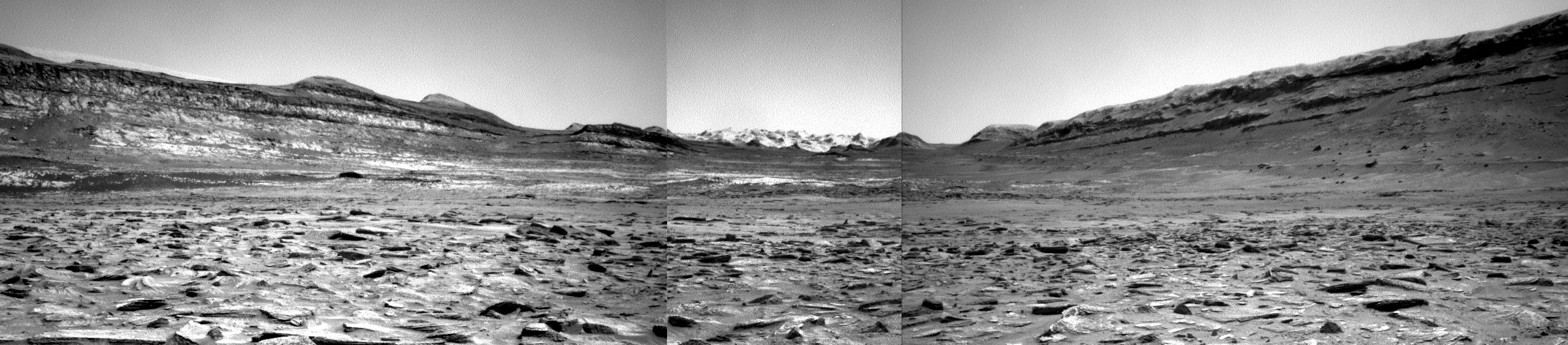
Click for high resolution. For original images go here, here, and here.


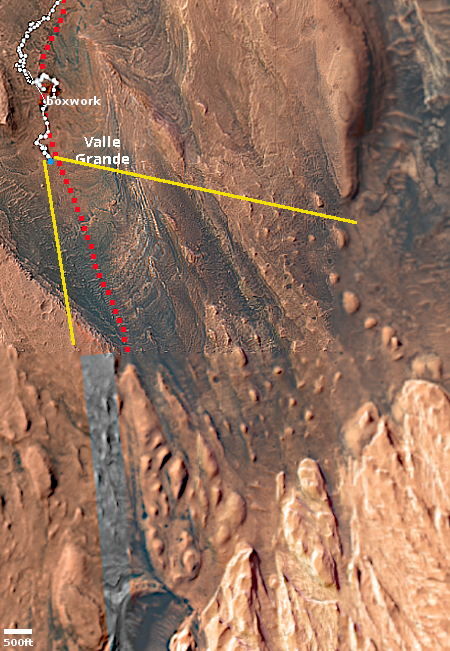
Click for interactive map.
Cool image time! The panorama above was created by me using three pictures taken today by the left navigation camera on the Mars rover Curiosity (see here, here, and here).
The overview map to the right provides the context. The white dotted line indicates Curiosity’s actual travels, while the red dotted lines its planned route, both in the past and in the future. The blue dot marks its approximate position when these images were taken. The yellow lines indicate approximately the view.
The panorama looks up this spectacular valley, which the science team has named Valle Grande. The red dotted line on the panorama is my guess as to the rover’s future route. It will likely not follow such a straight path, but weave back and forth as the science team directs it to look at interesting geological features along the way.
What remains unknown is the route the rover will take once it reaches those light-colored hills in the distance. The science team so far not indicated any chosen route through those hills. I suspect they want to get closer and do some on-site scouting before making any decision. The nature of that light terrain remains unknown. It could be easily traversed, or it could be a problem. From a distance it looks very soft, and thus it will likely required close inspection to make any definite plans.

On Christmas Eve 1968 three Americans became the first humans to visit another world. What they did to celebrate was unexpected and profound, and will be remembered throughout all human history. Genesis: the Story of Apollo 8, Robert Zimmerman's classic history of humanity's first journey to another world, tells that story, and it is now available as both an ebook and an audiobook, both with a foreword by Valerie Anders and a new introduction by Robert Zimmerman.
The print edition can be purchased at Amazon or from any other book seller. If you want an autographed copy the price is $60 for the hardback and $45 for the paperback, plus $8 shipping for each. Go here for purchasing details. The ebook is available everywhere for $5.99 (before discount) at amazon, or direct from my ebook publisher, ebookit. If you buy it from ebookit you don't support the big tech companies and the author gets a bigger cut much sooner.
The audiobook is also available at all these vendors, and is also free with a 30-day trial membership to Audible.
"Not simply about one mission, [Genesis] is also the history of America's quest for the moon... Zimmerman has done a masterful job of tying disparate events together into a solid account of one of America's greatest human triumphs."--San Antonio Express-News
Bob, do you have any clear idea of how much more operational time NASA thinks Curiosity has left in it?
(I suppose I’m assuming the wheels can hold out and the real limiting factor is power.)
Richard M: If the question is just power, Curiosity could likely function for decades. Think of the Voyager craft. As power declines they could prioritize the most important tasks. Either way, it should have enough power to move for at least one or two decades more.
As you say, the wheels are another question.
Should have had tracks says this old tanker. M48A5s, M60 Series, M1 Series, M3 Series, 25 years – all tracked
The comparison of planned vs actual track reminds me of a drunk uncle of mine navigating a dark alley