
A look back at a significant moment in human history: the first picture of the Moon’s far side

Click for original image.
Today’s cool image is being posted not because of its beauty or high resolution, but because it was a significant first that shined a light on a mystery that had baffled all humanity since the first time a human being in Africa looked up and observed the Moon.
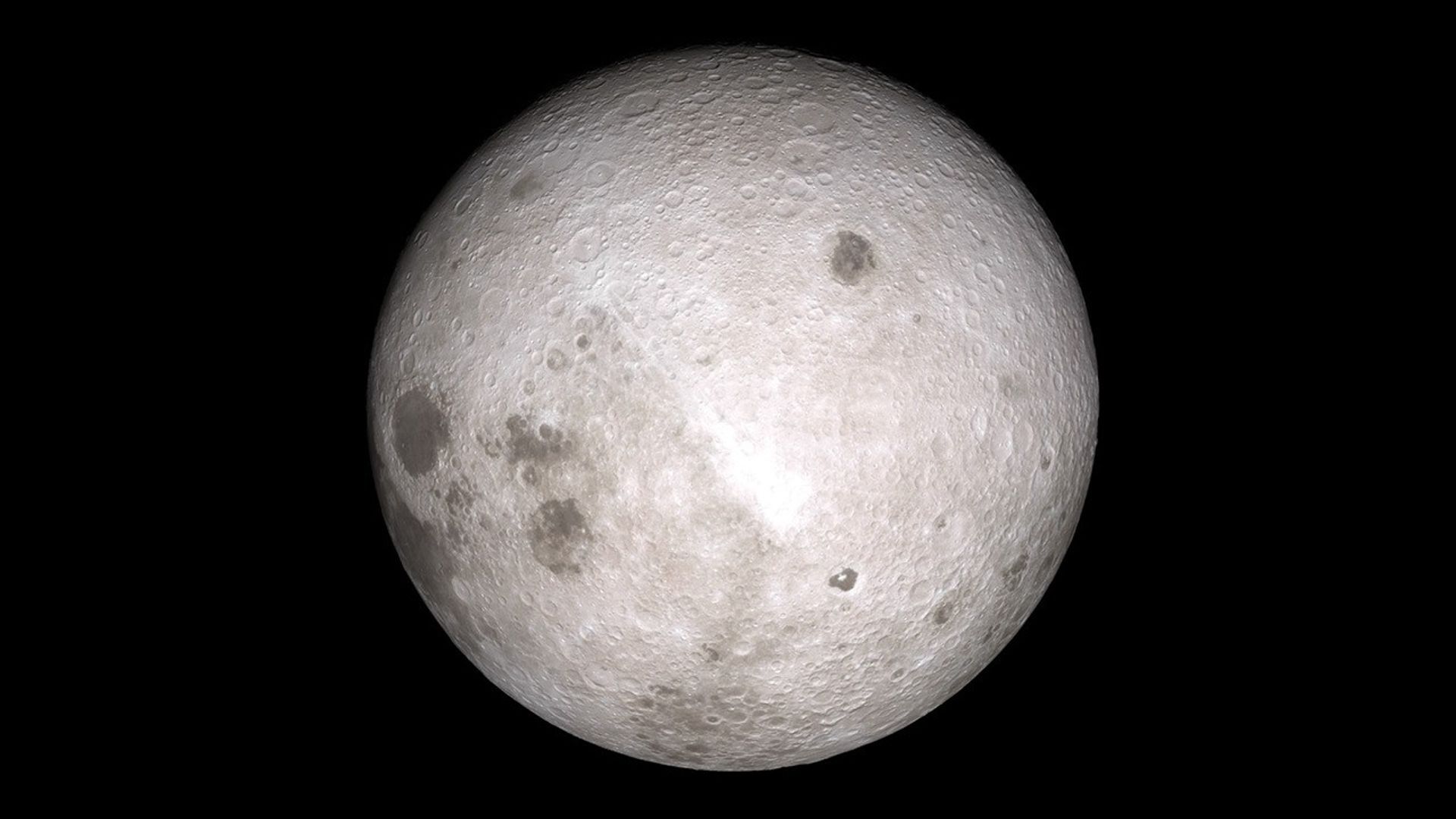
The picture to the right, reduced slightly and smoothed to remove some camera artifacts, was the first picture ever taken of the hidden far side of the Moon, captured by the Soviet Union’s Luna-3 probe on October 7, 1959, one day after it had passed less than 3,900 miles above the surface. As it moved away, it looked back, and took this picture from a distance of about 40,000 miles.
The picture ain’t what we are used to nowadays from space, but you need to put yourself back in time to truly appreciate it. For literally the entire history of humanity, this view had been hidden. Dreamers, philosophers, scientists, and ordinary people would look at the near side of the Moon almost nightly, but no one knew what was on the other side. Whole religious myths grew up about this unknown. Some science fiction writers of the 19th century fantasized there was air and water there and thus housed an alien civilization, purposely positioned so we couldn’t see it.
Suddenly, with this picture, that side was no longer hidden. This one Luna-3 picture showed humanity that the Moon’s far side was not much different than the near side, though much more cratered with fewer dark mare regions. It had no air or water. Nor were there alien civilizations.
But that age-old mystery was now solved. For those living in the 1950s, it was something of a revelation to see this picture. For those who came after, it is important to try to imagine the significance of that revelation. Suddenly, the mysteries of the universe were no longer unsolvable. Suddenly, we had the ability to solve them.
This picture, like all new knowledge, also brought with it new mysteries, based not on a hidden view but on real data and real questions. Now the goal was understand that data in order to solve the history of the Moon’s geology and how it fit into the formation of the Earth and the entire solar system. That endeavor is still on-going, with its solution not yet entirely in sight.
One last point: Though this picture is woefully inadequate compared to modern planetary images, it also carries a remarkable amount of good information that has since been confirmed by other spacecraft. To get an idea, compare it with a similar global view produced using Lunar Reconnaissance Orbiter (LRO)’s full dataset. The features match quite well, and a close look at the Luna 3 picture reveals many details not immediately evident that match well with the LRO image. The Russian engineers who made this happen should be rememberd and honored for their achievement.

On Christmas Eve 1968 three Americans became the first humans to visit another world. What they did to celebrate was unexpected and profound, and will be remembered throughout all human history. Genesis: the Story of Apollo 8, Robert Zimmerman's classic history of humanity's first journey to another world, tells that story, and it is now available as both an ebook and an audiobook, both with a foreword by Valerie Anders and a new introduction by Robert Zimmerman.
The print edition can be purchased at Amazon or from any other book seller. If you want an autographed copy the price is $60 for the hardback and $45 for the paperback, plus $8 shipping for each. Go here for purchasing details. The ebook is available everywhere for $5.99 (before discount) at amazon, or direct from my ebook publisher, ebookit. If you buy it from ebookit you don't support the big tech companies and the author gets a bigger cut much sooner.
The audiobook is also available at all these vendors, and is also free with a 30-day trial membership to Audible.
"Not simply about one mission, [Genesis] is also the history of America's quest for the moon... Zimmerman has done a masterful job of tying disparate events together into a solid account of one of America's greatest human triumphs."--San Antonio Express-News
The confirmation of the details of the original Luna-3 picture by one from the LRO reminds me of something that happened to a space photo taken a few years later:
https://science.nasa.gov/resource/first-lunar-earthrise-old-and-new/
One discovery image of many more to come, I’m sure. I wasn’t alive in 1959 but I can imagine the wonder. I was alive for some of Apollo and certainly Voyager and Viking.
The solar system and nearby stars are sufficiently local given reasonable propulsion and comms.
Dare I say, though, that an image of the entire Milky Way from afar is not in the cards anytime soon? It’s like Sam Gamgee looking at Venus: “high beauty for ever beyond reach”. Well, almost forever.
I think about what my parents saw in their lifetime – born a decade after the Wright Brothers’ first flight and inter-planetary missions.
I remember the sundial in the parka couple of blocks away from where I grew up , ‘Grow old with me, the best is yet to be.’
Ad Astra !
And the film came from a crashed US reconnaissance balloon. Most people are unaware of that detail.
M Puckett: This fact I have never heard before. Can you cite a source?
Yeah. It still blows me away to think that they pulled this off in 1959. 1959!
“That orbed maiden with white fire laden, Whom mortals call the moon”
– The Cloud, Shelley, 1819
R-7 opened the door….
More realistically, the V-2 opened the door. Or we can go back even earlier and credit Tsiolkovsky, Goddard, and Oberth.