
New Webb data suggests little red dots are supermassive black holes embedded in gas cloud
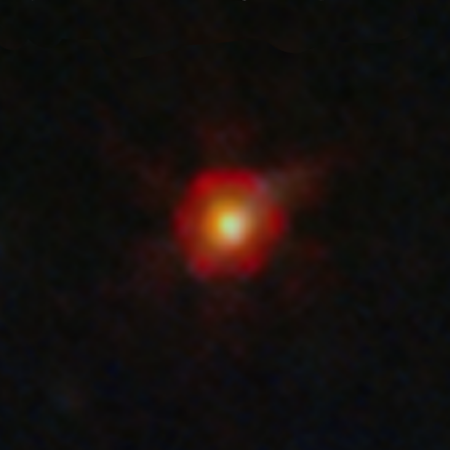
Little Red Dot GLIMPSE-17775
Using spectroscopic infrared data obtained by the Webb Space Telescope, astronomers now posit that the mysterious little red dots found by Webb in the very early universe are supermassive black holes embedded in a dense cloud of ionized gas.
The scientists focused Webb on the little red dot dubbed GLIMPSE-17775, shown to the right in a false color image produced by Webb’s near infrared camera. You can read their paper here [pdf].
The spectroscopic data collected by Webb contains multiple lines of evidence that support the interpretation that little red dot GLIMPSE-17775 is a black hole star: a rapidly accreting, or growing, black hole enveloped in a dense gas cocoon, which is reprocessing the light emitted from near the black hole and producing the features seen in the spectrum.
Among the 40-plus lines that the team detected in GLIMPSE-17775’s spectrum were various independent indicators that all align with the BH* scenario [the name the scientists use for this model]. For example, the team found that many of the spectral lines, such as hydrogen, oxygen, and helium, do not fit a simple model of a rotating gas cloud. Instead, the best fit model includes a broadening effect known as electron scattering, a telltale sign that a dense, layered gas cocoon is enshrouding this source.
The strength and ratios of certain lines to each other, most notably the 16 iron lines that compose what the team has dubbed an “iron forest” and certain oxygen lines, require a high-energy source to produce them, like a rapidly accreting black hole. Additionally, astronomers noted the fluorescence and absorption of helium in the spectrum, both of which individually suggest that there is a dense medium enveloping a powerful source.
The researchers claim this theory will work to explain all the other little red dots that Webb has detected in the early universe. They also claim it explains how the dots could be there so soon after the Big Bang, as they don’t have to be as supermassive as first believed. If very large, there wasn’t time for them to coalesce following the Big Bang. This model suggests instead that they can be much smaller black holes, thus allowing time for their formation without contradicting present Big Bang cosmology.
There is of course a lot of uncertainty here. For example, GLIMPSE-17775’s data is microlensed, which distorts it. While scientists think they understand the distortions fully, their inability to see this object and the foreground object doing the microlensing from multiple perspectives requires them to make many assumptions that cannot be proven, and could very well be wrong.

On Christmas Eve 1968 three Americans became the first humans to visit another world. What they did to celebrate was unexpected and profound, and will be remembered throughout all human history. Genesis: the Story of Apollo 8, Robert Zimmerman's classic history of humanity's first journey to another world, tells that story, and it is now available as both an ebook and an audiobook, both with a foreword by Valerie Anders and a new introduction by Robert Zimmerman.
The print edition can be purchased at Amazon or from any other book seller. If you want an autographed copy the price is $60 for the hardback and $45 for the paperback, plus $8 shipping for each. Go here for purchasing details. The ebook is available everywhere for $5.99 (before discount) at amazon, or direct from my ebook publisher, ebookit. If you buy it from ebookit you don't support the big tech companies and the author gets a bigger cut much sooner.
The audiobook is also available at all these vendors, and is also free with a 30-day trial membership to Audible.
"Not simply about one mission, [Genesis] is also the history of America's quest for the moon... Zimmerman has done a masterful job of tying disparate events together into a solid account of one of America's greatest human triumphs."--San Antonio Express-News
Curious as to why if the early Universe wa full of black holes; there is anything at all? I know black holes can only ingest so much material over a given time, but if matter is under the gravitational influence, it should all eventually depart this space-time.
“This little red dot is more distant than the galaxy cluster and magnified by gravitational lensing.”
So they’re doing spectral analysis of a red dot, that they claim is behind the galaxy? (Assuming bent light can re-organize itself perfectly and coherently without a corrective lens…)
How can they differentiate the foreground light from the background light without “overlapping” spoiling the sample?
In the past, all such objects were simply explained as red shifted meaning “further away”. Now that there are red dots nearly as numerous as white ones, the old explanations no longer work. Or fit the model.
Now let’s try a web picture performing the same experiment on a clear without obstruction red dot where the data isn’t mingled with nearby stars.