
Stoke Space successfully completes all tank tests for 1st stage of its Nova rocket
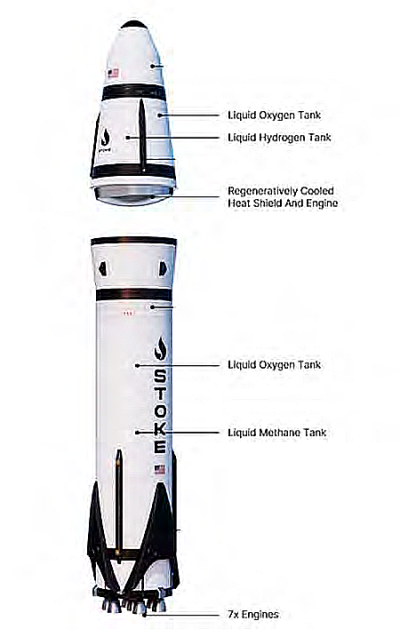
Stoke’s Nova rocket, designed to be
completely reusable.
The rocket startup Stoke Space announced earlier this week it has successfully completed all tank tests for 1st stage of its Nova rocket, thus increasing the odds that the rocket’s first launch will occur before the end of this year.
During this campaign, the team filled both tanks above their maximum expected pressure conditions, demonstrated automated pressure control across a range of fill levels, and operated the vehicle through challenging environmental conditions, including hurricane-force winds and a severe lightning storm. More than just a successful structural test campaign, the result was a broader demonstration that Nova’s hardware, software, ground systems, and operations approach are maturing together.
The company noted that it is not unusual for new rockets to experience explosions and other failures during this testing phase, thus making its complete success without a failure “a significant achievement.”
Stoke has consistently refused to set a launch date as it has been developing its rocket. It approach has been simply “We will launch when we are ready.” It has had this luxury in that it has successfully raised $1.34 billion in private investment capital, attracted to the company because of its rocket’s radical design that will allow both its first and second stages to be reusable. The first stage will land vertically, as does SpaceX’s Falcon 9.
The second stage uses a revolutionary nozzle design that makes its return possible. Instead of a single central nozzle, the engine has a ring of small nozzles on the outside edge of its heat shield. The stage will then return to Earth like a capsule, with those nozzles adding force to control and slow its descent.
The rocket itself has a smaller payload capacity than a Falcon 9, but its ability to be completely reusable means its second stage is far more capable. It can fly multiple times, thus lowering the launch costs for its customers. It can also provide an orbital manufacturing site, like a Varda capsule, which will attract a much larger customer base.

On Christmas Eve 1968 three Americans became the first humans to visit another world. What they did to celebrate was unexpected and profound, and will be remembered throughout all human history. Genesis: the Story of Apollo 8, Robert Zimmerman's classic history of humanity's first journey to another world, tells that story, and it is now available as both an ebook and an audiobook, both with a foreword by Valerie Anders and a new introduction by Robert Zimmerman.
The print edition can be purchased at Amazon or from any other book seller. If you want an autographed copy the price is $60 for the hardback and $45 for the paperback, plus $8 shipping for each. Go here for purchasing details. The ebook is available everywhere for $5.99 (before discount) at amazon, or direct from my ebook publisher, ebookit. If you buy it from ebookit you don't support the big tech companies and the author gets a bigger cut much sooner.
The audiobook is also available at all these vendors, and is also free with a 30-day trial membership to Audible.
"Not simply about one mission, [Genesis] is also the history of America's quest for the moon... Zimmerman has done a masterful job of tying disparate events together into a solid account of one of America's greatest human triumphs."--San Antonio Express-News
With all the launchers being built, it takes a lot of the zing out of ‘I’m rocket scientist’
I really like Stoke’s approach, and their design for upper-stage reuse. It wouldn’t surprise me if they end up uprating Nova to the point where it surpasses Falcon 9 in mass to LEO. They’ve also hinted at using it to fly well beyond GEO, including lunar missions, and they’ve got three launches upcoming for AstroForge. They won’t be able to compete with SpaceX for all missions, but they won’t need to. Low-cost reuse will let them find all sorts of profitable work.
I wish them well.
I want to see their shielding work for orbital re-entry.
They emulate Phil Bono’s plug-nozzle approach.
There are many different approaches, but few get real money.
It would be great if the scheme works and can scale to a degree where manned flight was possible.
Even more paradigm shifting than the Falcon booster.
It should be remembered that just because something works does mean it make sense economically.
There’s going to be a considerable mass and fuel penalty in getting this system back in one piece and unless you can reuse the second stage many times, you aren’t going to be cheaper that a regular expendable 2nd stage. I’d love to see the numbers.
If they can successfully demo this, I’m sure Elon will snatch them up.
The upper stage is already much bigger than Gemini. They’ll want reliability first.
I think that’s taken for granted by now. Full reuse generally starts making economic sense if you can fly forty times or more per year. Stoke has been intentionally designing the second stage first, and they’ve got some advantages over SpaceX when it comes to upper-stage reuse–rather than relying on tiles, for example, they’ll be protected using regenerative cooling, with the heat shield and the engines integrated into a single structure, which is a dramatic drop in mass. SpaceX doesn’t try to recover Falcon 9’s upper stage because it would be a significant reduction in capacity given the size of the vehicle, their goals, and that they expect Starship to be cheaper to operate than Falcon 9 as a mature system.
SpaceX historically does not buy launch companies, and they’ve shown no interest in being acquired.
With all due respect, reusability – especially full reusability – doesn’t require 40 launches per year to make economic sense. Against a completely expendable rocket with twice the mass-to-orbit capability, which costs customers $100 million a copy to fly, and a completely reusable system that costs anywhere even modestly below $50 million per flight, the customer is already ahead after the 2nd launch. If the customer has a lot of stuff to get upstairs in a relative hurry, the completely reusable system will handily beat the brawnier expendable one on launch cadence too – besides being cheaper.
You are correct that it’s hard to see why SpaceX would want to buy Stoke Space. Stoke has nice technology but, with the exception of that trick 2nd stage, they don’t have any tech SpaceX hasn’t already got. If SpaceX wanted to build a Starship-sized version of the Stoke 2nd stage all it would have to do is license the tech.
SpaceX has made very few acquisitions, historically, and only of companies it wanted pretty much all of, not just one bit of tech. Shotwell has hinted that that might change a bit now that SpaceX has more money than God, but I don’t see SpaceX snapping up other companies at the pace of, say, Rocket Lab or Voyager.
You are equally correct that Stoke is not interested in being acquired – or at least it had no interest in being acquired by uber-sketchy OpenAI guy Sam Altman. Perhaps, in future, Stoke might entertain such an offer by someone a lot less off-putting, but I’m inclined to think not. There is every reason, in my view, for Stoke’s future to be so bright it will need to wear shades. I think it will do just fine on its own without being roped into any combine.
pawn wrote: “There’s going to be a considerable mass and fuel penalty in getting this system back in one piece and unless you can reuse the second stage many times, you aren’t going to be cheaper that a regular expendable 2nd stage. I’d love to see the numbers.”
The numbers, or an approximation, should be able to be deduced in a few years, after Nova gets up to speed.
The point of reusability is not to maximize the payload to orbit. Rocket scientists did that optimization for decades, and the cost of orbital access remained so high that few companies could afford to do business there. The point of reusability is to reduce the cost to orbit, and SpaceX showed that with the loss of some technical efficiency — a loss to the battle with the rocket equation — the cost efficiency increases dramatically. The tradeoff has been worth it to the world, because now there are many companies that can afford to do business in space.
Stoke Space is riding this philosophy in hopes that compromising a bit on the battle with the rocket equation still wins the battle with the cost equation. As we have seen over the past decade or so, this is a war that will be fought for a long time as we find the best way to get the most mass to orbit for the least cost.
On the other hand, it may not be the most beneficial to get the most mass to orbit. We may continue to have a variety of sizes of rockets to take a range of masses to orbit for a variety of prices, where the customer has a choice of vehicles, each with its own advantages and disadvantages that frustrate the customers, just like every other competitive product on the free market. If only the competition for orbital access could be as confusing as the choice of laundry detergent.
The ability to launch as often as the Falcons currently launch is a side benefit of reusability that has made access to space not only inexpensive but available to a great number of customers. So far, the supply of launches has increased to meet the increased demand, and with the demand continuing to increase, hopefully Stoke Space’s Nova can continue the trend of increased supply of access for a reasonable price.
SpaceX has used Falcon 9 for its own benefit, adding a constellation of satellites that now makes more revenue than its launch services (SpaceX is no longer a launch company but a communication company, and will soon be a massive data-crunching company), yet even with all that self use, there is still launch capacity left over for dozens of other launches to provide the access that many other companies need in order to do their business. I am excited at the prospect of Nova adding to that launch capacity, especially when it need not make a second stage for each launch, which may be a major factor limiting SpaceX’s launch cadence.
As I recall from a decade ago, SpaceX critics were saying that Falcon 9 would have to launch an unheard of eighteen times a year to break even. Back then, critics thought SpaceX would certainly fail and go out of business, that the experiment was over before it began, because no large rocket had ever launched at that rate. This was with an expendable second stage, so we should be able to imagine that fewer Nova flights would be necessary in order to break even.
On the other hand, Falcon 9 seemed to make money before it reached eighteen flights a year, so Nova may be that successful, too.
In conclusion: I would like to see the numbers, too.
Jeff
‘“There are nine and sixty ways of constructing tribal lays, and every single one of them is right” – In the Neolithic Age by Rudyard Kipling
On plug nozzles and such
https://www.facebook.com/groups/spacemansluck/posts/4066855493554474/
http://aresinstitute.org/green-propulsion/plug-nozzles-the-ultimate-customer-driven-propulsion-system/