
The rocky surface of Gediz Vallis on Mars came from landslides and water-induced debris flows from above
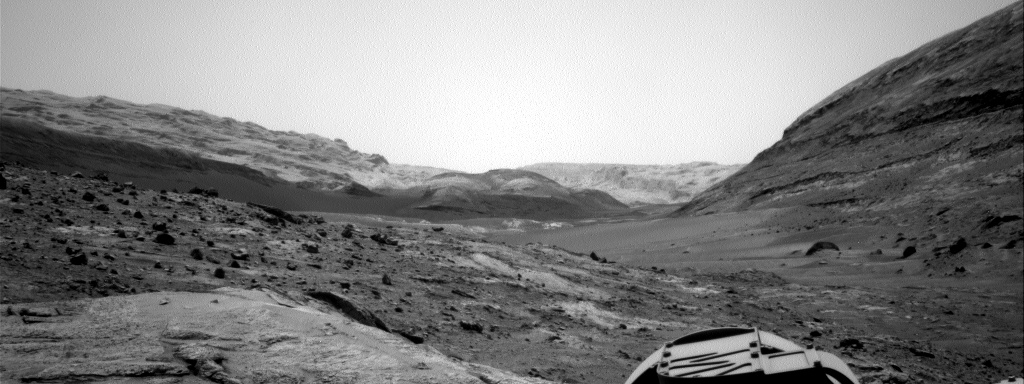
Looking uphill into Gediz Vallis, in 2024, when this research was being done.
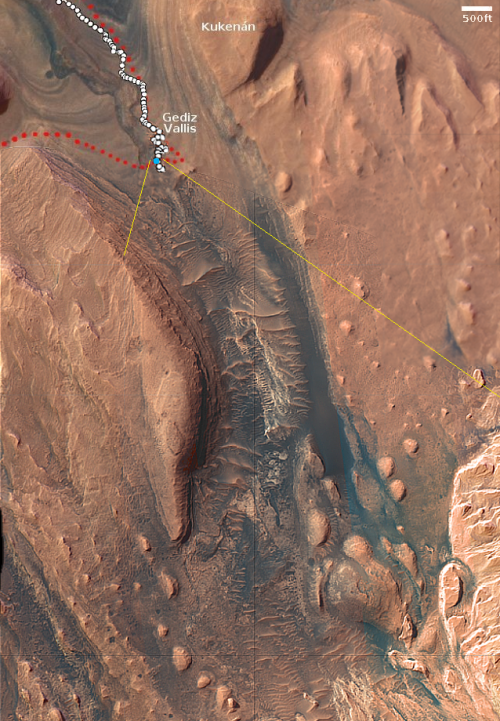
This map from 2024 provides the context for the panorama above.
Click for interactive map.
Using the data the rover Curiosity gathered during its exploration of the canyon dubbed Gediz Vallis on the lower flanks of Mount Sharp (Aeolis Mons) inside Gale Crater on Mars, scientists have concluded that the rocky material came from above, flowing downhill in the far past in major boulder landslides and water-induced debris flows.
The panorama above was taken when Curiosity was in Gediz Vallis. The overview map to the right provides the context, with the white dotted line showing Curiosity’s actual travels, and the yellow lines indicating the approximate area covered by the panorama. From the paper’s abstract:
Curiosity investigated Gediz Vallis, a canyon within Aeolis Mons, indicating that it must have formed late in Gale’s history. At the center of Gediz Vallis is a topographic ridge, comprised of sedimentary rocks. In the region where Curiosity crossed the ridge, Arc Pass, the rover investigated the processes that formed the ridge.
Curiosity found that rocks in Arc Pass were formed by water flows rich in debris, and landslides, which originated from higher up Aeolis Mons. These transport processes were separated by episodes of wind erosion and alteration of the rocks by groundwater. These observations indicate that liquid water continued to be available for brief periods late in the history of both Gale crater and Mars. [emphasis mine]
As noted by the highlighted sentence, the geology once again says that water in some form shaped the surface. As the scientists add in the paper, however, “Any surface water was likely only intermittently available, interspersed with significant hiatuses of aeolian erosion and dry granular transport processes.” It remains to be seen exactly what state that water was in, whether liquid or ice, considering that Mars has always been too cold with too thin an atmosphere for liquid water to exist on the surface.
Curiosity spent more than a year in this part of Gediz Vallis, then traversed west into the parallel canyon, dubbed Valle Grande, that it has been climbing for the past two years.

On Christmas Eve 1968 three Americans became the first humans to visit another world. What they did to celebrate was unexpected and profound, and will be remembered throughout all human history. Genesis: the Story of Apollo 8, Robert Zimmerman's classic history of humanity's first journey to another world, tells that story, and it is now available as both an ebook and an audiobook, both with a foreword by Valerie Anders and a new introduction by Robert Zimmerman.
The print edition can be purchased at Amazon or from any other book seller. If you want an autographed copy the price is $60 for the hardback and $45 for the paperback, plus $8 shipping for each. Go here for purchasing details. The ebook is available everywhere for $5.99 (before discount) at amazon, or direct from my ebook publisher, ebookit. If you buy it from ebookit you don't support the big tech companies and the author gets a bigger cut much sooner.
The audiobook is also available at all these vendors, and is also free with a 30-day trial membership to Audible.
"Not simply about one mission, [Genesis] is also the history of America's quest for the moon... Zimmerman has done a masterful job of tying disparate events together into a solid account of one of America's greatest human triumphs."--San Antonio Express-News