
FAA seeking comments on SpaceX’s request to expand Starship’s landing zones
The Federal Aviation Administration (FAA) today released its draft environmental reassessment [pdf] that would allow SpaceX to both expand add landing zones for bringing its Starship spacecraft back from orbit.
From the introduction:
Space Exploration Technologies Corporation (SpaceX) is seeking to obtain a modification of its existing vehicle operator license from the Federal Aviation Administration (FAA) to account for Starship reentry contingency operations in the Pacific Ocean as well as an additional Starship reentry trajectory for landing at the Boca Chica Launch Site in Starbase, Texas (TX). SpaceX must obtain a license modification from FAA to land the Starship vehicle in the Northern Pacific Basin (south of the Aleutian Islands), as well as information for airspace closures for an additional trajectory which includes landing at the Boca Chica Launch Site in Starbase, TX. SpaceX also intends to expand the previously evaluated landing areas in the Hawaii and Central Pacific Basin (southwest of the Hawaiian Islands) and the Southeast (SE) Pacific (off the coast of Chile) as additional contingency landing locations for Starship.
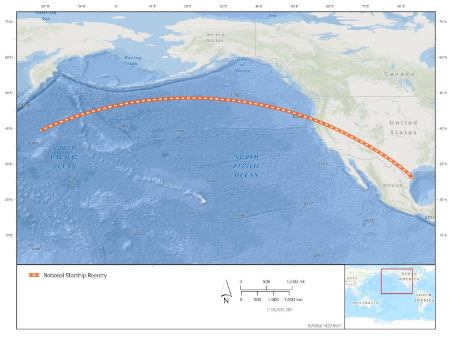
Starship flight path over the Pacific for landing at Boca Chica
The map to the right shows Starship’s proposed flight path for returning to Boca Chica.
The key quote however is in the FAA’s conclusion, after reviewing all the typical potential issues:
FAA has concluded that no significant impacts would occur as a result of SpaceX’s Proposed Action.
At this stage of the reassessment the FAA is seeking public comment through July 26, 2026. Expect the typical protests from the left, hostile to anything new (especially if Elon Musk is involved). Based on past rulings in these matters by the FAA (even when Biden was president), expect this expansion of landing sites to be approved. Under Trump expect the decision to be made more quickly, especially because this landing site expansion is crucial for allowing the company to begin routine orbital flights of Starship in preparation for NASA’s Artemis lunar landing.

On Christmas Eve 1968 three Americans became the first humans to visit another world. What they did to celebrate was unexpected and profound, and will be remembered throughout all human history. Genesis: the Story of Apollo 8, Robert Zimmerman's classic history of humanity's first journey to another world, tells that story, and it is now available as both an ebook and an audiobook, both with a foreword by Valerie Anders and a new introduction by Robert Zimmerman.
The print edition can be purchased at Amazon or from any other book seller. If you want an autographed copy the price is $60 for the hardback and $45 for the paperback, plus $8 shipping for each. Go here for purchasing details. The ebook is available everywhere for $5.99 (before discount) at amazon, or direct from my ebook publisher, ebookit. If you buy it from ebookit you don't support the big tech companies and the author gets a bigger cut much sooner.
The audiobook is also available at all these vendors, and is also free with a 30-day trial membership to Audible.
"Not simply about one mission, [Genesis] is also the history of America's quest for the moon... Zimmerman has done a masterful job of tying disparate events together into a solid account of one of America's greatest human triumphs."--San Antonio Express-News
Almost identical to the descending node approach for the Shuttles. As you would expect.
I wonder if they’ll approach Mexico for similar permission for an ascending node approach?
I did not see any references to firm inclinations, and Starship has demonstrated some cross-range capability, so perhaps that level of detail is not necessary.